
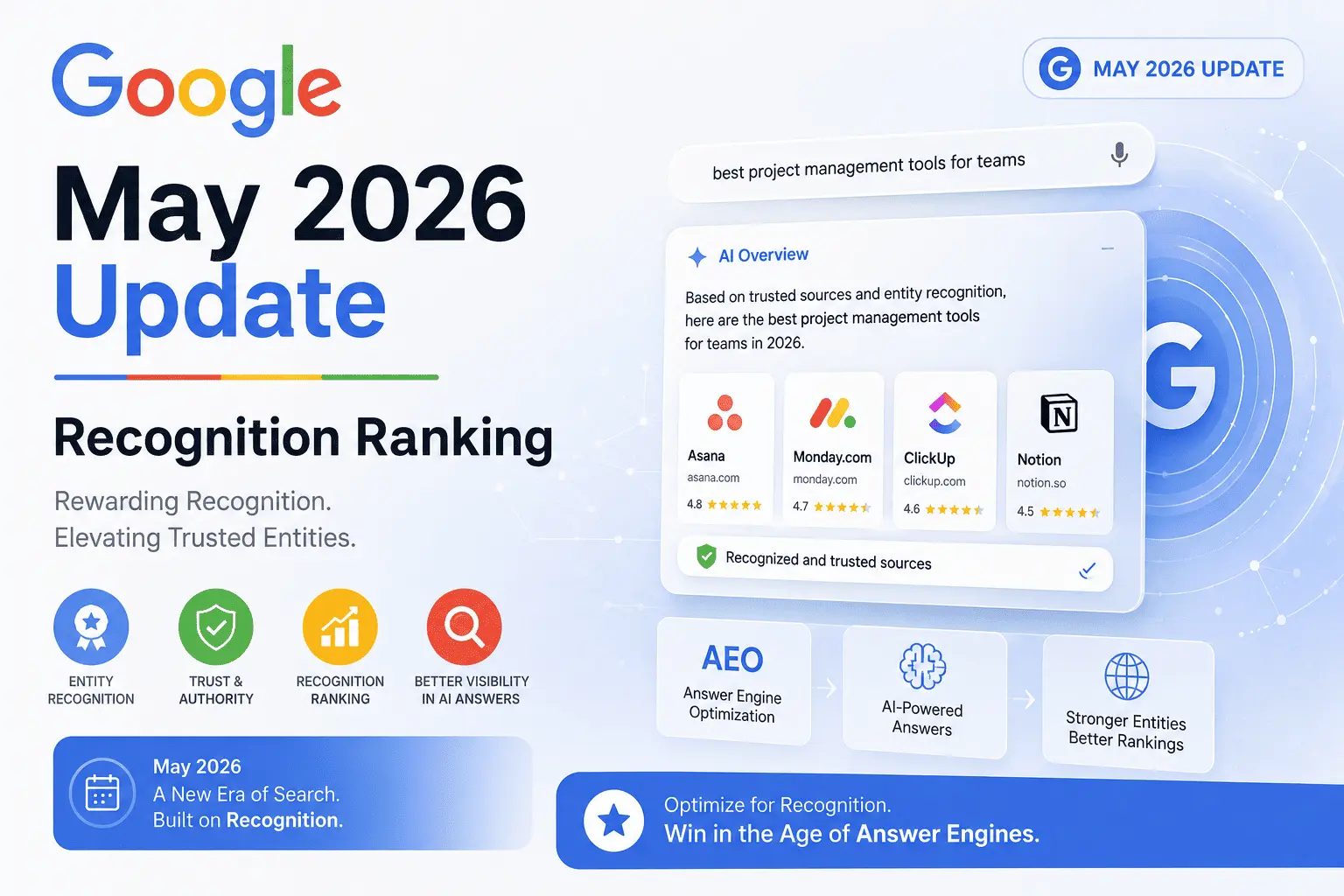
Beyond the Click: Why “Recognition” Is the New “Ranking” After Google’s May 2026 Update
Google’s May 2026 update didn’t just add new features it formalized a new game with a new scoreboard.
“Rankings still feed the system, but they are now just one signal among many.”
The operating principle of search after Google’s May 2026 update
On May 6, 2026, Google rolled out five simultaneous updates to AI Mode and AI Overviews. The tech press covered it as a publisher-friendly gesture a few extra links, a subscription label, a new “Further Exploration” section. Surface-level reading, surface-level coverage.
But for anyone thinking at the strategy level, the May 2026 update announced something more fundamental. It formalized a new regime: one where being recognized as a trusted source by Google’s AI infrastructure has become as commercially important as ranking on page one ever was and in many categories, more so.
The shift from ranking to recognition has been building since AI Overviews launched in 2024. Google’s May 2026 update is the clearest signal yet that this shift is structural, not temporary. It also introduced two features the Subscribed label for news publishers and the formalization of Google’s Delegation Boundary for brand recommendations that will define how visibility is earned for the next several years.
This article is for the strategists, CMOs, editorial directors, and thought leaders who need to understand not just what changed, but why it changes everything about how brands and publishers should think about search visibility.
📊 The numbers behind the shift: Referral traffic from Google has dropped 60% for small publishers and 47% for medium publishers over the past two years. 58.5% of Google searches now end without a click. The update doesn’t reverse these trends it creates a new lane for brands that earn recognition.
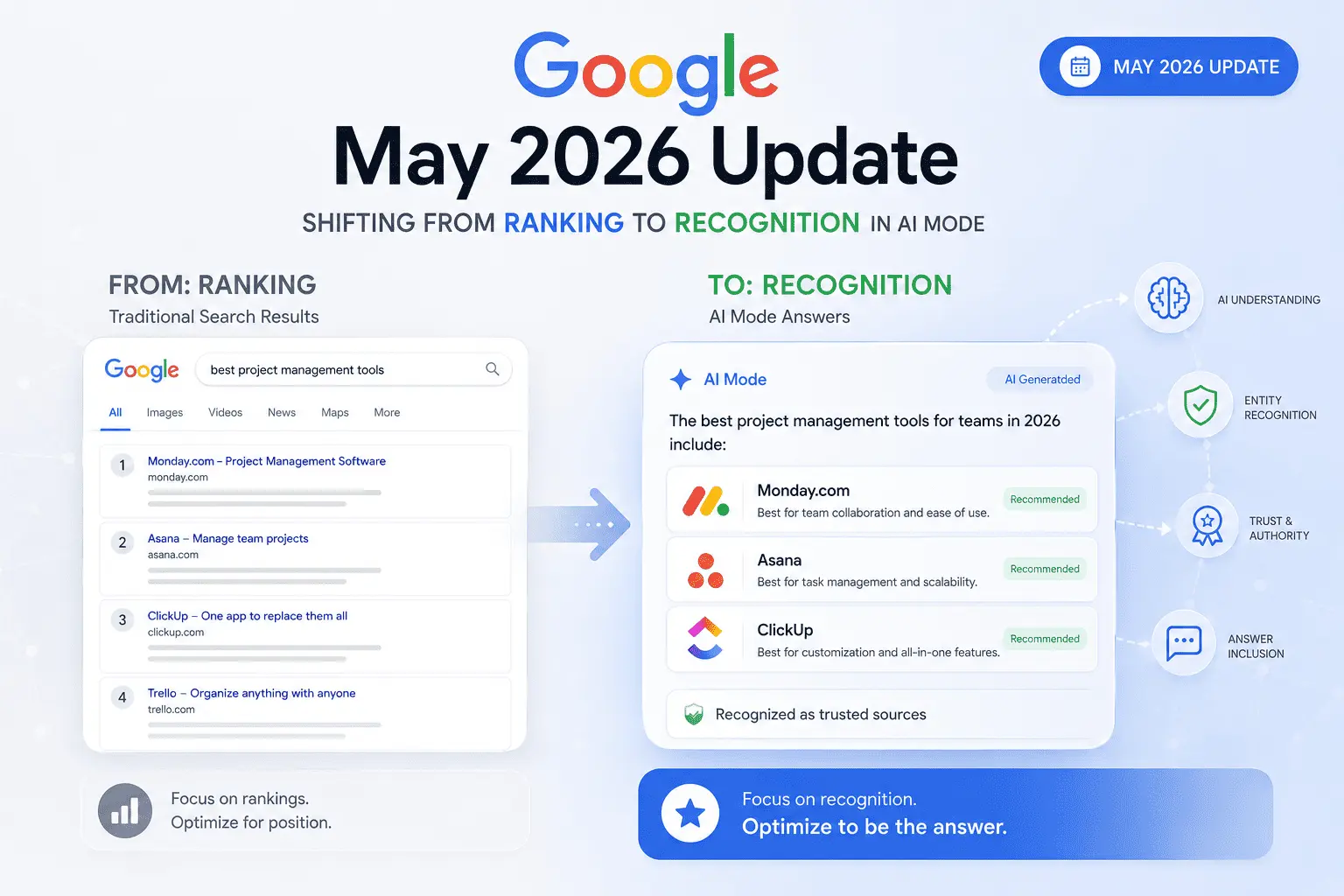
In classic search, a brand won by ranking high. In AI search after the May 2026 update, a brand wins by being recognized as trustworthy enough to cite a fundamentally different competition.
SHIFT 1
From SEO to AEO: The Conversation That Needs to Happen in Every Strategy Room
Search Engine Optimization was built around a single question: how do we rank higher? The metric was position. The game was ranking page one, position one, and everything below it was a gradient of diminishing returns.
Answer Engine Optimization (AEO) is built around a different question: how do we become the source AI chooses to cite? The metric is not position it is inclusion. Not “did we appear in results?” but “did the AI use us to construct its answer?”
This distinction matters more than most strategy teams currently appreciate. Research from Ahrefs Brand Radar across 15,000 prompts found that the overlap between AI citations and Google’s top-10 organic results is only 12%. For ChatGPT specifically, that overlap drops to 8%. This means a brand can rank #1 for a keyword and still be completely invisible in the AI answer that appears above their result the answer that 58.5% of users are satisfied with without clicking further.
The AEO vs SEO Distinction in Plain Language
| Dimension | Traditional SEO | AEO (After May 2026) |
|---|---|---|
| Goal | Rank on page one | Be cited inside the AI answer |
| Success metric | Position, impressions, clicks | Citation frequency, brand mention, AI referral traffic |
| Content job | Target keywords, earn backlinks | Answer questions clearly, be extractable, demonstrate entity authority |
| Trust signal | Domain authority, link profile | E-E-A-T, entity clarity, cross-source consistency |
| Visibility without a click | Featured snippet (partial) | AI Overview citation, AI Mode recommendation |
| Competitor threat | Higher-ranked pages | Brands cited by AI even if they rank lower |
⚠️ The strategic implication: Only 20% of organizations have begun implementing AEO despite 70% believing it will significantly impact their digital strategy within 1–3 years. This gap is the opportunity the brands that build AEO infrastructure now will establish citation dominance that latecomers will find structurally difficult to displace.
Why Rankings Still Matter Just Differently
This is not an argument to abandon SEO. Rankings still feed the system Google’s AI infrastructure draws heavily from its existing web index, and a well-ranked, well-indexed page is far easier for AI systems to discover and trust. Technical SEO (crawlability, indexability, page experience, Core Web Vitals) remains the cost of entry.
But ranking is now the floor, not the ceiling. Recognition being chosen, cited, and recommended by AI is where the ceiling moved. The brands capturing that recognition are not necessarily the ones with the highest domain authority. They are the ones whose content is structured to be extractable, whose entities are clearly defined, and whose expertise signals are consistent across the open web.
AEO Complete Guide 2026 (Frase) ·
AEO vs SEO Strategy Guide (ALM Corp) ·
How Brands Win AI Search (Moburst)
SHIFT 2
The “Subscribed” Label: The Biggest Win for Publishers Since Google News, New May 2026
Buried inside Google’s May 6 announcement between updates about “Personal Perspectives” and desktop hover previews was the feature that changes the economics for every paid news publisher operating in AI search: the “Subscribed” label.
Here is exactly what it does. When a Google user encounters an AI Overview or AI Mode response, content sourced from a publication they have linked to their Google account now displays a “Subscribed” label directly inside the AI-generated answer. Google’s own testing found that users were “significantly more likely” to click through to labeled content compared to unlabeled content from the same AI response.
To understand why this is significant, it helps to understand the problem it solves. Since AI Overviews launched in 2024, the fundamental tension for subscription publishers has been this: Google’s AI reads your paywalled content to construct answers, but strips away the signal that would motivate the user to click through and subscribe. The Subscribed label reintroduces that signal directly inside the AI answer, at the moment of maximum user attention.
✅ What the Subscribed label actually means: This is the first time Google has given subscription-based editorial content preferred visibility inside AI Search answers. Earlier link-visibility changes applied equally to all sources. The Subscribed label is the first feature that surfaces a specific content relationship paid subscriber status as a visible signal inside AI answers.
What Publishers Must Do Right Now
The Subscribed label does not activate automatically. It only displays for users who have connected their publication subscriptions to their Google accounts. This means publishers need to actively drive that connection and the window for first-mover advantage is open right now, before competitors mobilize.
- Contact Google directly to facilitate subscription linking for your paying readers. Google’s blog post explicitly invites publishers to reach out. This is not a self-serve feature yet it requires a direct publisher relationship with Google.
- Drive subscription-Google account linking in your onboarding flow. Every subscriber who links their account is a subscriber whose clicks inside AI Overviews are now labeled and measurably more likely to happen. Add this step to your post-signup sequence immediately.
- Structure content for AI citation. The Subscribed label only helps if your content is being cited inside AI answers in the first place. Clear, quotable, data-supported content with specific claims is more likely to appear inside AI Overviews. Restructure your highest-value articles with this in mind.
- Track labeled impressions separately in Google Analytics. Segment your referral traffic to measure whether the labeled impressions convert at the rates Google’s testing suggests. This is new data you didn’t have before.
⚠️ The hard truth for ad-supported publishers: Publishers without subscription models get none of the click-through benefits from the Subscribed label. The May 2026 update accelerates the competitive advantage of publishers who have diversified into subscriptions. If you haven’t started building a subscription product, this update makes the case for it more urgently than anything in the past two years.
❌ Before May 2026AI cites your paywalled article. User sees it as one of five source links. No differentiation. No motivation to click. Your journalism funds the answer without reward.
✅ After May 2026“Subscribed” label appears next to your citation. Users significantly more likely to click. Existing subscriber loyalty becomes a search visibility advantage for the first time.
Google’s Subscribed Label Nieman Journalism Lab ·
What Publishers With Subscribers Need to Know (Playwire) ·
Google AI Mode Subscription Labels Explained (The Keyword)
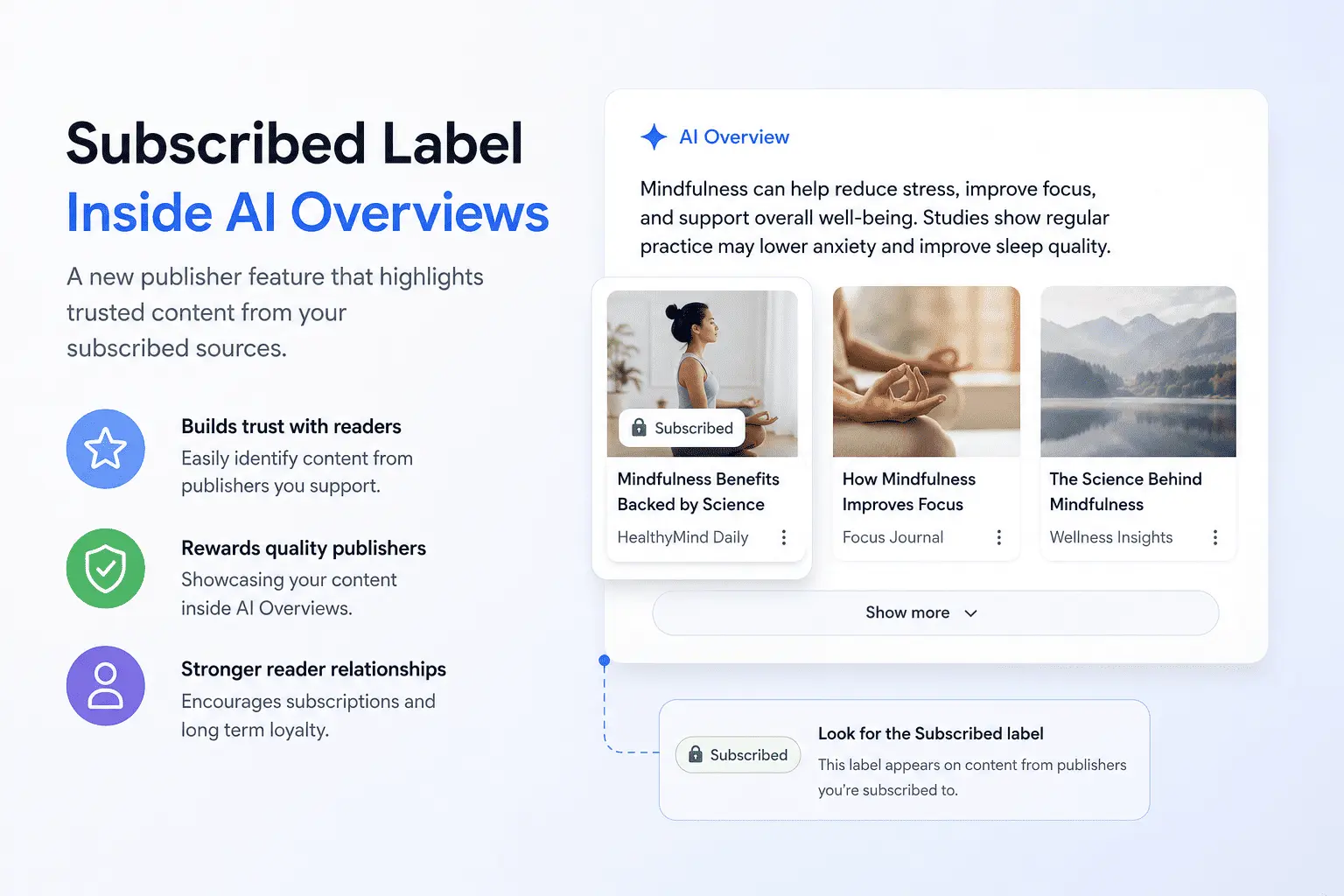
The “Subscribed” label appears directly inside AI Overviews and AI Mode responses the first time Google has given paid subscription status explicit visibility inside AI-generated answers.
SHIFT 3
The Delegation Boundary: How Google’s AI Decides Which Brands It Trusts Enough to Recommend Strategic
This is the concept that most marketing teams don’t have language for yet which is why it’s where the widest strategic gap exists.
When a Google user searches for “best CRM for a 50-person sales team” or “which accounting software should I use,” the AI doesn’t just list links. It constructs a recommendation. It says: based on your needs, these brands are the most appropriate solutions. It delegates the decision to a shortlist. The brands on that shortlist are not simply the highest-ranked ones. They are the brands Google’s AI infrastructure has determined are trusted enough to be recommended as a solution, not just cited as a source.
We call this the Delegation Boundary the threshold a brand must cross before Google’s AI treats it as recommendation-worthy rather than merely link-worthy. It is the difference between being a search result and being a Google endorsement.
What Determines Which Side of the Boundary You’re On
Before AI can recommend you, it has to understand you. That sounds obvious. The implications are not. Most brands are ambiguous entities to AI systems inconsistent descriptions across their website, LinkedIn, directories, and press coverage create uncertainty for systems trying to resolve what a brand actually does and what authority it brings to a topic.
The Delegation Boundary Spectrum
Most brands are stuck between Cited and Named. The Delegation Boundary sits between Named and Recommended. Crossing it requires entity clarity, cross-source consistency, and demonstrated topical authority not just high domain authority.
The Three Things That Get You Across the Boundary
1. Entity Clarity. A single, consistent description of who you are and what you do reused and reinforced across your website, LinkedIn, Google Business Profile, Wikipedia if applicable, Crunchbase, and industry directories. Small inconsistencies (different taglines, product definitions, or positioning across platforms) create ambiguity for AI systems trying to resolve your entity. An unambiguous “About” page that acts as the canonical reference point Google can anchor to is the single highest-leverage change most brands can make today.
2. Cross-Source Corroboration. Unlinked mentions can strengthen entity recognition and brand association when they appear on reputable sites in relevant contexts. The AI systems constructing recommendations are not just reading your website they’re reading what others say about you. Third-party reviews, industry analyst coverage, press mentions, and forum discussions that describe your brand in consistent, authoritative terms all contribute to the trust model. This is why brands that have invested in genuine thought leadership and earned media have a structural advantage in the post-May 2026 environment.
3. Topical Authority, Not Just Keyword Coverage. AI models prioritize niche authority. A brand that has 200 pieces of content about a specific problem and its solutions is more likely to be recommended for that problem than a brand with 2,000 pieces of content spanning 50 adjacent topics. Depth of topical ownership becoming the “undisputed expert in your specific corner of the internet” is what earns recommendation-level trust from AI systems.
💡 The executive test: Search your brand name in ChatGPT, Perplexity, and Google AI Mode. Ask each: “What does [your brand] do, and who is it best for?” The consistency and accuracy of those answers is your current Delegation Boundary score. Gaps, inconsistencies, and missing entities are the exact issues blocking your brand from recommendation-level visibility.
How AI Overviews Are Changing B2B Visibility (Inspired Marketing) ·
AEO Strategy Guide (O8 Agency) ·
AEO and AI Search Visibility (HTT)
Google’s Five May 2026 Features: What Each One Actually Means Strategically
Google launched five updates simultaneously on May 6, 2026. Each one is a data point in the same strategic signal. Here is what each feature means beyond the press release description:
| Feature | Surface Description | Strategic Signal |
|---|---|---|
| “Subscribed” Label | Marks content from a user’s paid subscriptions inside AI answers | Subscription loyalty becomes a search visibility asset for the first time |
| “Further Exploration” Links | Surfaces in-depth articles at the end of AI responses | Google acknowledges AI answers are insufficient for high-value queries depth and original reporting win this slot |
| “Personal Perspectives” | Surfaces firsthand social/forum discussions with creator context | First-person experience content (case studies, testimonials, community discussion) is now a cited signal, not a soft signal |
| More Granular Inline Links | More specific links placed next to relevant text within AI responses | Every factual claim in your content is now a potential citation anchor specificity and sourced data matter more than ever |
| Desktop Hover Previews | Shows website name/title before clicking an unfamiliar link | Brand recognition is now literally a click-through driver users who don’t know your brand are less likely to click, even if you’re cited |
📌 The pattern in all five features: These represent the third time this year Google has announced link-visibility improvements for AI Search. The pattern is visible and deliberate: Google is systematically rebuilding the link layer in AI Search. Each update adds more entry points for users to click out to the web and makes source origins more transparent. This is not altruism it is Google managing the legal and reputational risk of a search product that appears to consume and synthesize publisher content without compensation.
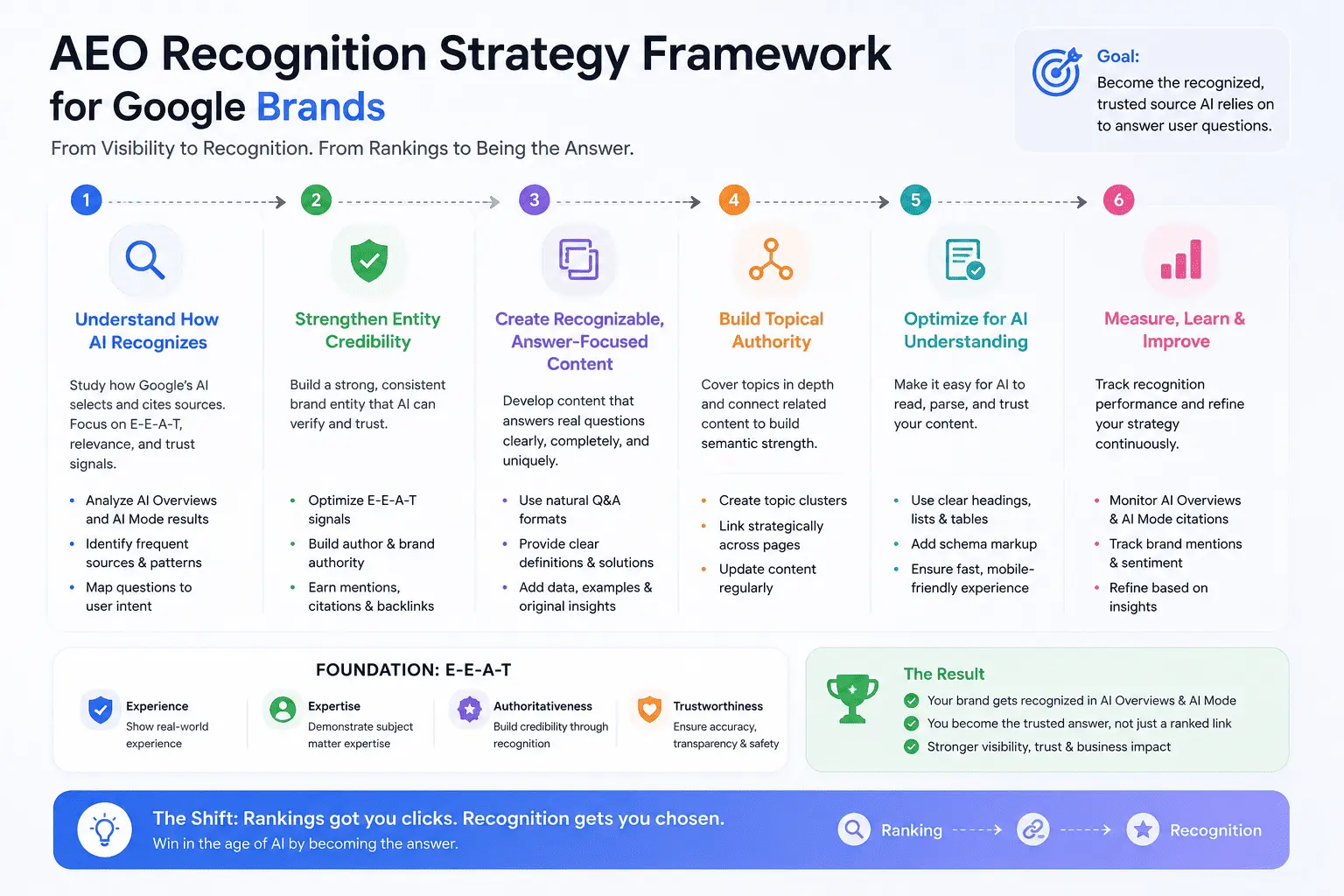
AEO and SEO are not competing strategies they are complementary layers. SEO earns discoverability. AEO earns inclusion in the answer. Both are required for complete search visibility after May 2026.
The Recognition Strategy: 7 Actions Every Strategist Should Prioritize Now
The following is not a list of technical SEO tweaks. It is a strategic operating framework for organizations that want to be recognized and recommended in the post-May 2026 search environment.
- Audit your entity across every major platform. Search your brand on Google, ChatGPT, Perplexity, and Gemini. Compare the descriptions each returns. Identify every inconsistency between how AI systems describe you and how you actually want to be described. This audit is your Delegation Boundary gap analysis. Fix inconsistencies on your own website first your About page, product pages, and author bios are the canonical sources. Then propagate consistency to LinkedIn, Crunchbase, Google Business Profile, and any industry directories where your brand appears.
- Restructure your highest-value content for extractability. Structure pages so that accurate, plain-language answers appear near the top, using H2 and paragraph blocks to directly address common queries. The AI reads the top-ranked source documents and synthesizes a response by extracting key facts. Content that buries its insight in the fourth paragraph of a five-paragraph essay is less extractable than content that leads with the answer and then expands. Add TL;DR sections, data callouts, and explicit FAQ blocks to your most-trafficked pages.
- Implement schema markup aggressively. Implementing schema markup correctly can boost AI citation chances by over 36%. Priority schema types for recognition: Organization (defines your entity), FAQPage (maps directly to AI query formats), Article (establishes authorship and publication context), and HowTo (for instructional content). Validate everything using Google’s Rich Results Test schema errors actively reduce AI trust signals.
- Build a cross-platform mention strategy, not just a backlink strategy. Unlinked mentions on reputable sites in relevant contexts support entity recognition and brand association. Commission original research that third parties will cite. Publish clear, citable positions on contested industry questions. Participate in industry analyst conversations. Seek podcast appearances that will be transcribed and indexed. Every mention that corroborates your entity claims in a relevant context strengthens your position relative to the Delegation Boundary.
- For news publishers: connect your subscription product to Google now. Reach out to Google to facilitate subscription linking for your paying readers. Update your post-signup and email onboarding flows to drive account linking. Every subscriber who links their account converts a passive loyalty signal into an active search visibility asset inside AI Overviews.
- Monitor your AI footprint weekly. Regularly query your brand, your category, and your key competitors across ChatGPT, Perplexity, and Google AI Mode. Track what gets said, what gets cited, and who appears in recommendations for the problems you solve. Develop a systematic measurement process AI visibility has no native dashboard yet, making proprietary monitoring processes a genuine competitive advantage.
- Own a specific topic area completely before expanding. AI models prioritize niche authority. Don’t try to be the answer engine’s source for everything in your broad market. Be the undisputed, deeply-sourced, consistently-cited expert in one specific corner first. Build semantic depth related concepts, use cases, comparisons, objections around that core before expanding outward. This is how a mid-sized brand with genuine expertise outranks a large generalist brand in AI citations.
The Strategic Bottom Line: What “Recognition” Means for Your Organization
Google’s May 2026 update didn’t change the rules of search arbitrarily. It reflected something that has been true for eighteen months and is now unmistakable: the user’s relationship to information has changed. The click was always instrumental a means to get an answer. AI search makes the answer available without the click. That changes what visibility means, what success looks like, and what brands need to build.
Rankings still feed the system. Technical SEO still matters. Content quality still matters. But in isolation, these things produce diminishing returns in an environment where the majority of search intent is satisfied before a user ever reaches your page.
What earns compounding returns is recognition being the brand an AI system considers trustworthy enough to cite, recommend, and put its implicit endorsement behind when a user delegates a decision. That recognition is earned through entity clarity, cross-source corroboration, demonstrated topical authority, and the kind of structural transparency that makes your content easy for machines to extract and trust.
The brands that understand this now, and build for it deliberately, will hold a position in AI search that is structurally difficult for latecomers to displace. Early adopters often establish citation advantages that become increasingly difficult for competitors to overcome. The window for that advantage is not permanently open.
“Rankings still feed the system, but they are now just one signal among many.”
The operating reality of search after Google’s May 2026 update
Recognition Audit Checklist: Where Does Your Brand Stand Today?
- Brand described consistently across website, LinkedIn, Crunchbase, Google Business Profile
- Canonical “About” page exists as a clear, machine-readable entity anchor
- Highest-value content leads with the answer in the first 1–2 sentences
- FAQPage, Organization, and Article schema implemented and validated
- Content references named entities and links to authoritative external definitions
- Original research or proprietary data published and cited by third parties
- Brand appears correctly and consistently in ChatGPT, Perplexity, and Gemini responses
- AI referral traffic tracked separately in analytics
- For publishers: subscription product connected (or in process) with Google linking
- Topical authority concentrated on core expertise area before expansion
- Content updated on a regular cadence (leading AEO brands update quarterly minimum)
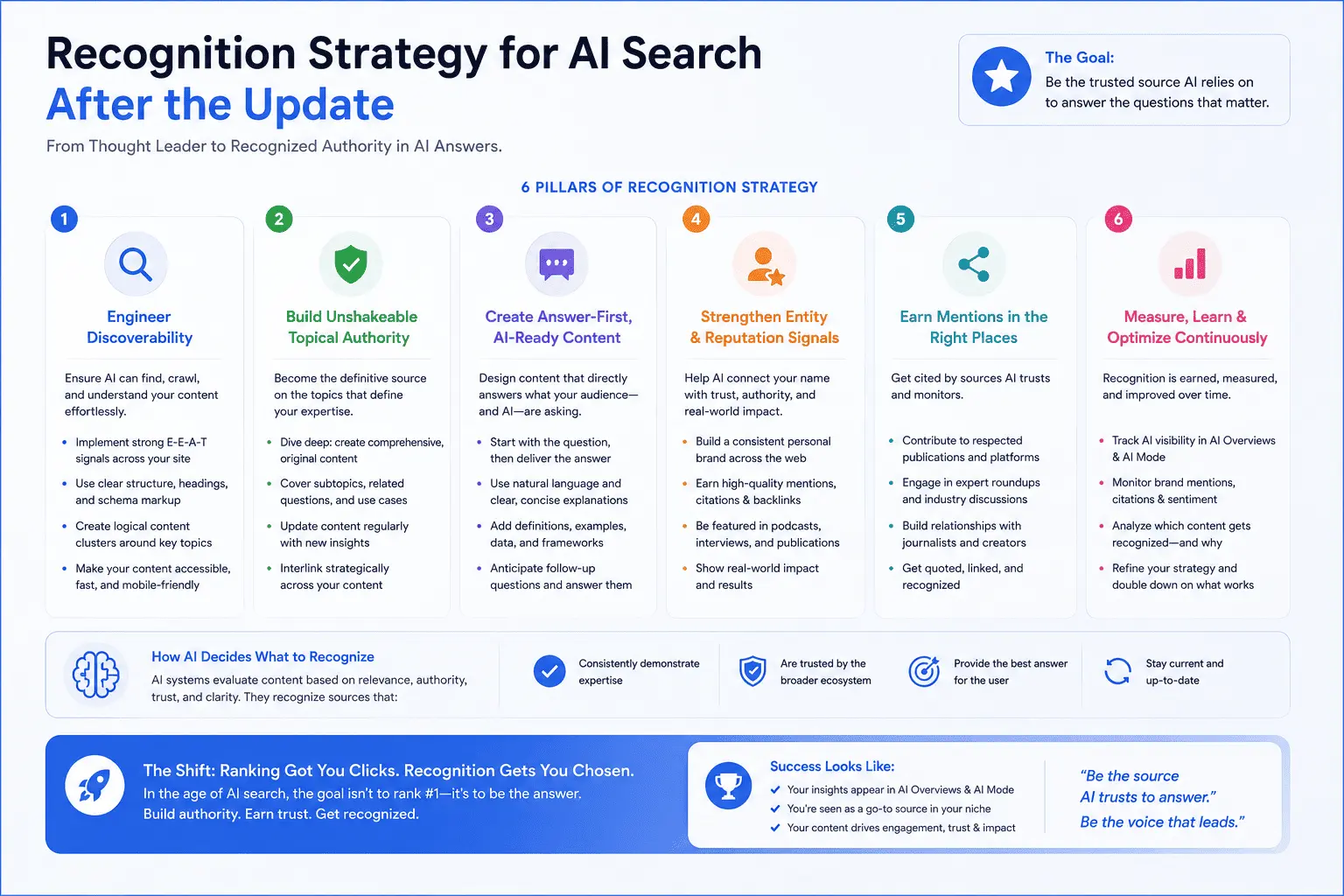
The organizations building recognition infrastructure today are making an investment that compounds AI citations; once established, are structurally difficult for competitors to displace.
This article reflects the state of Google’s AI search features as of May 2026 based on publicly available announcements and third-party research. AI search features evolve rapidly; specific feature availability, rollout timelines, and publisher program terms may change. Links to third-party sources are included for attribution and are not endorsements.