
Regulators stopped talking about AI and started issuing fines
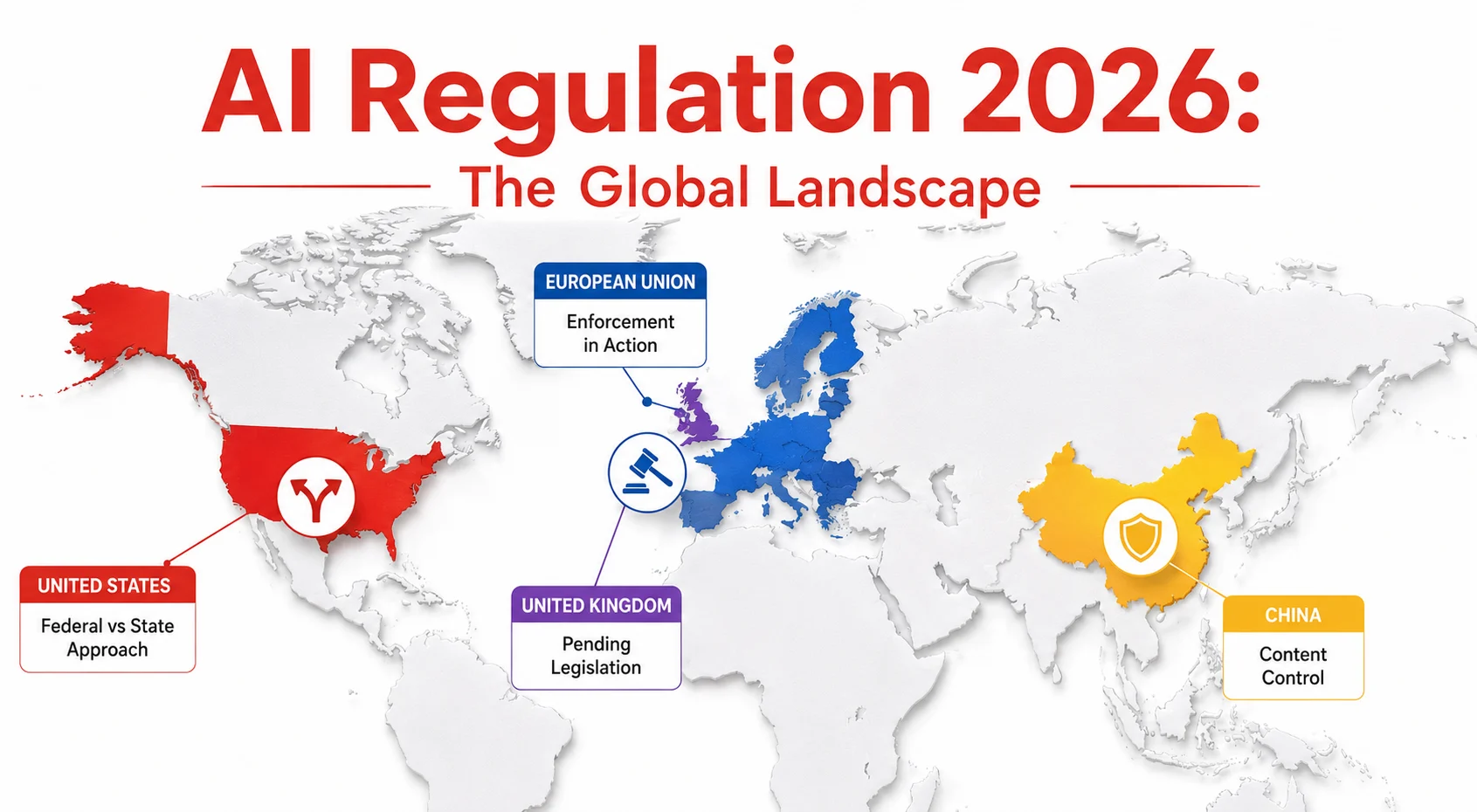
For years, “AI regulation News” meant white papers, summits, and voluntary guidelines. In 2026, that era ended. The EU began issuing enforcement notices. US states activated laws that companies spent years lobbying against. China added AI-specific requirements to its cybersecurity framework. The UK opened formal consultations that will determine whether companies can legally train AI models on British-sourced content.
If you build, deploy, or use AI in any commercial context, this is no longer a topic you can monitor passively. The August 2, 2026, EU AI Act deadline for high-risk AI systems is the most consequential single date in the history of AI regulation. US state laws covering California, Texas, and Colorado are already in force or taking effect within weeks. Penalties for non-compliance now reach 7% of global annual turnover in the EU and up to $20,000 per violation per day in some US states.
This article covers every major AI regulation update in 2026, region by region, with exact dates, penalty amounts, what the rules actually require, and plain-English answers to the questions compliance, legal, and product teams are asking most often.
Source: https://artificialintelligenceact.eu/the-act/
The EU AI Act: what is live now and what hits on August 2, 2026
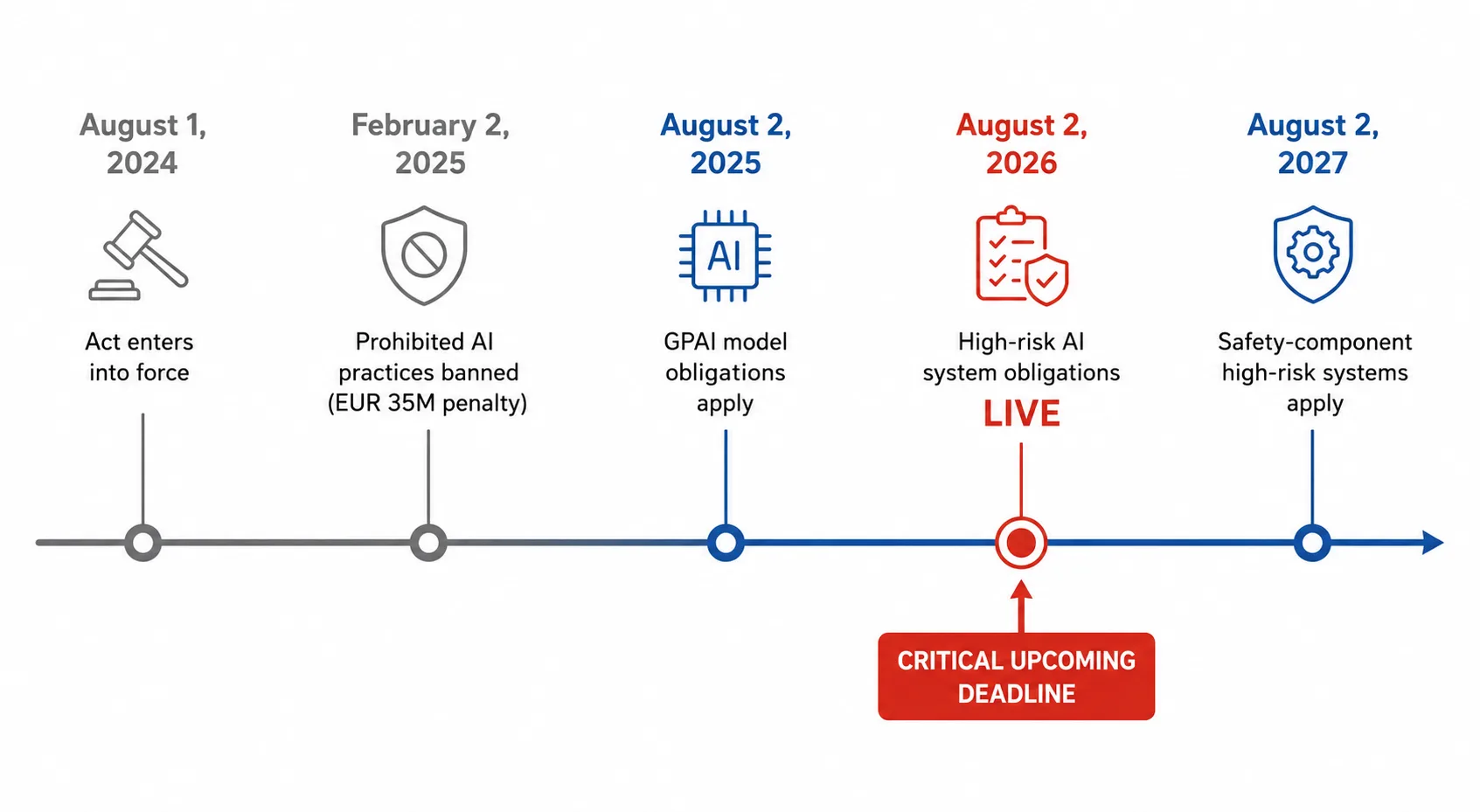
The EU Artificial Intelligence Act entered into force on August 1, 2024. It does not apply all at once. It phases in over four years, with each phase targeting a different category of AI risk. Understanding exactly which obligations are live today and which ones begin on August 2, 2026, is the most urgent compliance question for any company with EU exposure.
What is already enforceable right now
Since February 2, 2025: A complete ban on prohibited AI practices is in effect and fully enforceable. This includes social scoring systems used by public authorities, AI that manipulates people through subliminal techniques, real-time biometric identification in public spaces by law enforcement (with narrow exceptions), and emotion recognition systems used in workplaces and educational institutions. Violations of the prohibited practices list carry the highest penalty tier: up to EUR 35 million or 7% of global annual turnover, whichever is higher.
Since August 2, 2025: General-Purpose AI (GPAI) model obligations are in effect. Providers of foundation models, including large language models such as GPT, Claude, and Gemini, must now comply with transparency requirements, provide technical documentation, respect copyright opt-out policies, and publish a summary of their training data. Providers of GPAI models that exceed the 10^25 FLOPs systemic-risk threshold face additional cybersecurity, incident reporting, and adversarial testing requirements.
Source: https://eur-lex.europa.eu/legal-content/EN/TXT/?uri=CELEX:32024R1689
What changes on August 2, 2026
August 2, 2026, is the single most important compliance date in the EU AI Act’s rollout. On this date, the majority of the Act’s provisions become applicable, including all obligations for high-risk AI systems listed in Annex III.
High-risk AI systems under Annex III include: hiring and recruitment algorithms, credit scoring and lending decision systems, insurance pricing tools, medical diagnostic AI, biometric identification systems, educational assessment tools, AI used in law enforcement, border control systems, and AI that makes decisions affecting access to essential services. If your product falls into any of these categories, these are your obligations from August 2, 2026, onward:
- Conformity assessment: Complete a formal self-assessment (or third-party audit for highest-risk categories) confirming the system meets the Act’s requirements.
- Technical documentation: Maintain comprehensive records of the system’s design, training data, intended purpose, known limitations, and testing results. Regulators can request this documentation at any time.
- CE marking: Affix the CE conformity marking to the system, signalling compliance.
- EU database registration: Register the high-risk AI system in the EU’s publicly accessible AI database before deploying it to EU users.
- Human oversight mechanisms: Build in tools and processes that allow humans to monitor, understand, and override the AI system’s outputs.
- Post-market monitoring: Implement continuous performance monitoring after deployment and report serious incidents to national authorities within defined timeframes.
From August 2, 2026, national market surveillance authorities gain full investigatory powers. They can request access to your AI system, demand documentation, order systems withdrawn from the market, and impose fines. The European AI Office, operating within the European Commission’s DG CONNECT, holds concurrent enforcement authority over GPAI model providers.
The penalty structure under Article 99
The EU AI Act’s penalty structure under Article 99 establishes three tiers, and all three are currently active for their respective violation categories:
| Violation type | Maximum fine | As a percentage of turnover |
|---|---|---|
| Prohibited AI practices (Article 5) | EUR 35 million | 7% of global annual turnover |
| Other obligations (high-risk, GPAI) | EUR 15 million | 3% of global annual turnover |
| Providing false or misleading information | EUR 7.5 million | 1.5% of global annual turnover |
| GDPR violations involving AI personal data | EUR 20 million | 4% of global annual turnover |
For SMEs and startups, fines are capped at the lower of the fixed-euro amount or the percentage-of-turnover amount. Even so, EUR 7.5 million for providing false information to regulators is enough to end most early-stage companies.
Source: https://digital-strategy.ec.europa.eu/en/policies/regulatory-framework-ai
The Digital Omnibus complication
One development that compliance teams must monitor: in November 2025, the European Commission published the Digital Omnibus simplification package, which proposes conditional delays to some August 2, 2026, obligations, specifically linking enforcement to the availability of harmonized technical standards and common specifications. As of May 2026, the Digital Omnibus trilogue has not concluded. Legal advisors from multiple major law firms confirm that if the trilogue does not close before August 2, 2026, the original deadlines remain in force with no postponement.
The practical advice from compliance specialists is consistent: prepare for August 2, 2026, as if no delay is coming. The cost of being caught unprepared far exceeds the cost of preparing early.
United States: the federal versus state battle that is reshaping AI governance
The United States does not have a comprehensive federal AI law. What it has instead is a growing patchwork of state laws, a Trump administration executive order trying to limit those state laws, and a Justice Department task force actively working to challenge them in court. Understanding this tension is essential to understanding what US AI compliance actually requires in 2026.
Trump’s Executive Order 14365: what it does and what it cannot do
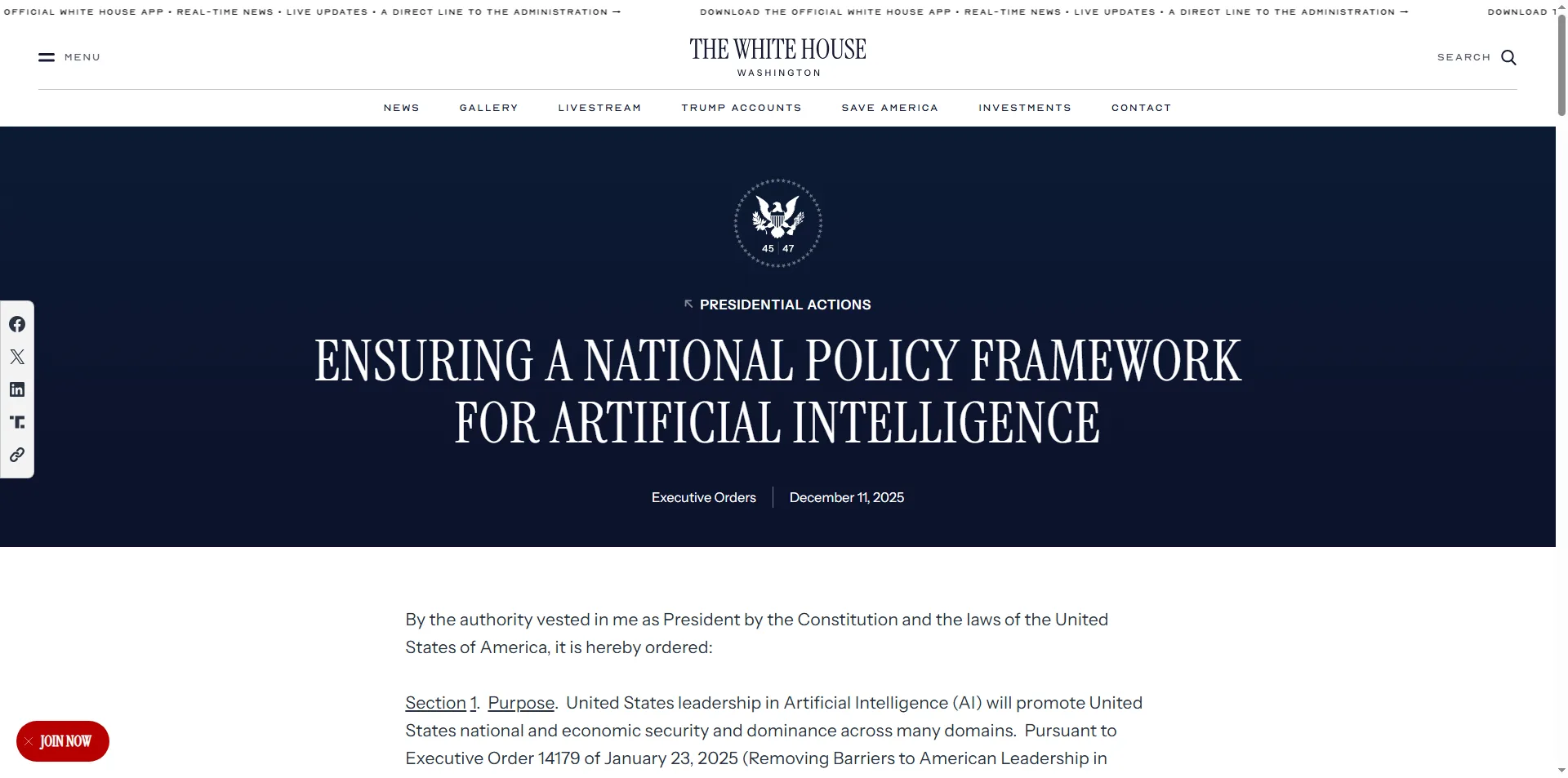
On December 11, 2025, President Trump signed Executive Order 14365, titled “Ensuring a National Policy Framework for Artificial Intelligence.” The order has three main components:
- It directs the Attorney General to establish an AI Litigation Task Force to identify and challenge state AI laws the administration considers inconsistent with federal policy. The task force was announced in January 2026.
- It allows the Department of Commerce to condition federal funding (including BEAD broadband infrastructure funds) on state alignment with the federal deregulatory AI policy.
- It explicitly singles out Colorado’s AI Act as an example of “excessive state regulation” and characterizes it as potentially compelling AI systems to produce false results.
Critically, an executive order cannot preempt state laws on its own. Federal preemption of state law requires congressional action. Legal experts across multiple law firms confirm that existing state AI laws will not be automatically invalidated by EO 14365. States retain full authority to pass and enforce their own AI regulations unless and until Congress passes a federal AI law that explicitly preempts them.
The governors of California, Colorado, and New York issued statements in December 2025 confirming they will not stop enforcing their state AI statutes based on the executive order.
State AI laws in effect in 2026: the key ones you need to know
California AI Transparency Act (SB 942): effective January 1, 2026
California’s SB 942 requires providers of generative AI systems to embed latent disclosures in AI-generated images, videos, and audio content. The disclosure must be detectable by standardized tools and indicate that the content was AI-generated. Additionally, California’s AB 2013 (the Generative AI Training Data Transparency Act), also effective January 1, 2026, requires developers of generative AI tools to publish high-level information about their training data, including data sources, collection history, copyright status, and whether personal data was included.
Texas Responsible Artificial Intelligence Governance Act (RAIGA): effective January 1, 2026
Texas RAIGA applies to developers and deployers of AI systems that conduct business in Texas, provide products or services to Texas residents, or develop AI systems within the state. It imposes disclosure requirements and governance obligations focused on transparency about how AI makes decisions that affect consumers. The law is broadly written and applies across industries.
Colorado AI Act (SB 24-205): effective June 30, 2026
Colorado’s is the most comprehensive US state AI law to date. Originally effective February 1, 2026, it was delayed to June 30, 2026 following significant political pressure and Trump’s executive order. As of May 2026, there is ongoing debate about whether the effective date will be pushed again or whether the law’s substantive provisions will be amended before taking effect.
As currently written, the Colorado AI Act requires developers of high-risk AI systems to use reasonable care to prevent algorithmic discrimination. Deployers must conduct impact assessments, document risk management policies, and provide consumer disclosures when AI makes consequential decisions in areas including employment, credit, education, healthcare, housing, insurance, and legal services. Penalties reach up to $20,000 per violation with no private right of action.
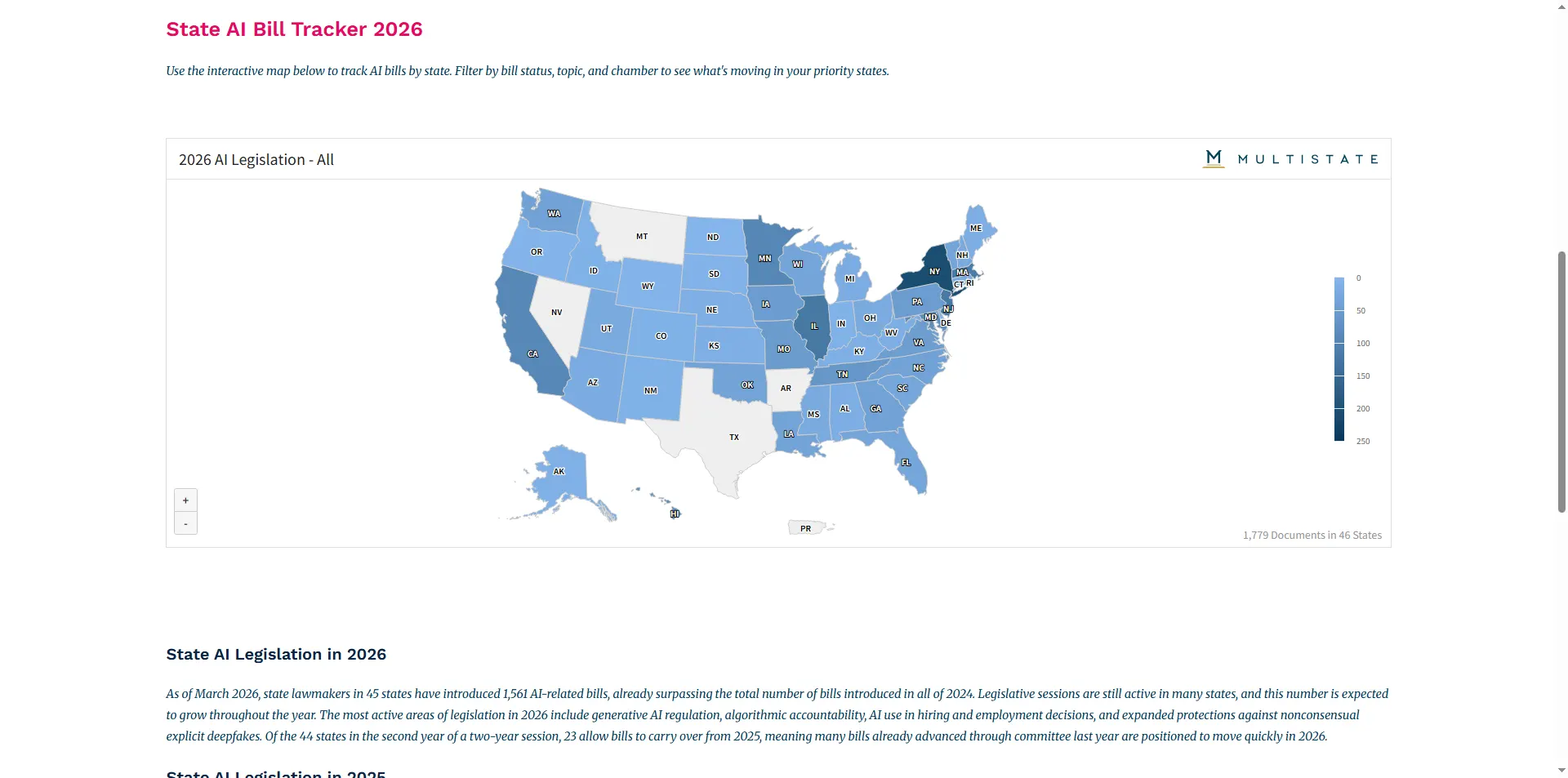
Source: https://www.multistate.ai/artificial-intelligence-ai-legislation
Illinois Human Rights Act amendment (HB 3773)
Illinois amended its Human Rights Act effective January 1, 2026, prohibiting employers from using AI in ways that result in discrimination based on protected characteristics. This applies to hiring, promotion, performance evaluation, and termination decisions made with AI assistance.
The federal Take It Down Act (TiDA): effective May 19, 2026
The first significant federal AI-specific law, signed in 2025, TiDA, went into effect on May 19, 2026. It requires online platforms to remove non-consensual AI-generated sexual imagery (deepfakes) within 48 hours of a valid takedown request. As of May 2026, 30 states have also enacted laws specifically addressing political deepfakes, requiring disclaimers on AI-generated content in campaign materials.
United Kingdom: principles-based regulation and a pivotal copyright battle
The UK does not have a dedicated AI law in force as of May 2026. Instead, it operates through a sector-by-sector approach: existing regulators (the FCA for financial services, ICO for data protection, Ofcom for communications, CMA for competition) apply five cross-sectoral AI principles within their existing mandates. The government has invested £100 million to build regulatory capacity for this model.
Under the Labour government, a planned Frontier AI Bill is under development. It is expected to target the most capable foundation models with targeted obligations, stopping short of the EU’s horizontal risk-based framework. No confirmed effective date exists as of May 2026.
The copyright and AI training data dispute
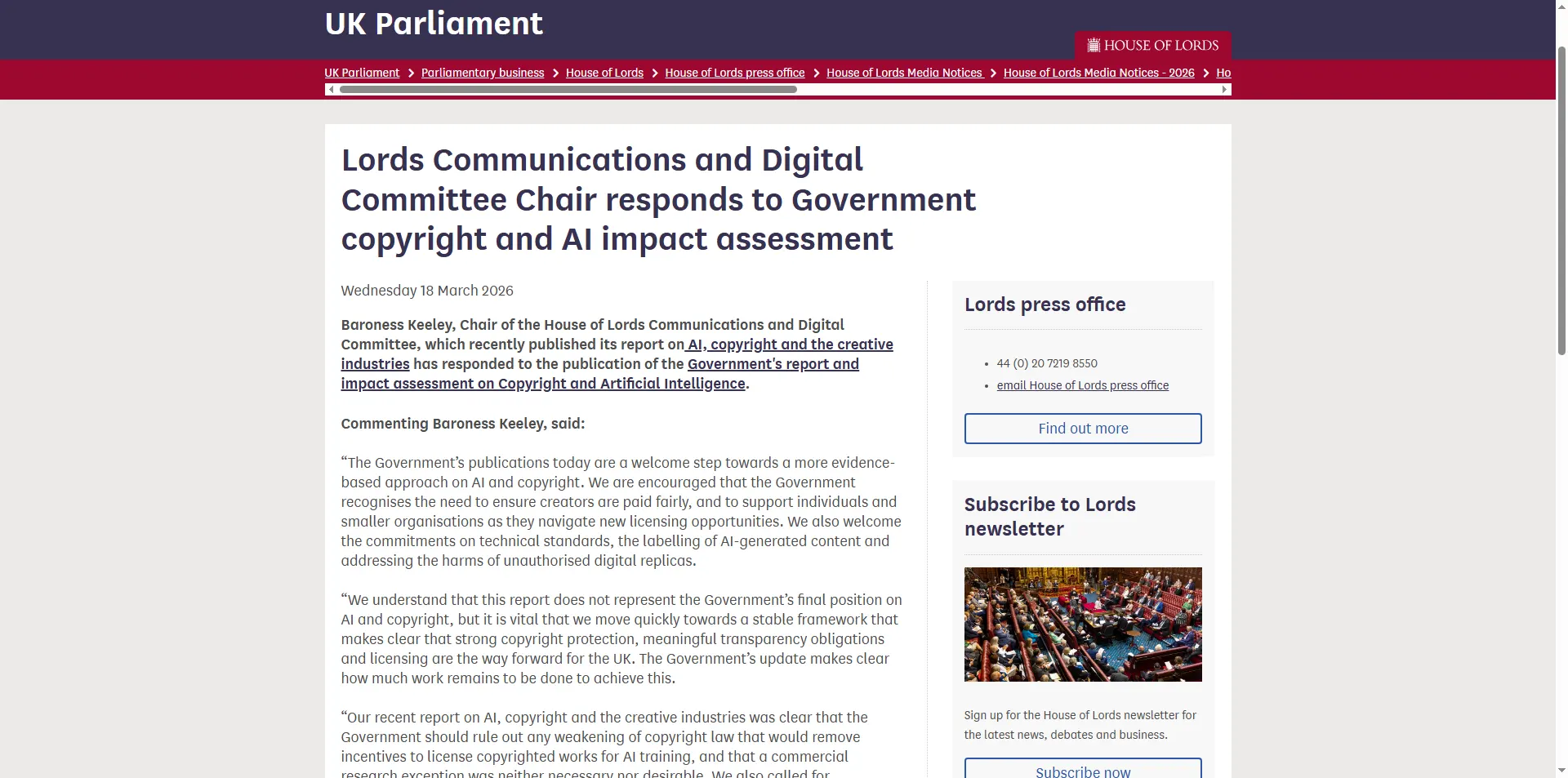
The most consequential unresolved UK AI policy issue is whether AI companies can legally train models on UK-sourced content without licensing agreements. The UK government launched a consultation on this question, with detailed responses due by March 18, 2026. In March 2026, the House of Lords Digital and Communications Committee published its inquiry report, urging the government to reject any new commercial text and data mining exception that would allow AI training without rightsholders’ consent. The committee recommended introducing transparency obligations for AI training data and closing gaps in protection for digital replicas of voice and likeness.
The UK government has not yet responded to either the consultation or the Lords committee report as of May 2026. The outcome of this decision will determine whether UK-based publishers, authors, and creators must separately negotiate data licensing agreements with AI companies or whether an opt-out model gives AI companies default access to published content.
Source: https://committees.parliament.uk/committee/170/communications-and-digital-committee/
China: binding cybersecurity rules for AI now in force
China’s approach to AI regulation is distinct from every other major jurisdiction. It operates through centralized state oversight, mandatory ethical reviews, and content-control requirements that require AI-generated content to align with state values.
The most significant 2026 development: an amended Cybersecurity Law that explicitly references AI became enforceable on January 1, 2026. It adds requirements for AI security reviews and data localization for AI systems handling certain categories of Chinese user data. Any foreign AI company operating in China or processing data from Chinese users must conduct a security assessment.
Three binding regulations already govern specific AI use cases in China: algorithmic recommendation systems (enforceable since 2022), deepfakes and synthetic media (enforceable since 2023), and generative AI services (enforceable since August 2023 under the Interim Measures for the Management of Generative AI Services). These require mandatory government filing for generative AI systems, real-name verification of users, and compliance audits.
China’s next five-year plan is due for publication in 2026 and is expected to set new strategic goals for AI development and regulation. The plan may introduce new binding requirements for high-risk AI systems, potentially creating a comprehensive domestic AI law equivalent to the EU AI Act.

Source: https://www.cac.gov.cn/
Deepfake regulation: where every major jurisdiction stands in 2026
Deepfakes moved from a theoretical threat to a concrete legislative priority between 2024 and 2026. Every major jurisdiction now has at least one binding rule addressing synthetic media, though the scope, enforcement mechanism, and penalties vary significantly.
United States
The federal Take It Down Act, effective May 19, 2026, is the first federal law specifically targeting AI-generated harmful content. It requires platforms to remove non-consensual sexual deepfakes within 48 hours of a valid takedown request. Separately, 30 states have passed laws requiring disclaimers on AI-generated content in political advertising as of May 2026. California’s AB 2839, covering political deepfakes in campaigns, faced constitutional challenges on free speech grounds that are still working through the courts.
European Union
The EU AI Act requires providers of AI systems that generate images, audio, or video to embed machine-detectable watermarks or markers identifying the content as AI-generated. This is a transparency obligation, not a ban. The EU’s Digital Services Act (DSA) adds separate requirements for very large online platforms to label AI-generated content and to implement mechanisms for users to flag synthetic media.
United Kingdom
The UK’s Online Safety Act includes provisions addressing harmful deepfake content, particularly non-consensual intimate images. Ofcom, as the designated regulator, issued its enforcement codes in 2025. Platforms operating in the UK must implement proportionate safeguards against deepfake-enabled harms or face fines up to 10% of global annual revenue.
AI and copyright: training data rules taking shape globally
Who owns the content AI models are trained on, and what rights do creators have when their work is used without explicit consent? These questions are being answered simultaneously in multiple jurisdictions, with conflicting answers emerging.
European Union position
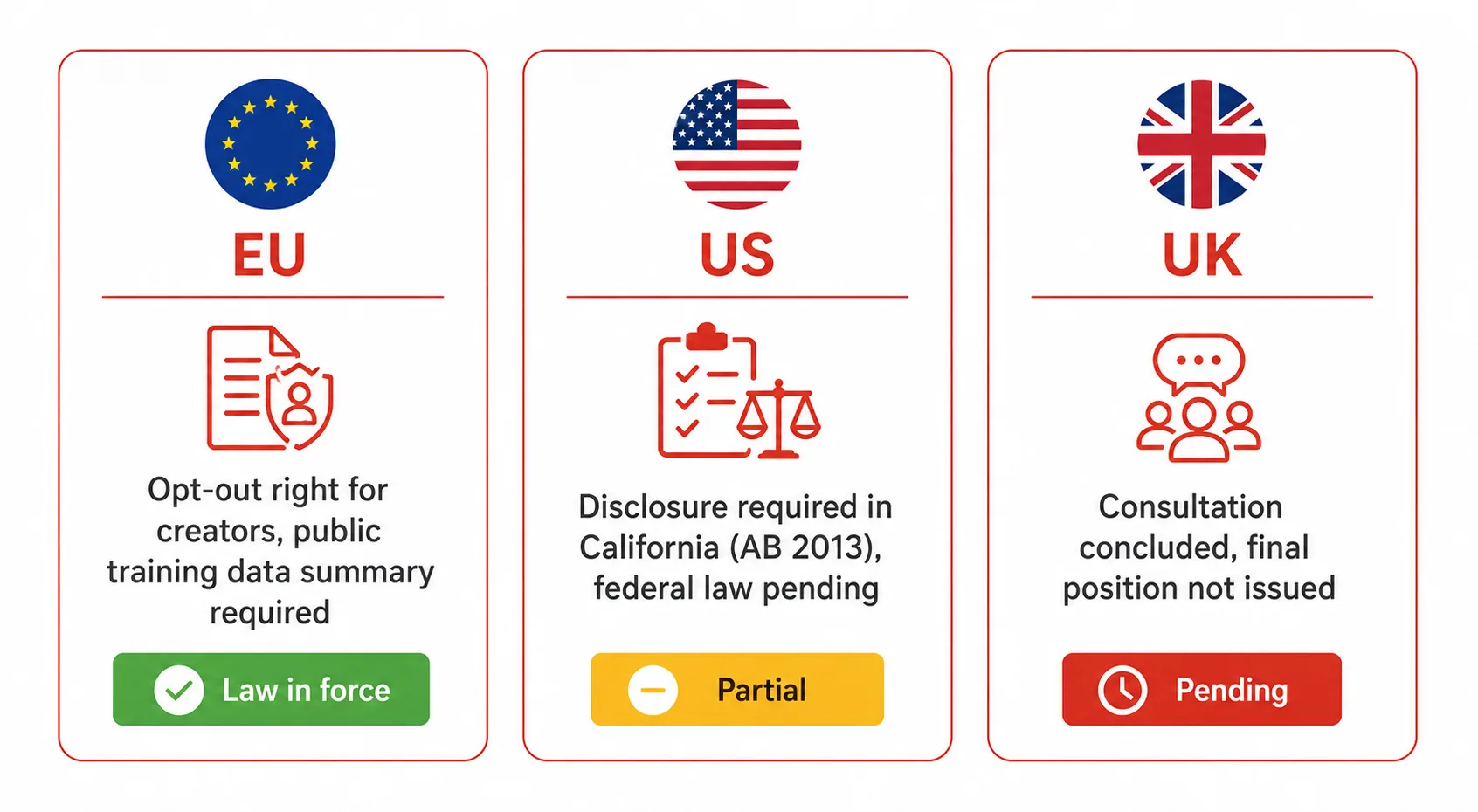
The EU AI Act requires GPAI providers to publish a public summary of training datasets and to comply with copyright opt-out requests under the EU Copyright Directive. Creators and publishers can register an opt-out, signalling that their content must not be used to train AI models. Enforcing this opt-out is technically and legally complex, but the obligation to respect it is now a legal requirement, not a voluntary courtesy.
United States position
California’s AB 2013 (effective January 1, 2026) requires AI developers to publish high-level training data disclosures, including whether copyrighted works were included and whether personal data was processed. Multiple lawsuits from publishers, authors, and news organizations against AI companies for training data copyright infringement are working through US federal courts as of May 2026. No federal statute specifically addresses AI training data copyright, leaving courts to apply existing copyright law to this new context.
United Kingdom position
The UK is the most contested battleground on this issue in 2026. The government’s consultation on whether to create a new text and data mining exception has prompted fierce opposition from creative industries. The House of Lords committee report in March 2026 explicitly recommended against such an exception. As of May 2026, the government has not issued its final position.
What this means for companies and developers: a practical checklist
If you build or deploy AI in any commercial context with EU exposure, US state market presence, or UK/China user bases, here is what your compliance posture should include as of May 2026:
For EU exposure
- Classify every AI system you deploy against the EU AI Act’s risk categories. Annex III high-risk classifications are not always obvious. Hiring tools, credit models, and insurance pricing algorithms are high-risk even when the AI plays only a supporting role in the decision.
- If you have a GPAI model with EU users, ensure that training data documentation, copyright opt-out compliance, and technical documentation are complete. This obligation has been in force since August 2025.
- If you have high-risk AI systems, complete conformity assessments, prepare technical documentation, and plan for EU database registration before August 2, 2026. Do not wait to see whether the Digital Omnibus delay materializes.
- Do not use AI for prohibited practices. Emotion recognition in workplaces and social scoring are already banned and carry maximum-tier penalties.
For US operations
- If you operate in California, Texas, or Illinois, your AI systems must comply with those states’ transparency and disclosure requirements as of January 1, 2026.
- If you operate in Colorado, monitor the June 30, 2026, effective date and any further legislative amendments closely. The law may be amended significantly before enforcement begins.
- AI hiring tools, credit models, and decision systems that affect consumers require the most immediate attention across all US states with active AI laws.
- If your platform hosts user-generated content, the Take It Down Act’s 48-hour deepfake removal obligation is federal law as of May 19, 2026.
For UK and China operations
- In the UK, existing sectoral regulations (FCA, ICO, Ofcom, CMA) apply to AI systems in their respective domains. Treat AI systems as within the scope of whichever sectoral regulator covers your industry.
- For China, any AI system processing Chinese user data requires a security assessment under the amended Cybersecurity Law. Generative AI services require government filing with the Cyberspace Administration (CAC).
Global AI regulation comparison: 2026 at a glance
| Jurisdiction | Approach | Status | Key 2026 deadline | Max penalty |
|---|---|---|---|---|
| European Union | Comprehensive risk-based law | Actively enforcing (phased) | August 2, 2026: high-risk AI obligations | EUR 35M or 7% global turnover |
| United States (federal) | No federal AI law; executive order | Deregulatory at federal level | May 19, 2026: Take It Down Act | Varies by violation |
| United States (California) | Transparency and disclosure | Active since January 1, 2026 | January 1, 2026 (already in effect) | Significant civil penalties |
| United States (Colorado) | High-risk AI, anti-discrimination | Effective June 30, 2026 (possibly amended) | June 30, 2026 | $20,000 per violation |
| United Kingdom | Sector-by-sector, principles-based | No dedicated AI law yet | Frontier AI Bill pending | Up to 10% global revenue (Online Safety Act) |
| China | State-controlled content and security | Actively enforcing since January 1, 2026 | Amended Cybersecurity Law in force | Varies; can include market access bans |
| Japan | Voluntary, principles-based | AI Promotion Act in force June 2025 | No hard deadlines; reputational disclosure | No financial penalties; name-and-shame |
Frequently asked questions about AI regulation in 2026
Does the EU AI Act apply to companies outside the EU?
Yes. The EU AI Act applies to any company whose AI system’s output “touches the EU in a meaningful way,” including through sales, user access, or downstream integrations. A US company with no EU office but whose AI product is used by EU residents is in scope. This extraterritorial reach mirrors the GDPR approach and is confirmed in the Act’s text and in guidance from the European AI Office.
What exactly is a “high-risk AI system” under the EU AI Act?
High-risk AI systems are defined in Annex III of the Act. They fall into eight broad areas: biometric identification and categorisation; critical infrastructure management; education and vocational training; employment and worker management; access to essential private and public services; law enforcement; migration and border control; and administration of justice. If your AI system makes or significantly influences decisions in any of these areas affecting EU residents, it is almost certainly high-risk.
Can a US company ignore US state AI laws if they are in a different state?
No. California, Texas, and Colorado’s AI laws all apply based on where users are located, not where the company is headquartered. A company based in New York whose AI product is used by Texas residents is covered by Texas RAIGA. A company based in Florida whose AI tool is used by California residents is covered by California’s transparency laws.
What does “algorithmic discrimination” mean under Colorado’s AI Act?
Under Colorado SB 24-205, algorithmic discrimination means an AI system producing outputs that unlawfully differentiate between individuals based on a protected characteristic such as age, race, sex, religion, disability, or national origin. Developers must use reasonable care to prevent their systems from producing such outcomes. Deployers must conduct impact assessments to detect potential discrimination before deployment and disclose to affected consumers when AI has made a consequential decision affecting them.
What is the GPAI Code of Practice and do I need to follow it?
The GPAI Code of Practice was finalized by independent experts convened by the EU AI Office in July 2025. It provides voluntary guidance in three areas: transparency, copyright, and safety for GPAI model providers. While signing the Code is technically optional, it provides a legal “presumption of conformity” with the Act’s GPAI obligations. This is effectively a safe harbor. AI companies that do not follow the Code have no presumption of compliance and face a higher evidentiary burden in enforcement proceedings.
Does the EU AI Act replace GDPR?
No. The EU AI Act and GDPR apply concurrently whenever an AI system processes personal data. Both sets of obligations apply simultaneously. Companies must integrate their GDPR compliance programs and AI Act compliance programs rather than treating them as separate workstreams. The EU AI Act’s transparency requirements, data governance obligations, and documentation requirements overlap significantly with GDPR’s accountability principle, Data Protection Impact Assessments, and lawful basis requirements.
What is the EU AI Office and who does it regulate?
The European AI Office was established within the European Commission’s DG CONNECT and became operational in February 2024. It is the primary enforcement authority for GPAI model obligations at the EU level. This means the AI Office directly regulates providers of foundation models, including major AI labs and model API providers. National market surveillance authorities handle enforcement for high-risk AI systems deployed in their countries. Data Protection Authorities retain jurisdiction over personal data processing aspects of any AI system.
What is “systemic risk” under the EU AI Act and which AI models qualify?
The EU AI Act designates GPAI models with cumulative training compute above 10^25 floating point operations (FLOPs) as posing “systemic risk.” These models face additional requirements beyond standard GPAI obligations: adversarial testing, cybersecurity measures, incident reporting to the AI Office, and broader model evaluations. As of 2025 to 2026, this threshold is understood to include the most advanced frontier models from major AI labs. The European AI Office published guidance in early 2026 describing how it may access model weights, code, and infrastructure to verify compliance.
Is the Take It Down Act already in effect in the United States?
Yes. The Take It Down Act (TiDA) became federal law in the United States and is effective as of May 19, 2026. It requires online platforms to remove non-consensual AI-generated sexual imagery within 48 hours of a valid takedown request from the person depicted. Platforms that fail to comply face enforcement by the Federal Trade Commission.
Will Trump’s executive order stop state AI laws from being enforced?
Not automatically. An executive order cannot preempt state law without congressional action. Multiple major law firms have confirmed that existing state AI laws, including California’s, Texas’s, and Colorado’s, remain valid and enforceable despite EO 14365. The Justice Department’s AI Litigation Task Force can challenge specific state laws in court, but court proceedings take years. Companies must continue complying with state AI laws that apply to their operations. The governors of California, Colorado, and New York have publicly stated they will continue enforcing their state AI statutes regardless of the federal executive order.
What to watch for in the second half of 2026
Several developments will determine the trajectory of AI regulation through the end of 2026 and into 2027. These are the highest-impact events to monitor:
- August 2, 2026: EU high-risk AI obligations take effect. The first enforcement actions from national market surveillance authorities are expected within weeks of this date for non-compliant systems already identified.
- June 30, 2026: Colorado AI Act’s current effective date. The outcome of ongoing legislative negotiations over the law’s scope and requirements will determine whether it takes effect as written, in amended form, or is delayed again.
- Digital Omnibus trilogue conclusion: If concluded, it may introduce conditional delays to some EU AI Act high-risk obligations. Monitor the European Parliament and Council negotiation updates at the EUR-Lex portal.
- UK government’s copyright and AI response: The government’s final position on whether to create a text and data mining exception will determine whether AI companies operating in the UK need to establish licensing frameworks with UK publishers and creators.
- China’s five-year plan: Publication of the new five-year plan in 2026 may introduce new binding AI requirements and investment priorities with significant implications for global AI supply chains.
- US federal AI legislation: Congressional debate over whether to pass a federal AI law that preempts state regulations continues. No bill has cleared committee as of May 2026, but the pressure from both industry (seeking uniformity) and states (seeking to preserve their laws) is intensifying.
The clearest message from 2026: build for compliance from day one
The companies struggling most with AI regulation in 2026 are those that built first and are trying to retrofit compliance onto existing systems. Conducting a conformity assessment on a hiring algorithm that has been deployed for three years, or retroactively documenting training data for a model built before transparency requirements existed, is significantly harder and more expensive than building compliance in from the start.
The clearest practical lesson from watching how the EU AI Act has been implemented so far is that regulators are not looking for perfect systems. They are looking for documented processes: evidence that you classified your AI systems, assessed their risks, built human oversight into deployment, and can demonstrate an ongoing monitoring program.
That documentation discipline, applied consistently from the beginning of a project, is the difference between a company that absorbs a new regulation without significant disruption and one that faces a market withdrawal order or a multi-million euro fine because it cannot produce the required evidence on demand.
Primary sources and official regulatory references:
- EU AI Act full text and timeline: artificialintelligenceact.eu
- European AI Office official page: European Commission
- EU AI Act Official Journal text: EUR-Lex
- White House Executive Orders including EO 14365 on AI
- UK House of Lords Digital and Communications Committee: copyright and AI report
- China Cyberspace Administration (CAC): generative AI regulations