
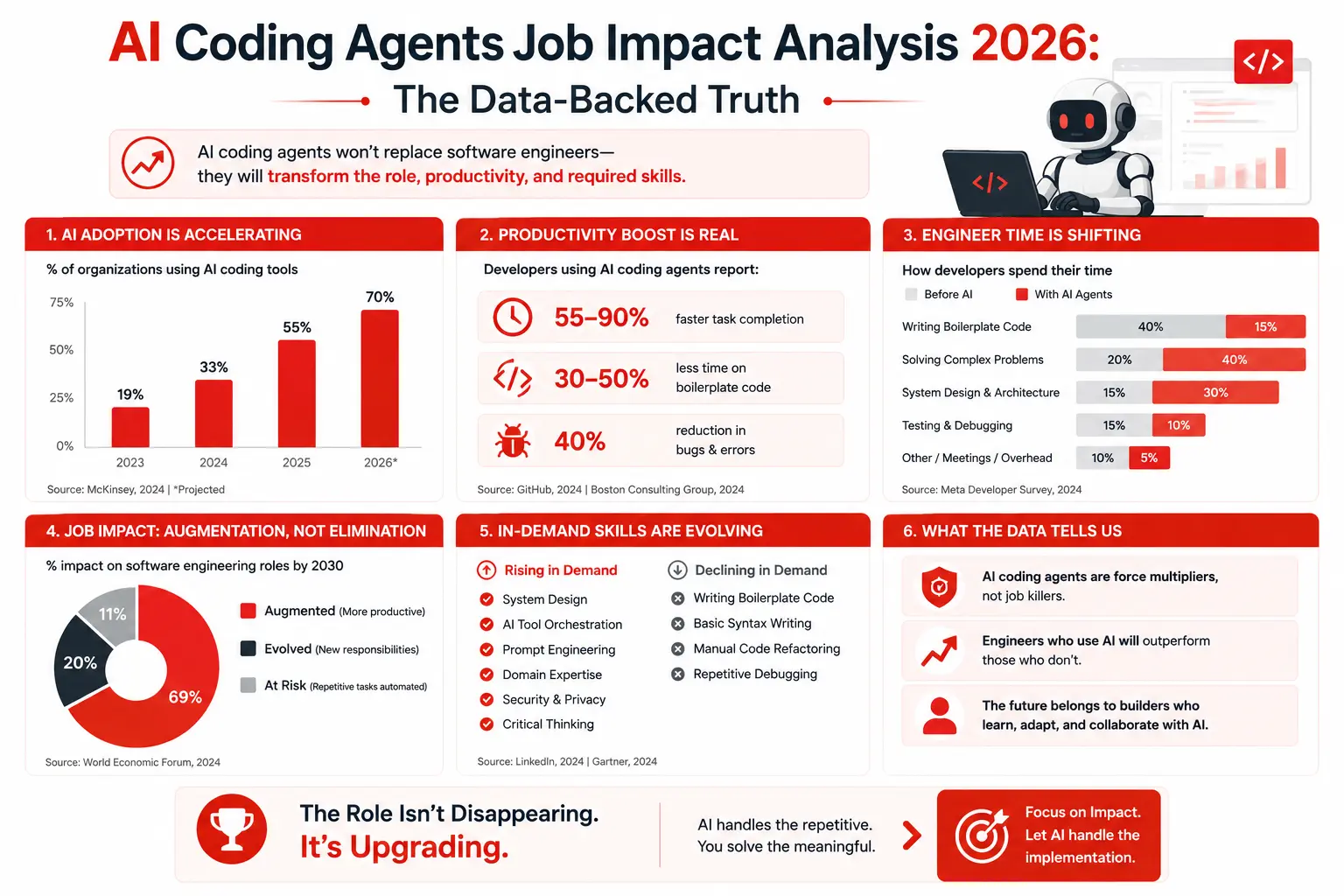
For the last few years, the debate surrounding artificial intelligence and software engineering has been mostly theoretical. We argued over whether LLM autocomplete tools made us marginally faster or if they were just glorified copy-paste machines. But as we move through 2026, the arrival of autonomous AI coding teams, long-horizon multi-file agents, and terminal-native execution setups has completely shifted the narrative.
We are no longer guessing about the future. The data for 2026 is officially in, and it paints a highly fascinating, somewhat paradoxical picture of the software engineering job market. The headline isn’t mass unemployment; it is mass restructuring.
Here is an unvarnished, data-driven analysis of how AI coding agents are impacting developer jobs, hiring budgets, and required skill sets right now.
1. The Junior Developer Bottleneck is Real
While total software engineering employment numbers are technically projected to grow by 15% to 17% over the next decade, the distribution of those new roles has aggressively tilted toward high-context engineers. The group bearing the brunt of the agentic revolution is entry-level talent.
Data from recent hiring market analyses reveals that entry-level and fresh-graduate hiring at major tech firms has dropped by roughly 25% to 50% compared to pre-AI baselines. Harvard research tracking macro employment trends showed that within six quarters of an enterprise adopting generative AI workflows, junior developer hiring contracts consistently by 9% to 10%.
The economic logic driving this is straightforward: AI coding agents are highly proficient at handling the isolated, low-complexity tasks that traditionally served as the training ground for junior developers—tasks like writing unit test scaffolds, drafting documentation, and cranking out boilerplate components. Because a senior engineer can now use an agent to spin up these pieces instantly, the traditional corporate “apprenticeship” model is breaking down.
2. The “Premium” Shift: Senior Salaries and Agent Building
While entry-level hiring faces severe friction, demand for senior, staff, and principal engineers has spiked, creating a massive skills gap. However, the exact skills companies are willing to pay a premium for have fundamentally evolved.
According to live job board data analyzing tens of thousands of active engineering postings, “AI Agents” has become the fastest-growing software engineering job requirement, appearing in nearly 10% of all open engineering listings. This beats out generic keywords like “LLMs” or “Generative AI.”
Crucially, companies aren’t looking for developers who simply know how to use AI tools like Copilot or Cursor. They are hiring engineers to build and orchestrate agentic systems—pipelines where models dynamically use tools, handle Retrieval-Augmented Generation (RAG), manage context state, and execute workflows autonomously.
This builder-level requirement carries a heavy financial incentive. Job postings requiring these new-wave agentic and LLM engineering skills command a median US base salary of $151,000, representing a $21,000 (16.2%) wage premium over traditional software roles lacking AI requirements.
3. Shifting from Code Production to Intent and Verification
Research on developer workflows highlights a critical nuance in how software is actually getting shipped. While engineers now integrate AI agents into roughly 60% of their daily workflows, studies show they are only able to “fully delegate” 0% to 20% of their end-to-end tasks without human intervention.
This reality has transformed the developer’s core role into an operator of intent and verification. The software delivery pipeline has inverted:
| The Old Workflow (Coding-First) | The 2026 Workflow (Review-First) |
|---|---|
| Spend 70% of time typing syntax, debugging typos, and setting up environments. | Spend 20% of the time writing high-level technical specifications and prompt intent. |
| Spend 20% of the time testing and checking logic paths manually. | Spend 60% of time reviewing multi-file agent pull requests, verifying security, and checking edge cases. |
| Spend 10% of the time on architecture planning. | Spend 20% of time handling complex system boundaries and cloud infrastructure orchestration. |
Because agents can now run autonomously for hours or days to build full feature sets, the primary human vulnerability has moved down the line. Codebases are growing faster and becoming structurally more complex, meaning the value of an engineer is no longer measured by lines of code written, but by their ability to audit code for architectural decay and security vulnerabilities.
4. Non-Tech Sectors Are Becoming Tech Hubs
An unexpected silver lining of the agentic explosion is where the new software jobs are actually appearing. As AI coding agents lower the financial barrier to building custom software, traditional non-tech industries are aggressively building out internal engineering teams.
Biotech leads the pack, with over 42% of its software engineering job descriptions explicitly demanding AI and agentic capabilities. Energy, cybersecurity, and advanced manufacturing follow closely behind. These industries previously relied on massive, slow, third-party enterprise vendor software; now, small teams of 3 to 5 AI-empowered engineers can build, maintain, and scale bespoke internal platforms that used to require an engineering department of 20 people.
The Operational Reality: The software engineering market isn’t shrinking; it is decentralizing. The jobs are migrating out of pure Silicon Valley SaaS companies and dispersing into heavily specialized domain-specific industries.
How Engineers Must Upskill to Survive
If you are looking at the 2026 landscape, the path to remaining highly compensated and indispensable requires an immediate pivot in your learning roadmap:
- Master Task Decomposition: Learn to break large, vague business goals into modular, programmatic sub-tasks that a multi-agent team can execute sequentially without losing state.
- Double Down on System Architecture: Deepen your understanding of data modelling, system boundaries, and integration patterns. The AI can write the functions, but you must design the web that connects them.
- Develop an Auditor’s Mindset: Cultivate advanced debugging, security auditing, and telemetry analysis skills. When an agent introduces a subtle security vulnerability or a race condition, you must be capable of catching it during peer review.
The Bottom Line
The year 2026 has officially broken the myth of the lone, manual coder. AI coding agents have successfully commoditized code creation. However, they have simultaneously amplified the demand for human gatekeepers who possess the system-level thinking, business context, and defensive engineering skills required to safely guide these autonomous engines. The code is automated; the engineering is firmly human.