
If you search for an AI engineer roadmap, you’ll find two kinds of advice. One says you need a master’s degree, linear algebra, three years of PyTorch and a paper or two before anyone will take you seriously. The other says you can become an AI engineer in a weekend by learning to write prompts. Neither matches what the job looks like at most companies in 2026.
Here’s the version that does. An AI engineer is, first of all, a software engineer. They build products on top of large language models: chat features, document search, agents that take actions, pipelines that turn messy text into clean data. The hard parts are mostly engineering problems with a new twist. How do you test something that gives a slightly different answer every time? How do you keep costs predictable? How do you stop a model from being tricked into leaking data?
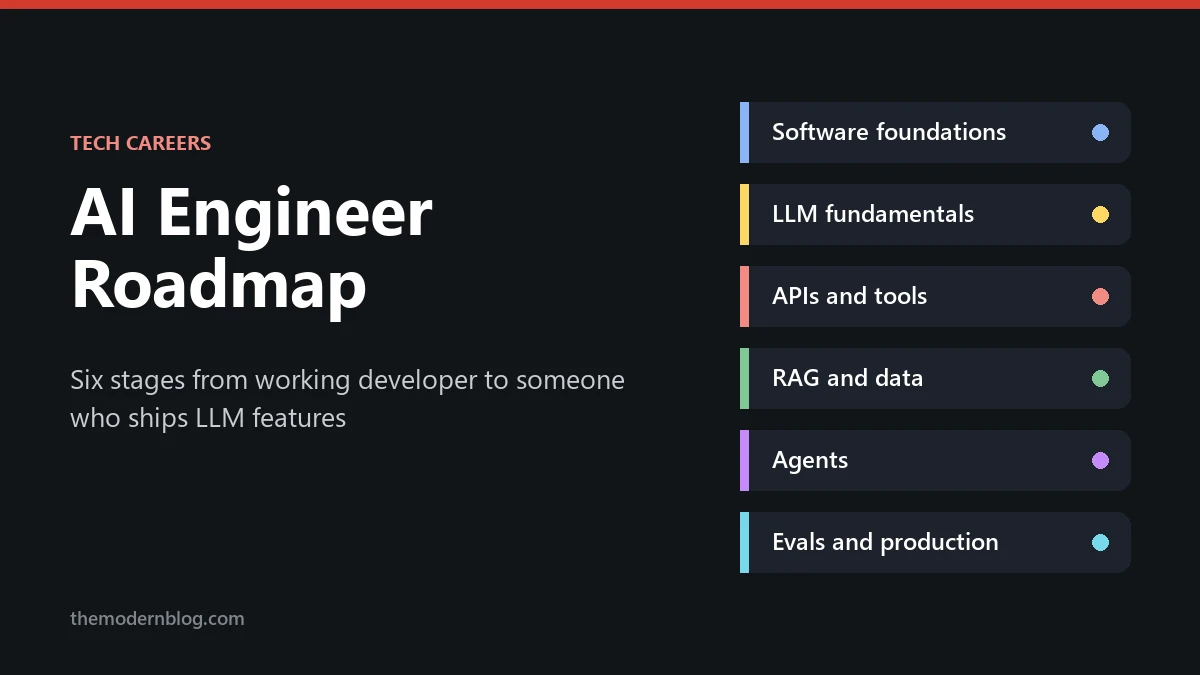
This roadmap is written for developers who already know how to build software and want to move into AI engineering. It’s split into six stages, in the order I’d learn them, with a project for each so you have something real to show at the end.
What does an AI engineer actually do?
The term took off after Shawn Wang (better known as swyx) wrote “The Rise of the AI Engineer” in 2023. His point was that a new role was forming between machine learning research and regular product engineering. Most companies won’t train their own large models. They’ll use models from Anthropic, OpenAI, Google or open source projects, and they need engineers who can turn those models into reliable products.
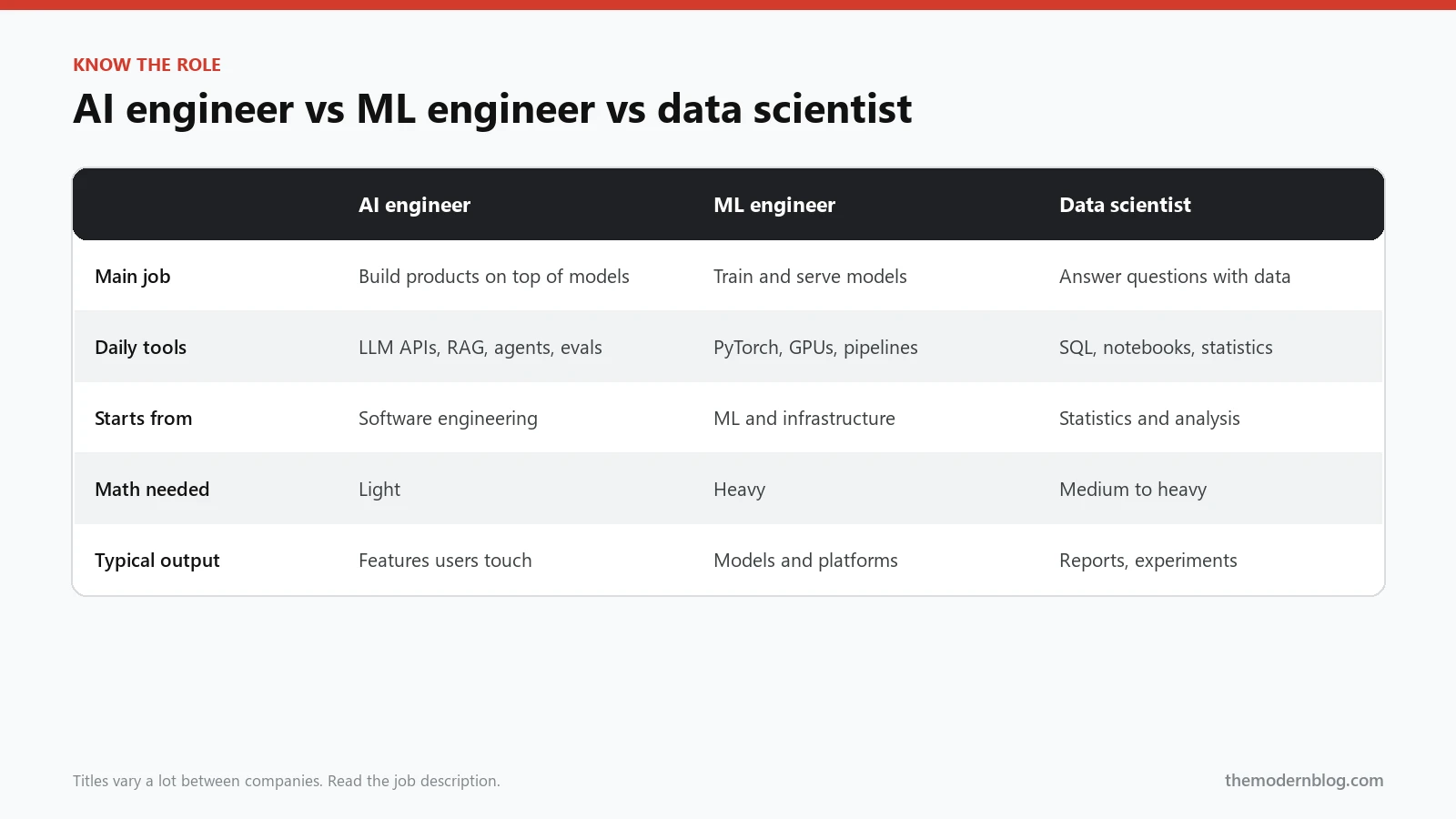
A typical week for an AI engineer might include writing a retrieval pipeline for a support bot, tuning a prompt that misclassifies refund requests, building an evaluation set from real user conversations, adding tracing so the team can see why an agent made a bad decision, and figuring out why the API bill doubled last month. Not much calculus. A lot of careful engineering.
That’s good news for working developers. You already have the hardest-to-teach half of the skill set. The roadmap below is about adding the other half.
The AI engineer roadmap at a glance
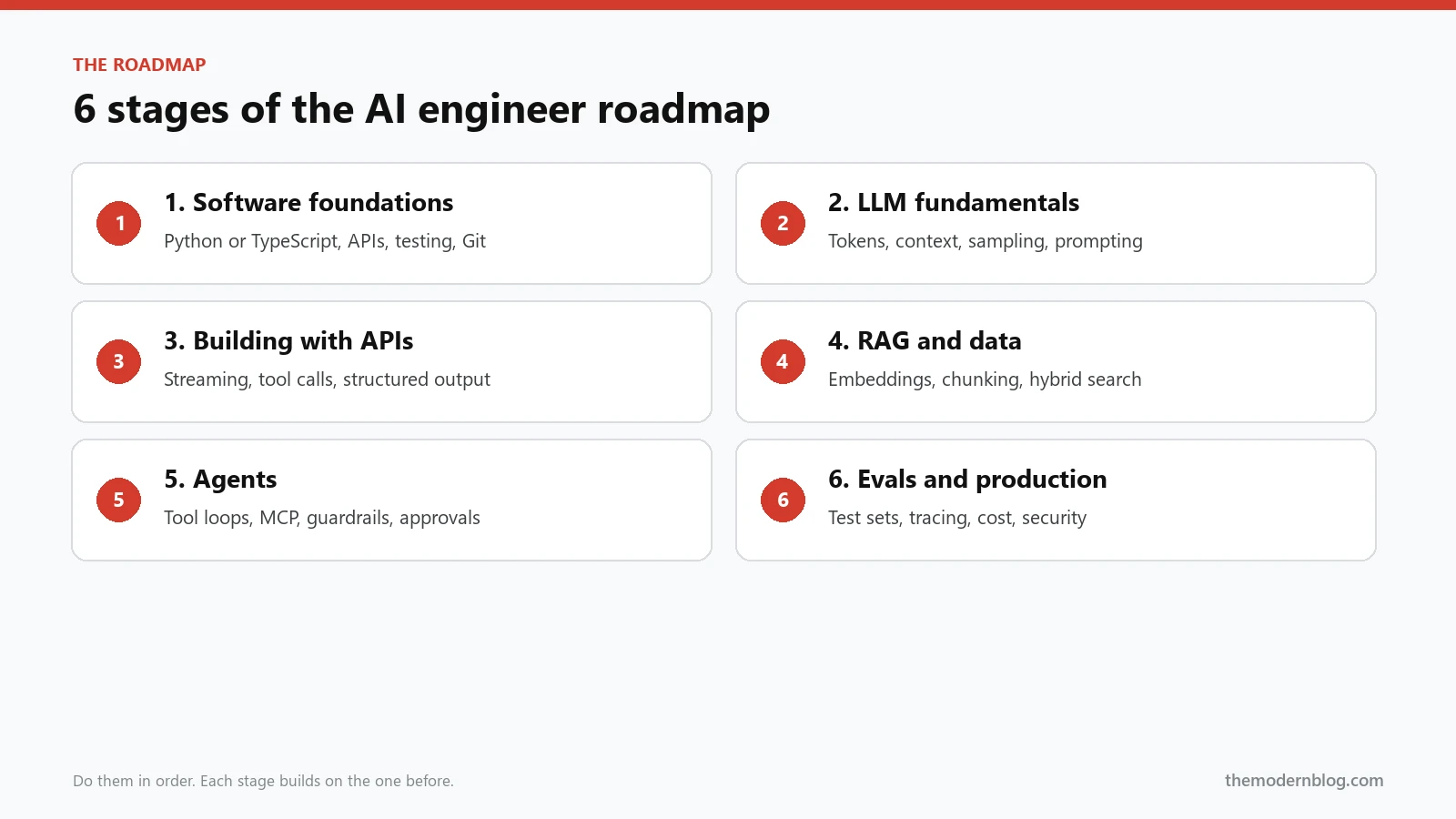
Each stage builds on the one before it. You can skim a stage you already know, but resist the urge to jump straight to agents. Agent bugs are usually stage 2 or stage 4 problems in disguise.
Stage 1: Solid software foundations
If you’re already a working developer, this stage is mostly a check. AI engineering leans on a few specific skills more than usual:
- Python or TypeScript, comfortably. Nearly every SDK, framework and example is in one of the two. Python is still more common for data-heavy work; TypeScript dominates for web products.
- HTTP APIs and async code. You’ll make a lot of slow network calls that can fail, time out or hit rate limits. Retries with backoff, timeouts and concurrency limits become daily tools.
- Working with JSON and schemas. Structured outputs from models are validated against schemas (Pydantic in Python, Zod in TypeScript).
- Testing. You’ll need to adapt your testing habits to non-deterministic outputs, but the habit itself is essential.
- Basic SQL and one database. Many AI features are, underneath, a database with a model attached.
If you’re coming from a non-programming background, spend real time here first. Every shortcut you take at this stage shows up later as a feature that works in a demo and falls over in production.
Stage 2: LLM fundamentals
You don’t need to be able to train a transformer. You do need a working mental model of what’s happening when you call one, because almost every weird bug traces back to these basics.
- Tokens. Models read and write tokens, not words. Pricing, limits and some odd behaviours (like trouble counting letters) all come from this.
- Context windows. Everything the model knows about your request has to fit in its context. Long contexts are possible, but quality and cost both change as they grow.
- Sampling. Temperature and related settings control randomness. Low for extraction and classification, higher for brainstorming.
- Prompting. Clear instructions, examples, a defined output format, and letting the model think before answering when the task is hard. Read the official prompting guides from Anthropic and OpenAI; they’re better than most courses.
- What models are bad at. Hallucinations, outdated knowledge, arithmetic, and following instructions buried in very long prompts. Knowing the failure modes is half the job.
If you want to go deeper than the APIs, Andrej Karpathy’s free “Neural Networks: Zero to Hero” video series builds a small GPT from scratch. It’s optional for this roadmap, but it removes a lot of the mystery, and many people find it changes how they write prompts.
Stage 3: Building with LLM APIs
Now you start building. Pick one provider’s SDK and learn it properly before reaching for frameworks. Frameworks change fast, and when something breaks you’ll want to understand the raw API calls underneath.
The skills to practise here:
- Streaming responses to a UI so users see text appear as it’s generated.
- Structured output: getting reliable JSON back and validating it.
- Tool calling (also called function calling): letting the model request that your code run a function, then feeding the result back. This is the foundation of every agent. Our explainer on AI agent tool calling walks through the loop step by step.
- Error handling: rate limits, overloaded errors, timeouts, and model refusals.
- Cost awareness: logging tokens per request and estimating monthly cost before you launch. Prompt caching alone can cut input costs dramatically for apps with long system prompts.
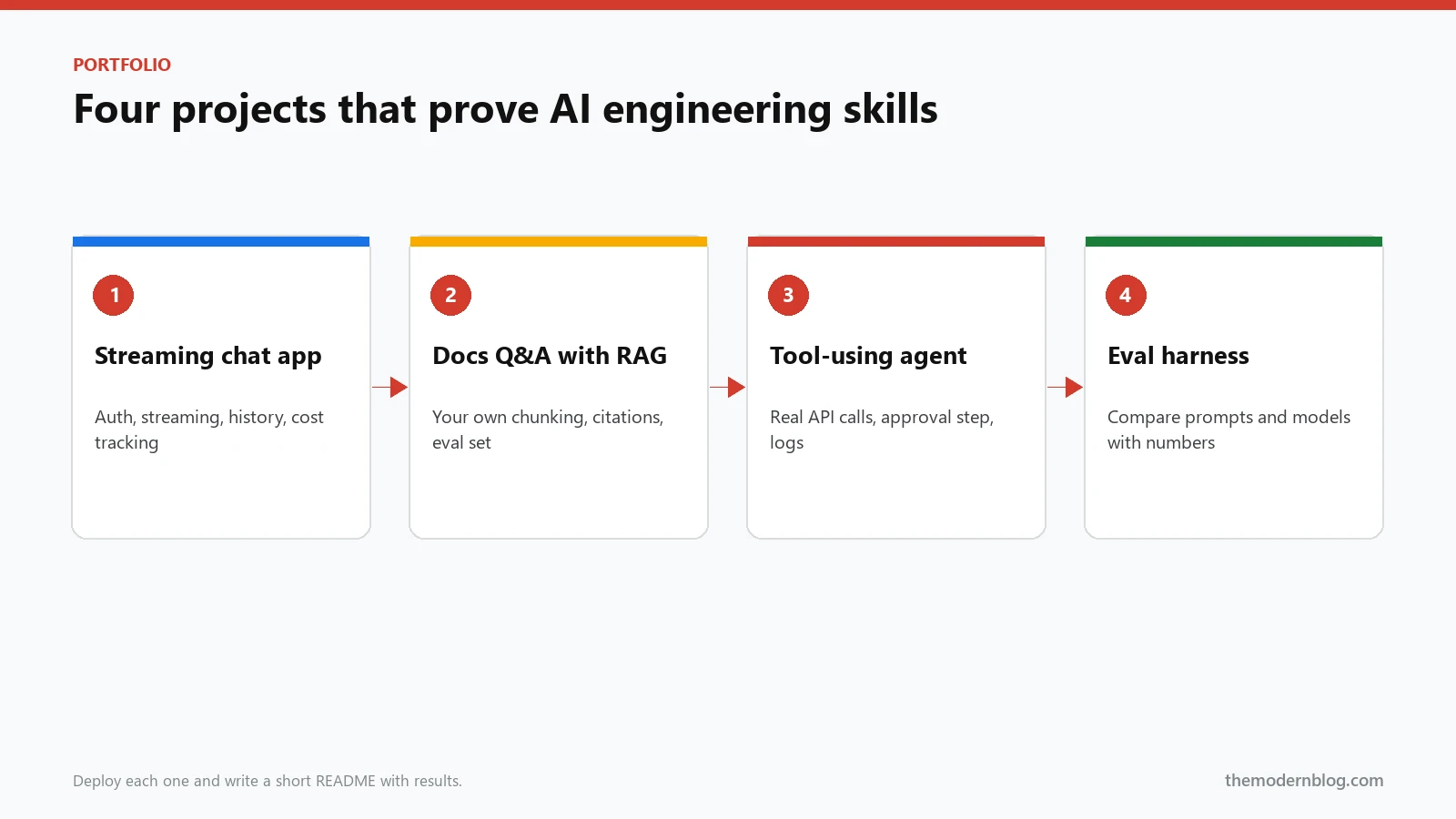
The project for this stage is a small chat app with login, streaming, saved conversation history and a cost counter per conversation. It sounds simple. Doing it well touches nearly every skill above.
Stage 4: RAG and working with data
Retrieval-augmented generation (RAG) is how you give a model knowledge it wasn’t trained on: your docs, your tickets, your product catalogue. It’s also where a lot of AI engineering time goes, because the quality of the answer depends heavily on the quality of what you retrieve.
Learn these pieces:
- Embeddings: turning text into vectors so you can find similar passages.
- Chunking: splitting documents into pieces that make sense on their own. Bad chunking ruins good models.
- Vector search, using a vector database or simply Postgres with pgvector.
- Hybrid search: combining keyword search with vector search, which often beats either one alone, especially for product names and error codes.
- Reranking: using a second model to reorder the top results before they go to the LLM.
- Citations: making the model point to the sources it used, so users (and you) can check them.
Build a docs Q&A bot over a real set of documents, ideally something you know well so you can tell when answers are wrong. Then write 30 to 50 real questions with known answers. That little list becomes your first evaluation set, and it’s the bridge to stage 6.
Stage 5: AI agents
An agent is a model in a loop: it decides on an action, calls a tool, looks at the result and decides what to do next, until the task is done. Agents are where the excitement is, and also where things go wrong in the most interesting ways.
What to learn:
- The agent loop itself, built by hand at least once, before you use a framework.
- Tool design: clear names, tight input schemas, useful error messages the model can act on.
- The Model Context Protocol (MCP) for connecting agents to external tools in a standard way. See how MCP servers work for the technical details.
- Planning and memory: how agents break down tasks and what they keep between steps.
- Guardrails: limits on steps and spending, human approval for risky actions, and defenses against prompt injection.
Your project: an agent that does something real with an external API, like triaging GitHub issues or drafting replies to support emails, with an approval step before anything is sent and a log of every tool call.
Stage 6: Evals and production
This is the stage that separates people who can build a demo from people companies want to hire. Anyone can get an LLM feature working once. The job is making it work reliably, measuring whether a change made it better or worse, and keeping it running.
- Evals. Test sets built from real usage, automated scoring (exact match where possible, model-graded where not), and the discipline to run them before every prompt or model change. Hamel Husain’s writing on evals is some of the most practical material available.
- Observability. Tracing every model call, tool call and retrieval step so you can replay what happened when a user reports a bad answer.
- Cost and latency. Caching, smaller models for easy steps, batching for offline work.
- Security and privacy. Prompt injection, data leakage, PII handling, and access control for retrieved documents.
The project: an evaluation harness that runs your test questions against two prompts or two models and prints a comparison table with accuracy, cost and latency. Put the results in the README. Hiring managers notice this one.
A realistic timeline
For a developer studying part-time alongside a job, something like six to nine months is a reasonable estimate to work through all six stages of this AI engineer roadmap and finish the four projects. Stage 1 might take no time at all if you’re experienced, or a few months if you’re not. Stages 3 and 4 usually take the longest, because that’s where most of the building happens.
Two things speed it up a lot. First, apply what you learn at your current job. Most teams have some internal tool, search problem or repetitive text task that would make a good first AI feature, and shipping one real feature teaches more than three tutorials. Second, write about what you build. Short posts about what broke and how you fixed it are a portfolio in themselves.
The best resources for each stage
There’s far more material out there than anyone can get through. These are the ones that hold up for AI engineering specifically:
- The official documentation and cookbooks from Anthropic, OpenAI and Google. They’re updated constantly and full of working examples.
- Chip Huyen’s book AI Engineering (O’Reilly, 2025), the most complete single overview of building applications on foundation models.
- Andrej Karpathy’s “Zero to Hero” series, for understanding how models work underneath.
- DeepLearning.AI’s short courses, which are free and focused on single topics like RAG or agents.
- The Latent Space podcast and newsletter, for keeping up with what practitioners are actually doing.
Pick one or two per stage. Finishing one good resource and building something beats starting ten.
How to land your first AI engineering role
Finishing the roadmap is one thing. Getting someone to give you the title is another, and the path there is often less direct than people expect.
The easiest route for most developers is an internal move. If your company is adding AI features (and most are), volunteer for the first one. Teams usually don’t have anyone with AI engineering experience yet, so the developer who shows up with a working prototype, a small eval set and a cost estimate tends to become “the AI person” quickly. A year later, that’s a very strong line on a CV.
If you’re applying externally, read job descriptions carefully. “AI engineer” means very different things at different companies. Some postings are really ML engineering roles that want model training and GPU experience. Others are product engineering roles that happen to use LLM APIs. Look at the tools listed and the problems they describe, and apply to the ones that match the skills from this roadmap.
When you apply, lead with the projects. A short description of what you built, the problem it solved, how you measured quality and what it cost to run says more than a list of frameworks. If you can show a before-and-after number from an eval (“accuracy went from 71% to 88% after adding hybrid search and a reranker”), that’s the kind of detail that gets you an interview.
Expect AI engineer interviews to mix normal software engineering questions with AI engineering specifics: how you’d design a RAG system for a given use case, how you’d evaluate a chatbot, how you’d handle prompt injection, how you’d cut costs on a feature that’s too expensive. If you’ve built the four projects, you’ll have a real story for each of those.
Common mistakes on the path to AI engineer
- Spending months on math and model training when the jobs you want are about building products.
- Learning a framework before learning the raw API, then being stuck when the framework does something unexpected.
- Building only demos. A deployed project with a few real users, logs and an eval set is worth five notebooks.
- Ignoring cost and security until an interviewer asks about them.
- Chasing every new model release instead of getting good at the fundamentals, which change much more slowly.
Is AI engineering a good career move?
The demand is real. Companies of every size are adding LLM features, and many have found that the hard part isn’t access to models, it’s people who can build reliable systems around them. Our look at how AI coding agents are changing developer jobs covers the wider market in more detail.
The honest caveat is that the tools change quickly. Some of what you learn this year will be handled by better models or better frameworks next year. The parts that last are the engineering habits: measuring quality, controlling cost, designing for failure and thinking about security. Those are exactly the skills this AI engineer roadmap puts at the end, and they’re the ones worth the most.
Frequently asked questions
Do I need a degree to become an AI engineer?
No. Most AI engineering jobs care far more about whether you can build and ship reliable software with LLMs. A computer science background helps, but a strong portfolio and relevant work experience count for more at most companies.
How much math does an AI engineer need?
Less than you’d think. Basic statistics helps with evals, and understanding what an embedding is helps with RAG. Heavy linear algebra and calculus are needed for ML research and model training, which is a different role.
Python or TypeScript for AI engineering?
Either works. Python has the deepest ecosystem for data work and evals. TypeScript is common for products built on the web. Learn one well and be able to read the other.
Should I learn fine-tuning?
Eventually, but not first. Most problems are solved better and cheaper with good prompts, retrieval and evals. Fine-tuning makes sense once you have an eval set that shows exactly where prompting falls short. In practice, plenty of AI engineers go a year or more on the job without needing to fine-tune anything.