

I once watched a junior developer spend forty minutes trying to install a package that an AI coding assistant had confidently recommended. The import line looked completely normal: from aws_secrets_helper import get_secret. The function names matched AWS naming conventions. The whole snippet read like it had been lifted straight from official documentation (AI hallucinations in software development).
It hadn’t. The package did not exist anywhere. The model had built a plausible-looking string from spare parts, a mashup of real boto3 patterns and a naming convention it had seen a thousand times before. Multiply that by every developer on a team who trusts AI-generated code without checking it, and you get a real, increasingly weaponized problem: AI hallucinations in software development.
If you write code with the help of an AI assistant, and at this point most of us do, you have probably already shipped a hallucination without realizing it. This article breaks down why it happens, what it actually costs you, and the concrete checks that catch it before it ever reaches production.
Why AI hallucinations happen in the first place
A hallucination is what happens when an AI model generates an answer that sounds plausible but is not actually true. In coding terms, that means a function that does not exist, a package that was never published, a configuration flag the framework dropped three versions ago, or logic that looks correct but quietly does the wrong thing.
The root cause is simple once you see it. Large language models are trained to predict the next most likely token based on patterns in their training data. They are not querying a live database of real packages, real APIs, or your actual codebase while they generate a response. When a model does not have a confident answer, it rarely says “I don’t know.” It produces the statistically most plausible-looking answer instead, complete with clean syntax and confident phrasing.
This matters more in software development than almost anywhere else, because code either runs or it does not. A hallucinated historical date is embarrassing in a chat window. A hallucinated package name sitting in your requirements.txt file is an open door.
How the hallucination actually slips into your code
Every AI coding assistant works the same basic way under the hood. You give it a prompt, it breaks that prompt into tokens, and it generates a sequence of new tokens that statistically follow from your request and everything the model absorbed during training. There is no built-in step where it checks PyPI, npm, or your project’s actual package.json before suggesting a dependency.
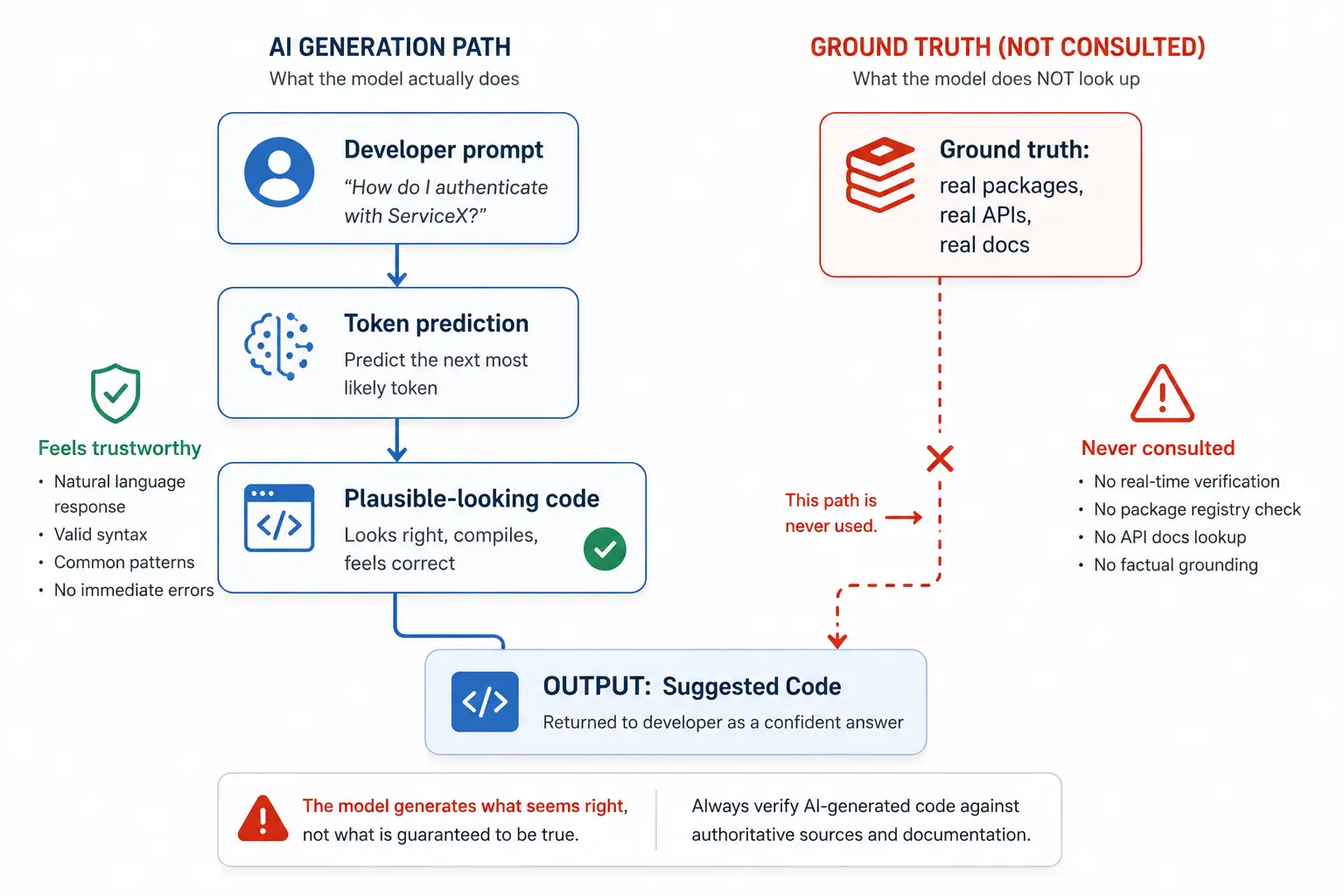
That gap between “sounds right” and “is right” is exactly why hallucinations show up so often in dependency suggestions. Academic research covered by CSO Online tested sixteen code-generating models across more than half a million code samples and found that close to one in five recommended packages did not actually exist, adding up to over 200,000 unique hallucinated package names across the study.
The real problems AI hallucinations cause
Hallucinations are not just an annoyance that breaks your local build. They create specific, named risks that security teams now track closely.
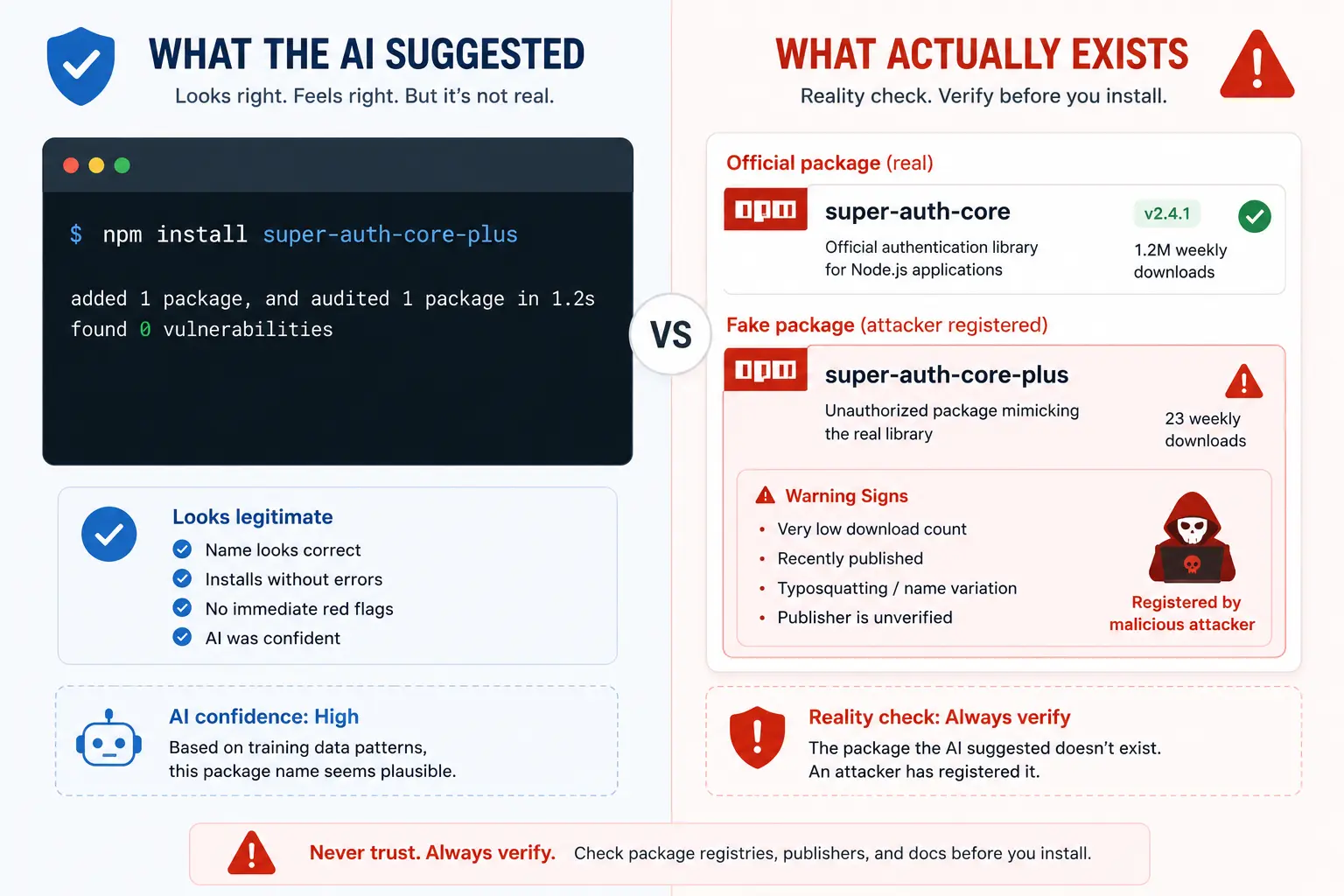
Phantom packages and slopsquatting
When an AI assistant recommends a package that does not exist, it creates an opening for an attack researchers call slopsquatting. The term, coined by Python Software Foundation developer in residence Seth Larson, describes what happens when an attacker registers the exact non-existent package name a model tends to suggest, then waits for a developer, or an autonomous coding agent, to install it. Documented cases include a hallucinated package name that pulled more than 30,000 downloads in three months after a researcher registered it purely to prove the risk was real (AI hallucinations in software development).
This is not a one-off curiosity. Research from Socket found that 43 percent of hallucinated package names reappear every single time a prompt is rerun, and 58 percent show up more than once across ten runs. That consistency is what makes the attack scalable. An attacker does not need to guess at random; they just watch what models commonly invent and register those exact names first.
Phantom methods and outdated APIs
The smaller, far more common version of this problem shows up almost every day: a method that does not exist on a class, a parameter that was renamed two major versions ago, or a config option borrowed from a completely different framework. It looks correct on screen and fails the moment it actually runs.
Confidently wrong logic
The most dangerous hallucinations are not the ones that crash loudly. They are the ones that run fine, return a plausible-looking result, and are simply wrong: an off-by-one error in a billing calculation, a missing edge case in a date conversion, an authorization check that looks complete but quietly skips one role.
Security vulnerabilities wearing a disguise
Plausible code is not the same thing as secure code. A hallucinated implementation of authentication, encryption, or input validation can look complete while skipping the one step that actually mattered, because the model is reproducing the shape of secure code rather than reasoning about your specific threat model. The OWASP Top 10 for LLM Applications lists misinformation, the broader category hallucinations fall under, as one of the most consistently underestimated risks in LLM-powered tools, precisely because the output looks finished.
How to fix and prevent AI hallucinations in your codebase
None of this means you should stop using AI coding tools. It means you need a few specific habits that turn AI output from a finished answer into a draft that gets verified.
- Verify every dependency before it touches your lockfile. Before running an install command an AI suggested, check that the package actually exists on the real registry, confirm it predates your project, and glance at the publisher and download history. A quick
npm view package-nameorpip index versions package-nametakes seconds and catches the fake ones instantly. - Run the code instead of trusting it. A hallucinated method call or wrong API signature usually fails the first time it executes. Treat “it compiled” and “it ran successfully against real inputs” as two completely different milestones.
- Ground the model in real documentation. Tools that use retrieval-augmented generation, or that give the assistant direct access to your current codebase and live docs instead of relying on memorized training data, hallucinate far less often because they have something real to check against.
- Ask narrower, more specific questions. Vague prompts invite the model to fill gaps with invented detail. Naming your exact framework version, your exact library, and your exact constraint gives it less room to guess.
- Use static analysis and type checking as a safety net. Linters, type checkers, and dependency scanners catch a large share of hallucinated references automatically, before a human ever has to notice.
- Pin versions and use lockfiles religiously. A locked, hash-verified dependency tree means a hallucinated package cannot quietly slide into a future install even if it gets suggested again.
- Treat AI output like a draft from a sharp but overconfident contractor. Smart, fast, occasionally wrong with total confidence. Read everything before it merges.
How to pause AI hallucinations before they ship
Catching a hallucination after it reaches production is expensive. Catching it before merge is nearly free. A few checkpoints make the difference:
- Require CI to actually install dependencies and run the full test suite, not just lint, before any AI-assisted pull request can be merged.
- Keep autonomous coding agents off an allowlist for package installation. If an agent wants to add a new dependency, a human approves the exact name first.
- Add a one-line checklist item to code review: “Does this PR introduce any new package, API call, or config flag, and has someone verified it actually exists?”
- Log which parts of a codebase were AI-generated so reviewers know where to apply extra scrutiny.
None of this slows a team down nearly as much as a 2 a.m. incident caused by a hallucinated dependency that nobody checked.
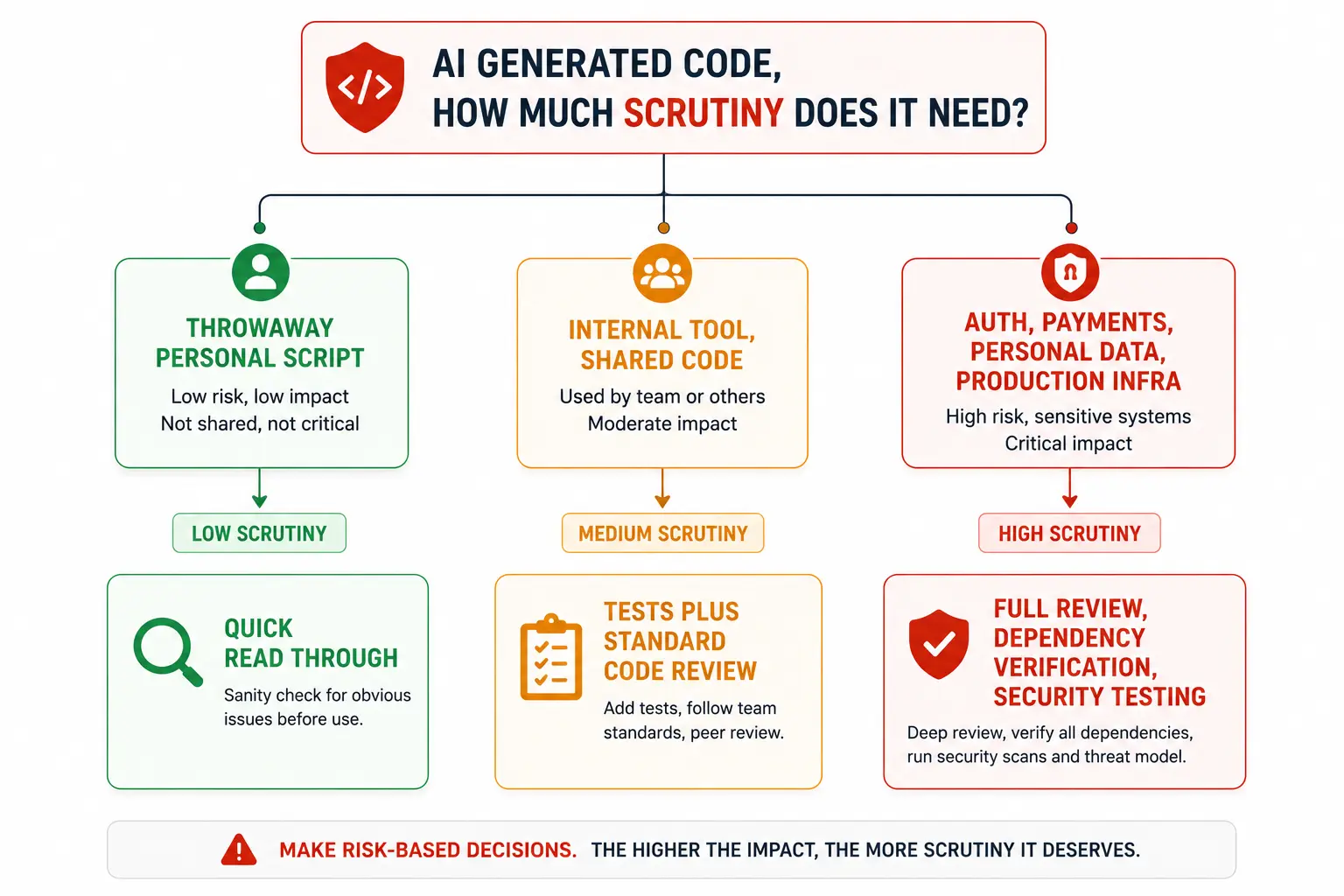
A simple decision tree for trusting AI-generated code
Not every line of AI-generated code deserves the same level of scrutiny, and pretending otherwise just trains people to skip review entirely. A practical mental model looks like this: a throwaway script you run once on your own machine gets a quick read-through. An internal tool that other people will use gets tests and a real code review. Anything touching authentication, payments, personal data, or production infrastructure gets full review, dependency verification, and security testing, no exceptions, regardless of how confident the AI sounded while writing it.
Quick reference: AI hallucination risks and fixes
| Risk | What it looks like | Fix |
|---|---|---|
| Hallucinated package (slopsquatting target) | Plausible install command for a package that does not exist | Verify on the real registry before installing, pin and lock versions |
| Phantom method or API | Code that looks right but throws at runtime | Run the code against real inputs, check official docs |
| Confidently wrong logic | Code that runs fine but produces incorrect results | Unit tests with real edge cases, not just happy path tests |
| Disguised security gap | Auth or validation code that looks complete | Security-focused review, threat modelling, never assume “looks done” means “is done” |
| Outdated API usage | Code matching an older version of a framework | Ground the assistant in current docs, specify exact versions in prompts |
Mistakes that make AI hallucinations worse
- Trusting confident tone as a signal of correctness. AI models sound exactly as sure when they are wrong as when they are right.
- Letting an autonomous agent install packages with no human checkpoint in the loop.
- Skipping tests because the code “looks clean.”
- Copy-pasting an entire AI-generated block without reading every import and every function call inside it.
- Assuming a hallucination is rare. Independent research puts package hallucination rates at roughly one in five suggestions across many models, so it is closer to routine than rare.
- Reviewing AI-generated code less carefully than human-written code, when it actually deserves more scrutiny, not less.
Wrapping up
AI hallucinations in software development are not a sign that AI coding tools are broken or not worth using. They are a predictable side effect of how these models work: predicting plausible text, not verifying facts against reality. Once you understand that, the fix stops feeling like a mystery and starts feeling like an ordinary engineering discipline. Verify dependencies. Run the code. Ground the model in real documentation. Review AI-generated code with the same rigor, or more, that you would apply to a contractor you just met.
Do that consistently, and you get to keep the genuine speed benefits of AI-assisted development without inheriting its biggest hidden cost. For deeper reading, the OWASP Top 10 for LLM Applications and Socket’s research on slopsquatting are both worth bookmarking the next time you wonder whether that AI-suggested package is actually real.