
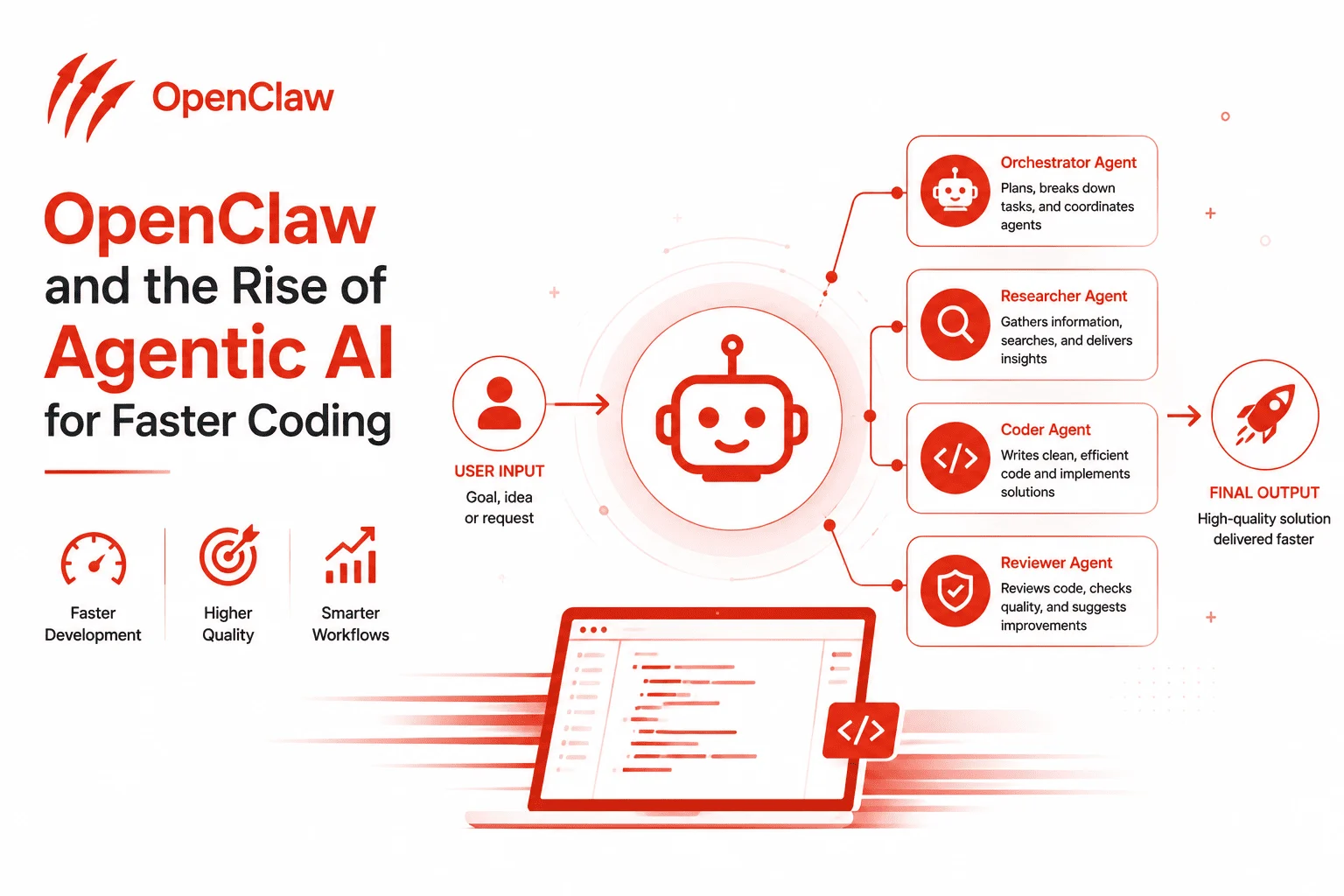
I thought AI coding tools were already “good enough” until OpenClaw changed the workflow completely
I honestly reached a point where every new AI coding tool started feeling the same.
One model generated boilerplate. Another fixed syntax errors. Another helped with documentation. But after the excitement faded, I still found myself doing the same exhausting work manually: planning architecture, debugging integrations, switching tabs endlessly, reviewing broken code, and cleaning up AI-generated messes.
That frustration is exactly why the rise of OpenClaw agentic AI caught my attention.
This was not another “autocomplete on steroids” product pretending to replace developers. OpenClaw represented something much bigger: autonomous AI agents capable of coordinating work together like a mini engineering team.
And the moment I understood how it worked, I realized something important.
The future of software development is not one giant AI model typing code faster.
The future is orchestrated AI agents collaborating together.
That changes everything.
What is OpenClaw agentic AI?
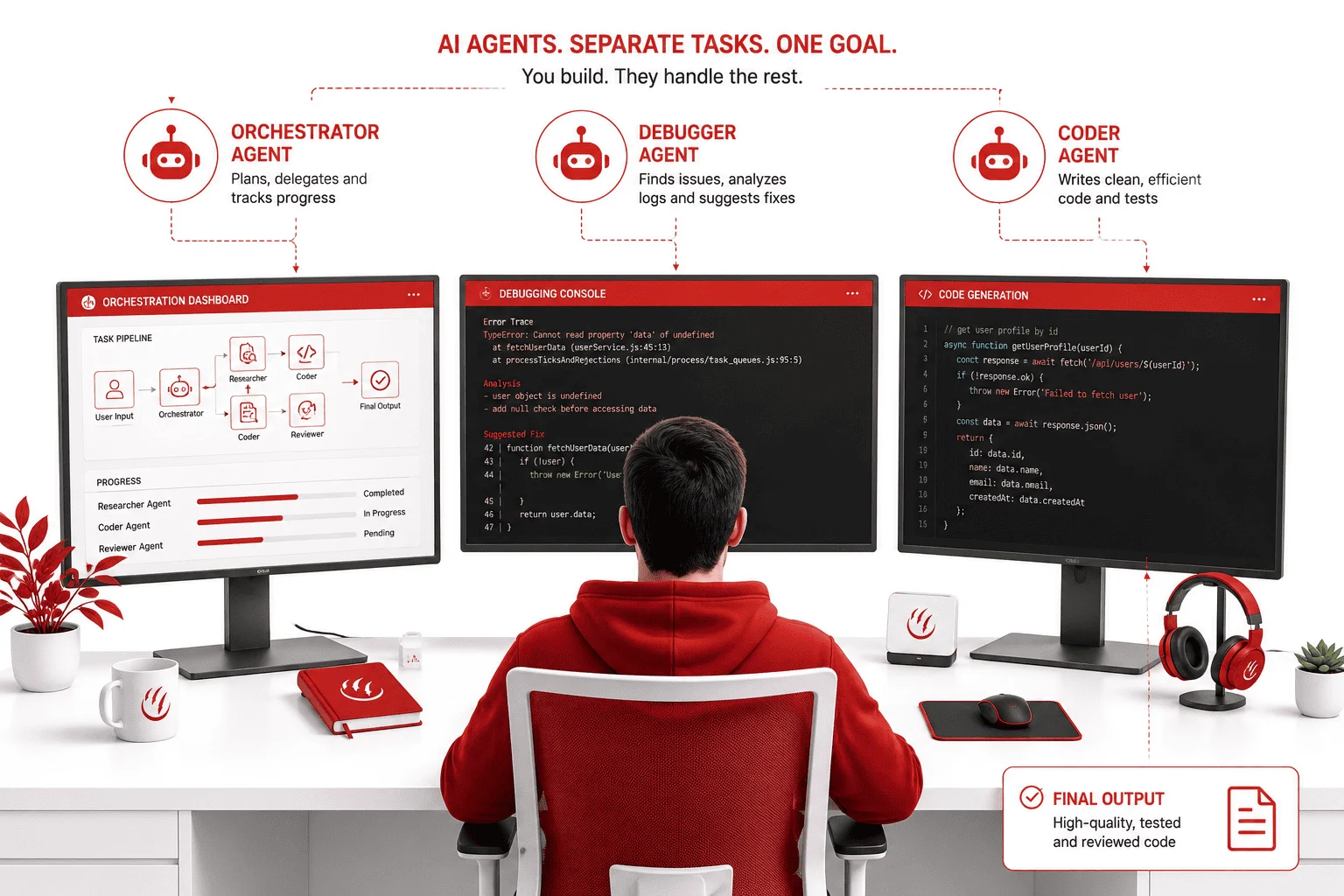
OpenClaw agentic AI is an autonomous multi-agent coding framework designed to handle complex software development workflows by assigning tasks across specialized AI agents.
Instead of asking one chatbot to do everything, OpenClaw breaks work into coordinated systems.
One agent researches documentation.
Another writes code.
Another reviews outputs.
Another validates tests.
Another handles orchestration.
This approach mirrors how real engineering teams operate.
That is the major shift happening inside modern AI development.
Traditional AI assistants are reactive. Agentic AI systems are proactive.
OpenClaw belongs to the growing category of AI systems focused on autonomous execution rather than simple response generation.
You can think of it as moving from:
- AI as a helper → toward → AI as an operator
This architecture is heavily inspired by the rapid growth of autonomous software engineering frameworks, multi-agent orchestration systems, and MCP-based tooling.
Official references for understanding modern agentic systems:
Why OpenClaw exists in the first place
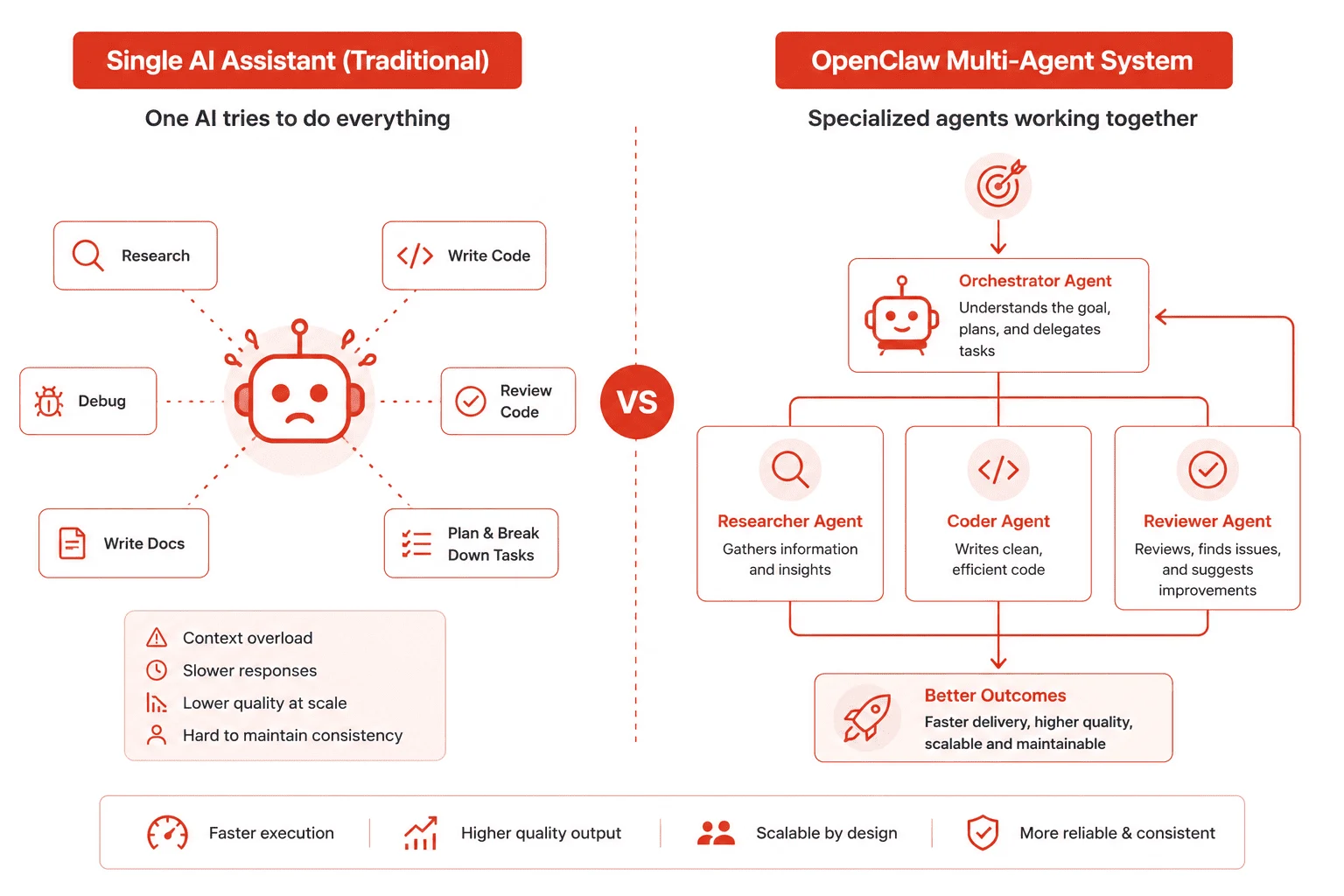
The current AI coding workflow breaks at scale.
That is the real issue nobody talks about enough.
Generating a small React component with AI is easy.
Maintaining a production application with thousands of files, APIs, deployment pipelines, authentication layers, testing systems, and infrastructure logic is completely different.
Single-model workflows struggle because:
- Context windows become overloaded
- Reasoning degrades over time
- Debugging loops become repetitive
- Models lose architectural consistency
- Long-term planning becomes unreliable
- One failed task breaks the entire chain
OpenClaw attempts to solve this by distributing responsibility across agents.
That is the key difference.
Instead of one overloaded AI trying to “remember everything,” each agent focuses on a narrow role.
The result is significantly faster execution and cleaner workflows.
How OpenClaw agentic AI actually works
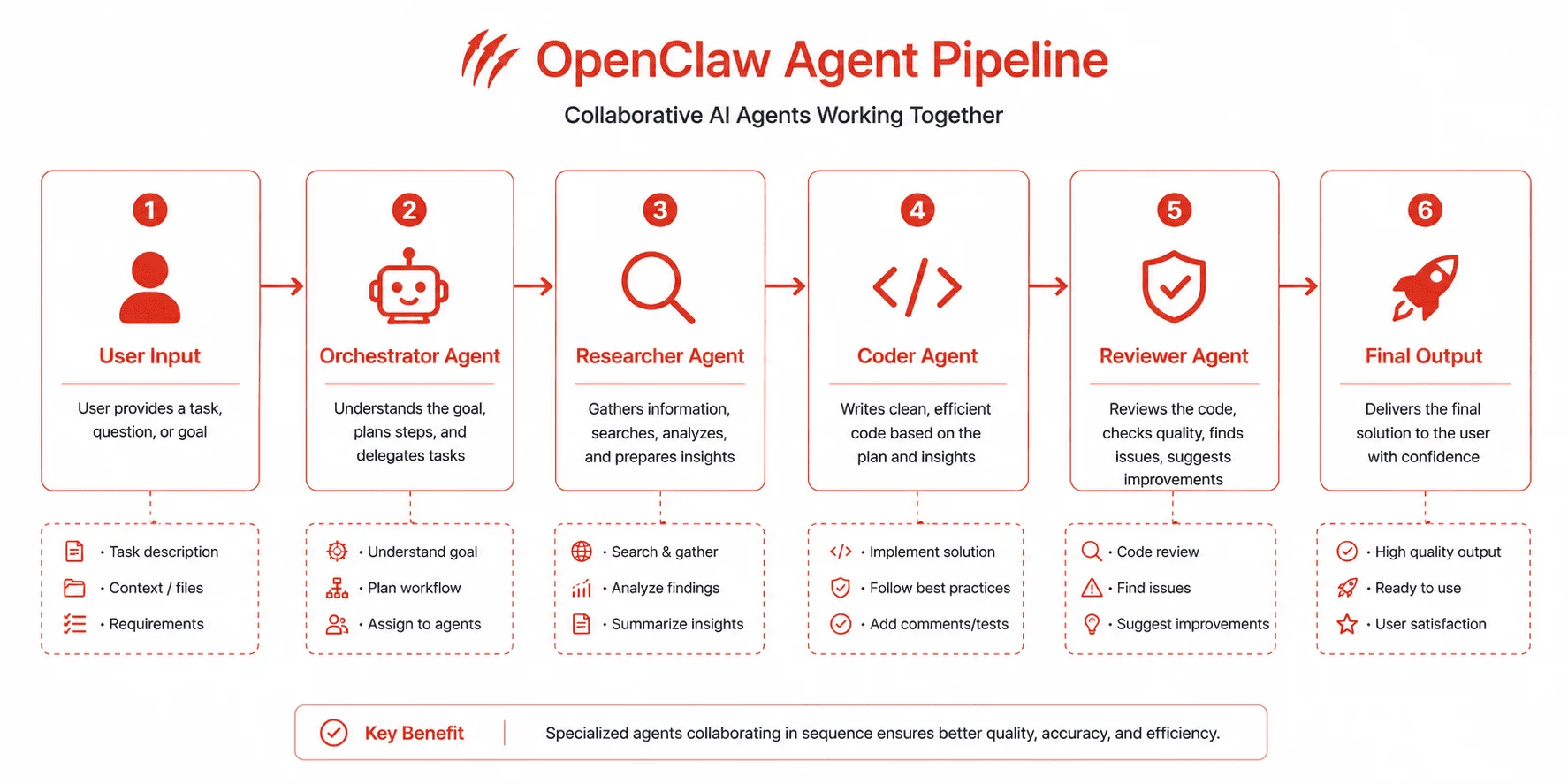
OpenClaw operates through orchestrated AI pipelines.
The workflow usually follows a structured sequence.
1. Orchestrator agent receives the goal
The orchestrator acts like a technical lead.
It breaks large requests into smaller executable tasks.
For example:
Build a SaaS dashboard with:
- Authentication
- Stripe billing
- Analytics charts
- Admin panel
- API integrations
Instead of generating random code immediately, the orchestrator plans execution.
2. Researcher agent gathers context
This agent scans documentation, APIs, dependencies, repositories, and architectural requirements.
It prevents hallucinated implementations.
That alone solves a massive pain point in AI coding.
3. Coder agent executes implementation
The coding agent focuses only on generating working logic.
Because context is narrowed, code quality improves significantly.
4. Reviewer agent validates outputs
This step is extremely important.
The reviewer checks:
- Code consistency
- Security issues
- Performance bottlenecks
- Missing imports
- Logic conflicts
- Testing failures
5. Feedback loop continues automatically
If something breaks, the workflow loops back automatically.
The developer becomes more of a supervisor than a manual operator.
That is where the productivity gains start becoming very real.
Why developers are suddenly paying attention to agentic AI
Because the speed difference is becoming impossible to ignore.
I tested several traditional AI workflows before diving deeper into multi-agent systems.
The biggest bottleneck was never code generation.
The real bottleneck was coordination.
Humans waste enormous time moving information between systems:
- Copying logs
- Reading docs
- Updating prompts
- Reviewing outputs
- Re-running fixes
- Maintaining context
Agentic AI removes a large portion of that operational overhead.
Instead of manually guiding every step, developers define objectives.
The agents handle execution.
This is why frameworks like OpenClaw are becoming important.
They are not just “better chatbots.”
They are workflow automation systems for engineering itself.
The biggest problems with current AI coding systems
Despite the hype, most AI coding assistants still struggle with reliability.
Problem #1 — Context collapse
Large projects overwhelm single-model workflows.
Once context becomes massive, output quality degrades.
Problem #2 — Endless debugging loops
You fix one issue and create three more.
Every developer using AI coding tools has experienced this frustration.
Problem #3 — Weak architectural planning
Most AI systems generate local solutions instead of system-wide thinking.
Problem #4 — No persistent reasoning
Traditional assistants forget decisions quickly.
Agentic systems attempt to maintain continuity.
Problem #5 — Human bottlenecks
The developer still acts as project manager, QA tester, architect, and debugger simultaneously.
That does not scale.
How OpenClaw improves coding speed in real projects
The biggest productivity gains appear in medium-to-large development environments.
Here is where OpenClaw-style workflows become powerful.
Rapid feature development
Instead of sequential work:
- Research docs
- Write logic
- Test manually
- Review outputs
- Fix errors
Multiple agents execute in parallel.
That dramatically reduces iteration cycles.
Automated debugging
Reviewer agents can analyze stack traces automatically.
That removes repetitive debugging tasks developers hate.
Architecture consistency
Orchestrator agents maintain higher-level planning across files and systems.
This reduces random AI-generated inconsistencies.
Documentation synchronization
Agentic systems can update documentation while code changes happen.
That alone saves massive maintenance time.
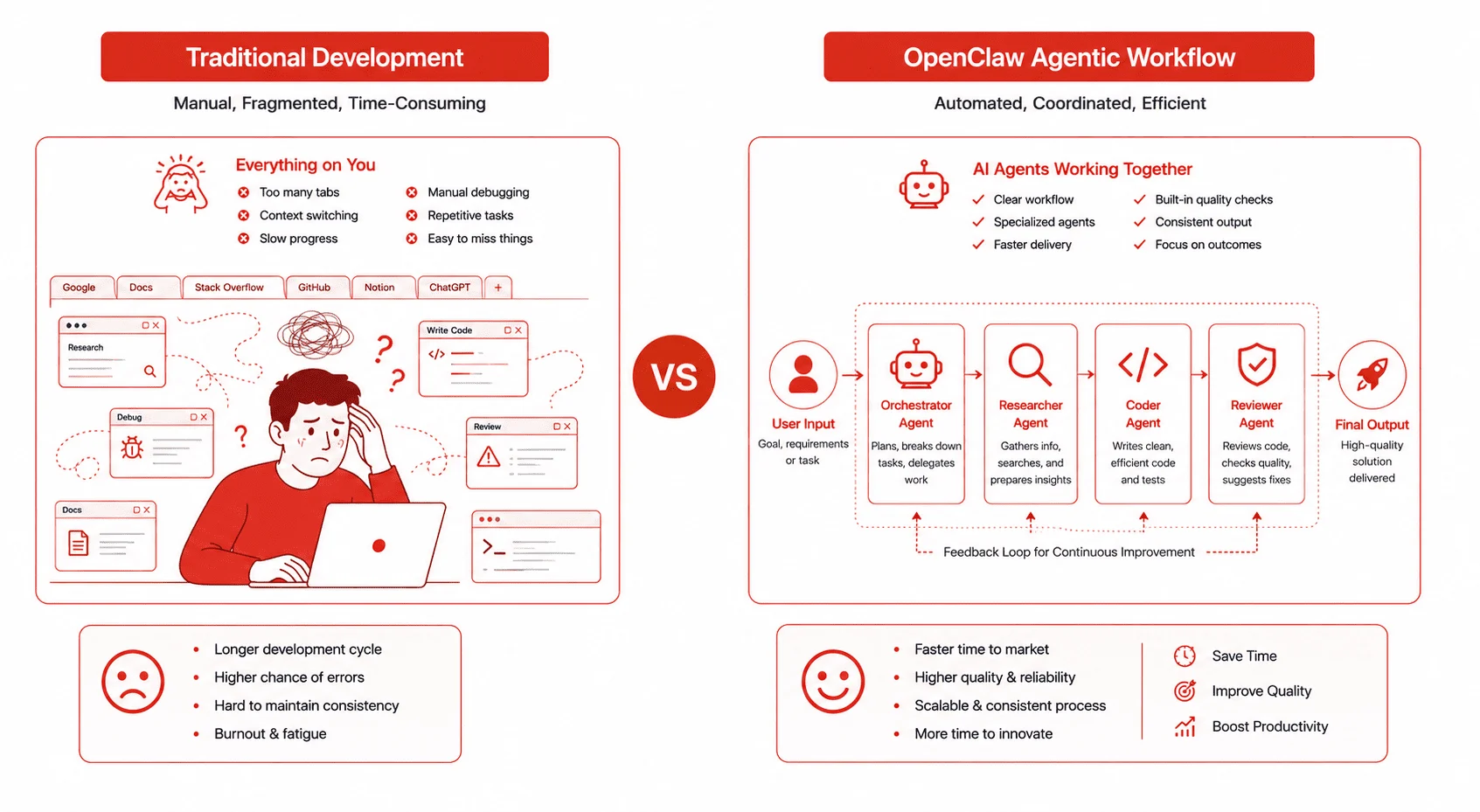
Step-by-step example of an OpenClaw-style workflow
Here is a simplified example.
Step 1 — Define the goal
Create a Next.js SaaS application with:
- User authentication
- Stripe subscriptions
- AI dashboard
- PostgreSQL database
- Admin analytics
Step 2 — Orchestrator creates task map
- Backend setup
- Database schema
- Authentication flow
- Billing integration
- Frontend dashboard
- Analytics module
- Testing pipeline
Step 3 — Specialized agents begin execution
- Researcher agent reads Stripe documentation
- Coder agent builds subscription logic
- Reviewer validates webhook handling
- Testing agent runs integration checks
Step 4 — Automatic correction loops happen
If billing tests fail, the reviewer agent reports issues back into the pipeline.
The coder agent updates implementation automatically.
Step 5 — Human supervises instead of micromanaging
This is the major productivity shift.
The developer focuses on product decisions instead of repetitive execution.
Can OpenClaw replace developers?
No.
But it absolutely changes what developers spend time doing.
The industry keeps framing AI as “developer replacement,” but the reality looks very different.
Agentic AI removes operational friction.
It accelerates implementation.
It automates repetitive engineering tasks.
But product thinking, architecture decisions, UX understanding, business strategy, and critical reasoning still require humans.
The best developers will likely become AI workflow directors.
That role is becoming more valuable, not less.
Developers who understand orchestration, automation pipelines, and AI coordination will move faster than teams still relying on manual workflows.
How MCP and agentic AI connect together
The rise of MCP is one reason systems like OpenClaw are becoming more powerful.
Model Context Protocol (MCP) standardizes how AI systems interact with tools, databases, APIs, terminals, and external environments.
This means agents can:
- Read repositories
- Access documentation
- Use terminals
- Interact with APIs
- Run scripts
- Coordinate workflows
Without MCP-style integrations, agentic systems remain isolated.
With MCP, they become operational.
That distinction matters enormously.
Learn more here:
Real-world workflow mindset developers need now
The smartest shift developers can make right now is changing from “prompt engineering” toward “workflow engineering.”
That is the real evolution happening.
| Old AI Workflow | Agentic AI Workflow |
|---|---|
| One chatbot | Multiple specialized agents |
| Manual debugging | Automated review loops |
| Prompt repetition | Persistent orchestration |
| Single-task execution | Parallel workflows |
| Reactive assistance | Autonomous execution |
That table explains the transition happening across the AI development industry right now.
Quick reference cheat sheet for OpenClaw agentic AI
| Concept | Purpose | Benefit |
|---|---|---|
| Orchestrator Agent | Task planning | Better coordination |
| Researcher Agent | Documentation analysis | Fewer hallucinations |
| Coder Agent | Implementation | Faster development |
| Reviewer Agent | Validation/testing | Cleaner code quality |
| MCP Integration | Tool communication | Real-world execution |
| Feedback Loops | Automatic correction | Reduced manual debugging |
Mistakes developers should avoid with agentic AI
Using AI without architecture planning
AI agents still require strong system design.
Bad architecture becomes amplified faster.
Blindly trusting outputs
Autonomous does not mean perfect.
Human review still matters.
Overcomplicating workflows
Too many agents create unnecessary orchestration overhead.
Keep workflows practical.
Ignoring security validation
AI-generated code can still introduce vulnerabilities.
Security review pipelines remain essential.
Treating AI as magic
The best developers understand limitations.
That realism creates better systems.
Where OpenClaw and agentic AI are heading next
This is still early.
But the direction is becoming very clear.
Future development environments will likely include:
- Persistent autonomous coding agents
- Self-healing debugging systems
- AI infrastructure orchestration
- Automatic documentation generation
- Cross-agent reasoning pipelines
- Real-time production monitoring agents
And honestly, after watching how quickly this space evolved over the past year, I do not think software engineering workflows will ever fully return to manual-only development.
The speed difference is already too large.
The productivity gains are already visible.
The tooling is improving every month.
OpenClaw represents one piece of that broader transformation.
The real story is not just OpenClaw itself.
The real story is the arrival of agentic software engineering.
Final thoughts on OpenClaw agentic AI
I started exploring OpenClaw because I was tired of repetitive AI coding workflows that still required constant babysitting.
What surprised me most was not the code generation speed.
It was the coordination.
That is the layer most people underestimate.
Once AI systems begin coordinating tasks autonomously, software development starts feeling fundamentally different.
Developers stop acting like typing machines.
They start acting like orchestrators.
That transition is already happening.
And developers who learn these workflows early will likely have a major advantage over the next few years.
If you are exploring AI-powered software engineering seriously, agentic workflows are worth paying attention to now — not later.
The future of coding is not just faster autocomplete.
It is an autonomous collaboration between intelligent systems.
And honestly, that future arrived much faster than I expected.
Want to stay ahead in AI coding workflows? Start experimenting with multi-agent systems, orchestration pipelines, and MCP-based tooling now. The developers learning agentic AI today will likely shape the engineering workflows everyone else uses tomorrow.