
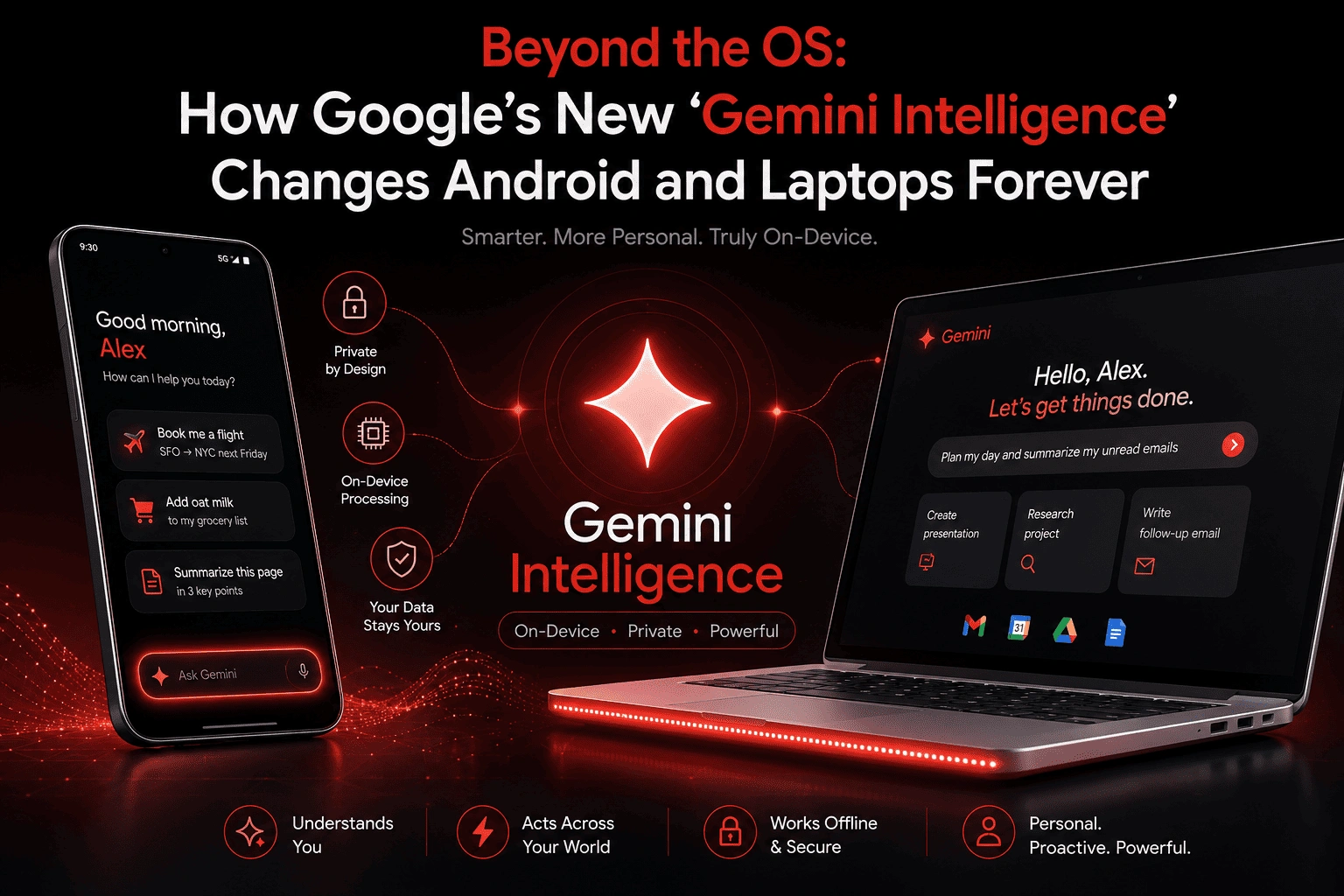
What is Gemini Intelligence? Announced at Google’s May 2026 Android Show, Gemini Intelligence is a system-wide agentic AI layer built natively into Android and the new Googlebook laptop category. Unlike traditional chatbots, Gemini Intelligence operates proactively across third-party applications, tracks multi-app on-screen context, and uses on-device NPUs to execute complex, real-world task automations autonomously.
The global tech ecosystem just crossed a critical milestone. For years, artificial intelligence felt like an isolated destination—a tab open to ChatGPT, a dedicated app workspace, or an interactive text box. However, Google’s latest presentations have systematically destroyed the “prompt-and-chat” era. With the rollout of Gemini Intelligence and a completely new hardware class termed the Googlebook laptop category, Google is successfully transforming operating systems into proactive, autonomous machine networks.
For business owners, creators, and marketers tracking the aggressive AI Overview CTR Drop, this update alters web discovery paths. Devices are no longer passive gateways to websites; they are smart agentic filters running on Android 17 architecture. Here is everything you need to know about Google’s paradigm shift.
From Operating System to Agentic Ecosystem: Inside Android 17
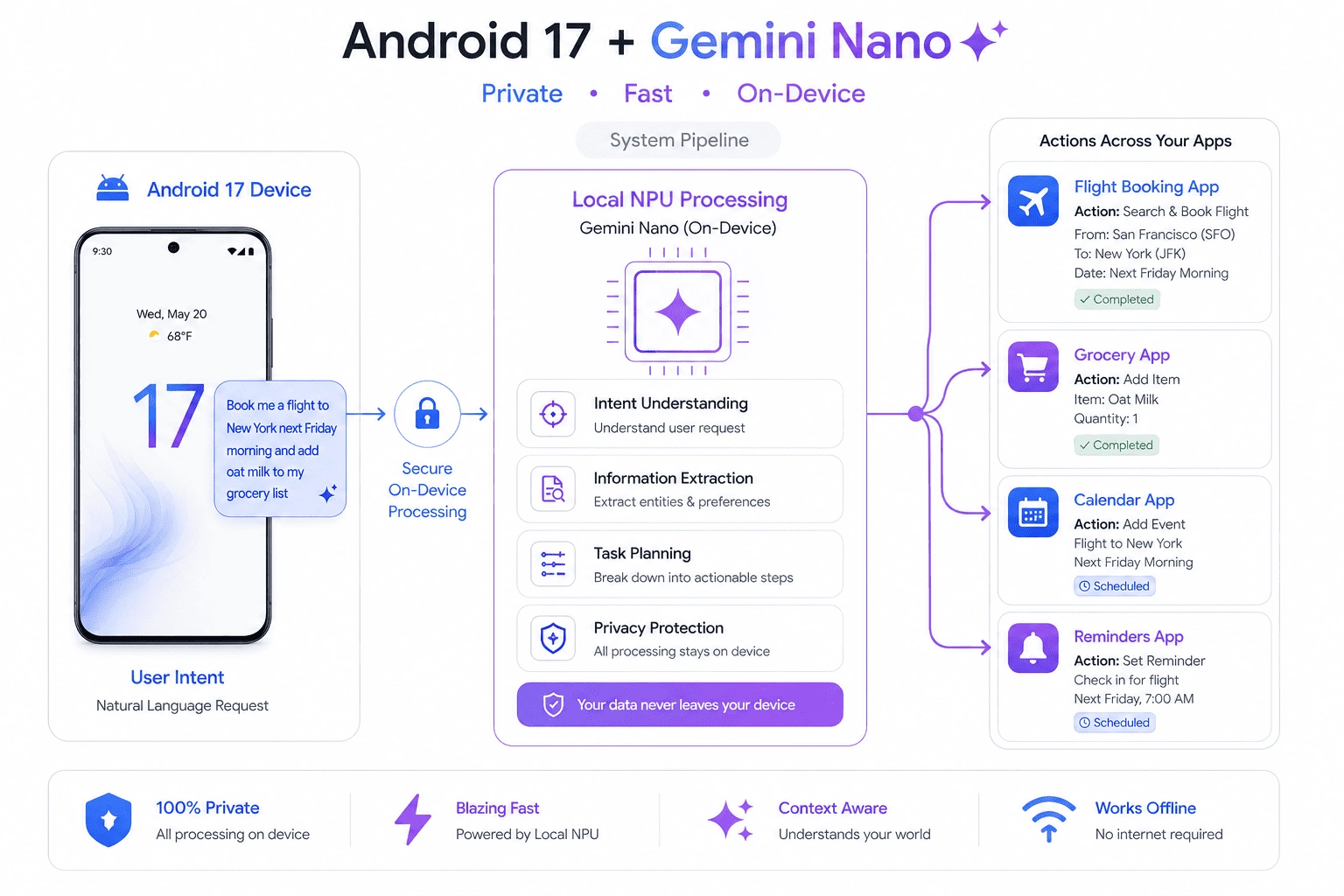
The core philosophy powering Gemini Intelligence Android integration is deep contextual automation. Historically, executing tasks on a smartphone required heavy manual intervention: extracting text from an email, flipping to a note pad, launching a third-party app, pasting the content, and clicking buy. Gemini Intelligence works invisibly underneath the graphical user interface to eliminate this friction entirely.
During live tracking demonstrations, Google showcased features running locally on the Samsung Galaxy S26 and Google Pixel 10 devices. Instead of building siloed features, the system-wide AI actively operates across various applications via complex agentic workflows.
1. Cross-App Task Automation
Gemini can now securely look across your apps to process contextual chains. For instance, you can point your camera at a physical travel brochure in a storefront or hotel lobby and say: “Find a tour identical to this on Expedia for a party of six.” In the background, Gemini reads the image context, maps out the itinerary options, processes the logistics via third-party APIs, and leaves you on the final checkout screen while keeping you updated via live progress notifications.
2. “Create My Widget” Generative UI
Static application dashboards are giving way to temporary, tailored user interfaces. Using the new “Create My Widget” capability, users describe their exact data tracking needs using natural language sentences. A prompt such as “Build me a tracker displaying my daily cycling mileage, local wind speed, and rain forecasts” will force Gemini to compile real-time web scripts, query Google Calendar, and generate an active, beautifully rendered widget right on your home screen.
3. Gboard Rambler Tool
Voice dictation has fundamentally changed. The new built-in Gboard engine, “Rambler”, eliminates natural speech imperfections. If you record a frantic voice message containing pauses, self-corrections, or filler phrasing like “um” and “uh”, the localized model completely restructures the message into polished, concise textual arrays before sending.
Enter Googlebook: The Demise of the Chromebook Era
Google didn’t stop at mobile screens. After fifteen years of pushing ChromeOS as an affordable, cloud-dependent operating system, Google announced its premium replacement: the Googlebook laptop category. This marks a radical technological shift from a lightweight web browser machine to an AI-native workspace running on a new Android-based operating system architecture (codenamed Aluminium).
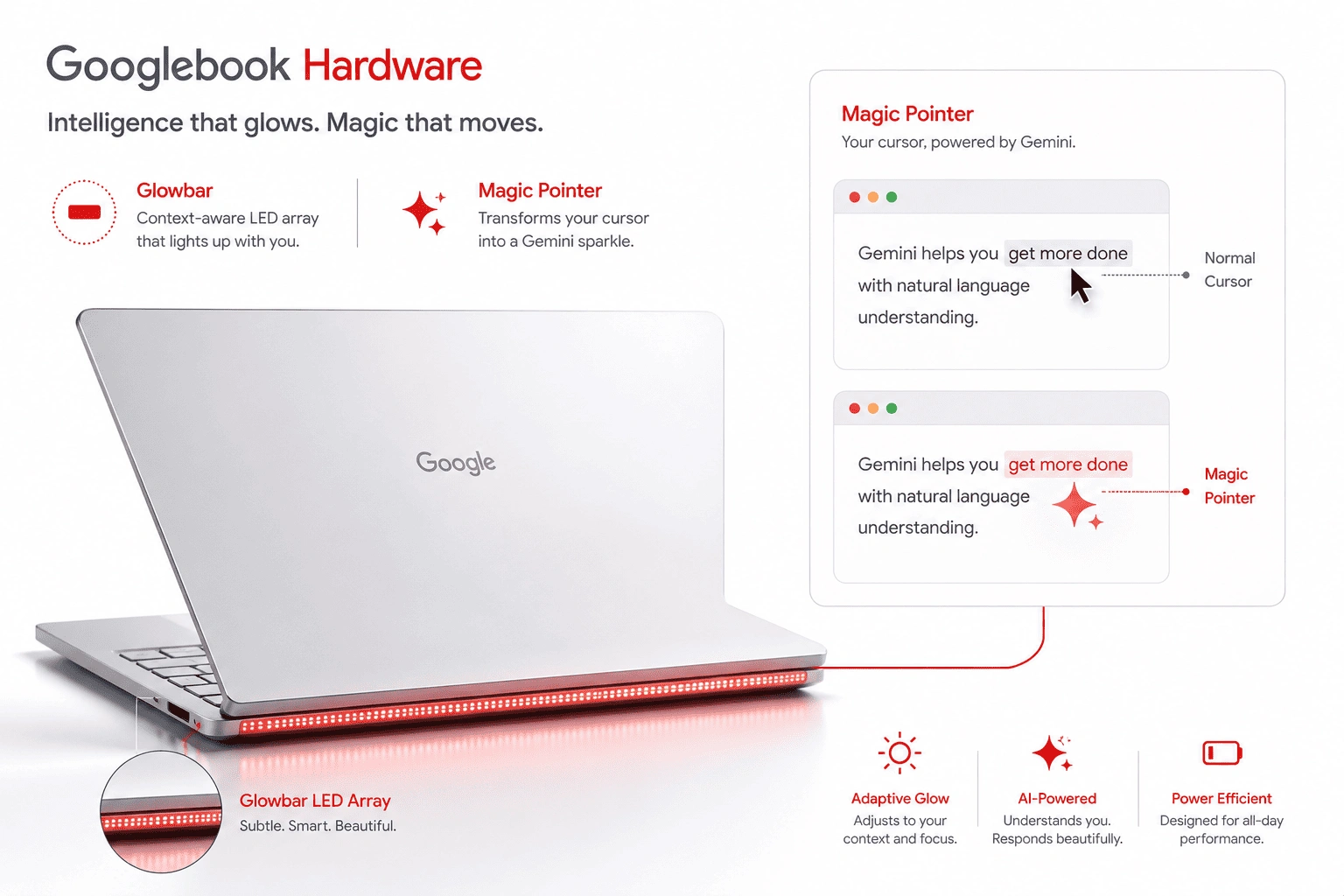
Unlike old software iterations, a Googlebook runs Android apps natively without relying on laggy emulation layers. Hardware heavyweights—including Acer, ASUS, Dell, HP, and Lenovo—are launching premium, hardware-certified Googlebooks built with integrated “Glowbars” (physical AI notification indicators) and powerful local Neural Processing Units (NPUs).
The DeepMind “Magic Pointer”
The standout utility within the Googlebook architecture is the **Magic Pointer**, an AI-infused cursor tracking engine co-developed with Google DeepMind. By simply wiggling your mouse pointer over any visual asset on your display, the built-in Gemini model awakens. The cursor reads what you are actively viewing and creates intelligent execution prompts. If your pointer is hovering over two scattered product images, it can seamlessly combine them; if it rests over a specific schedule within an open browser window, it cross-references your personal workspace data to draft calendar holds instantly.
The Structural Grid: Old Tech Architecture vs. 2026 AI Architecture
To truly understand how fast consumer tech is shifting, we can look at how user interactions and system layers have evolved into the current 2026 standards:
| Operational Vector | Legacy Mobile / Laptop Model | Gemini Intelligence & Googlebook Model |
|---|---|---|
| User Workflows | Manual copy-pasting across static, isolated apps. | Autonomous multi-step background automation. |
| User Interface (UI) | Fixed grids, templates, and pre-packaged designs. | Generative UI constructed on-demand via prompts. |
| Processing Surface | Heavy reliance on cloud servers and persistent internet. | Localized NPU calculations featuring privacy boundaries. |
| Navigation Inputs | Keyboard typing, manual touch gestures, and clicks. | Natural speech, visual context, and Magic Pointer tracks. |
Surviving the AI Overview CTR Drop: Strategic Guide for Businesses
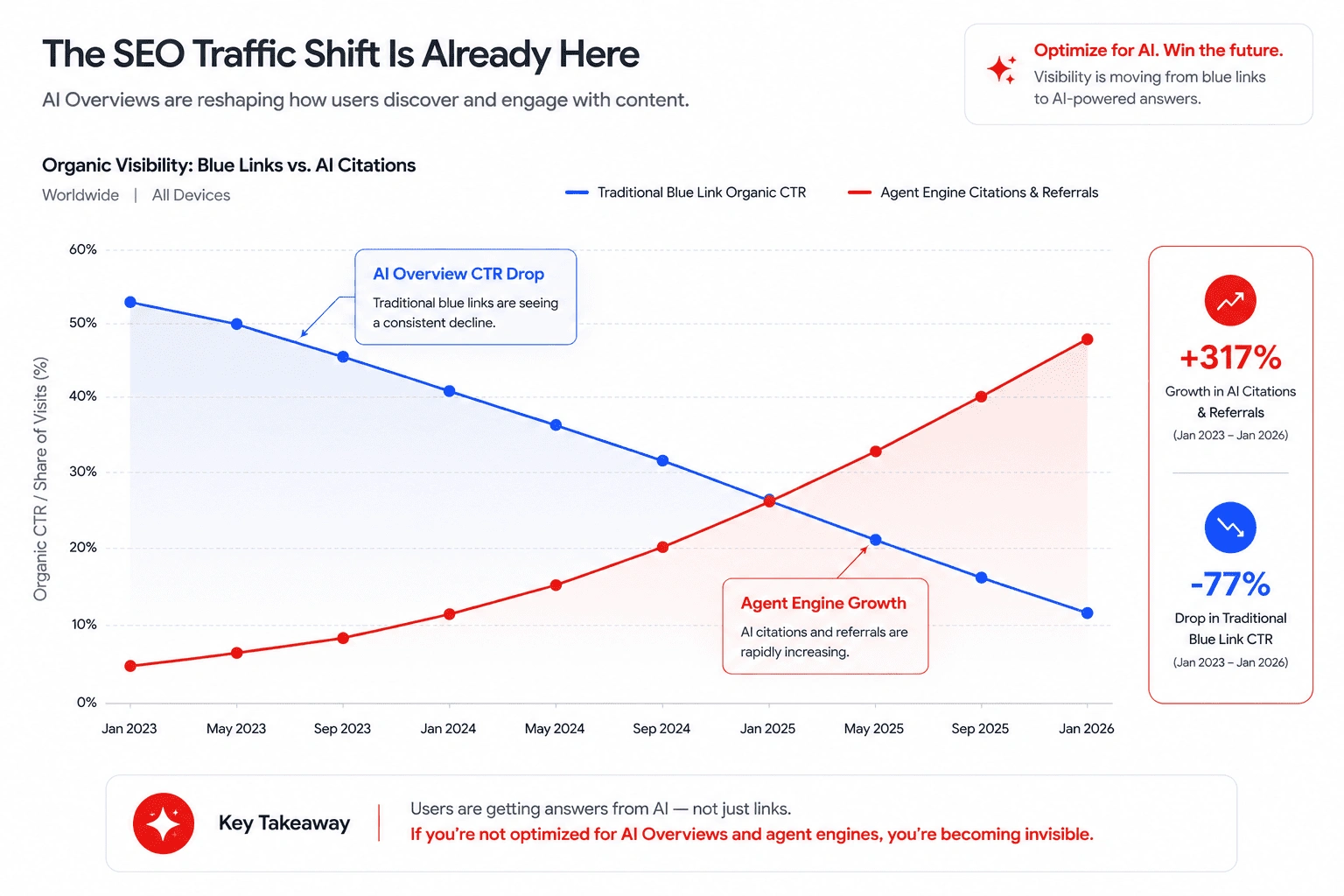
While consumer convenience spikes to an all-time high, business owners face an impending wall. Google’s newly expanded **Chrome Auto Browse** feature allows Gemini to browse search results, fill out checkouts, and summarize documentation directly within browser panels without a human user clicking your page.
This dynamic has caused a pronounced AI Overview CTR Drop for brands reliant on standard blog clicks. If local smart assistants extract and solve problems inside the phone’s native skin, standard search engine visibility must be reinvented. To make your brand visible in an agent-first marketplace, update your digital strategies immediately using these guidelines:
- Prioritize Structured API Data: Ensure your inventory systems, booking apps, and local service dates feature immaculate schema markups. If Gemini Intelligence is trying to buy tickets or order food, its underlying script reads organized backend structures, not clever sales copywriting.
- Target the Information Gain Score: Google’s search bots are systematically penalizing derivative content. To be cited within Chrome’s data summaries, your material must include proprietary data, distinct human case studies, or specialized testing metrics that an LLM cannot guess on its own.
- Adopt Entity-Centric Formatting: Start your articles with concise summaries containing explicitly defined subjects. By organizing your definitions right at the top of headers, you clear the parsing requirements for Google’s indexing engines to scrape your pages as authoritative answers.
Conclusion: The Future of Consumer Tech
Google’s move from a tool you talk to into an enterprise-wide “intelligence layer” confirms that the chatbot era was simply an intermediary step. As Gemini Intelligence Android updates push out to global audiences and hardware partners line up to launch the first consumer Googlebook laptop category models this upcoming fall, the internet will continue to shift toward background delegation.
To thrive in this new landscape, businesses can no longer build content paths solely for human clicks—they must architect infrastructure that autonomous AI systems can trust, digest, and utilize instantly.