
The digital advertising landscape just experienced a seismic shift, and it happened with almost zero fanfare.
If you have been keeping an eye on the intersection of Artificial Intelligence and performance marketing, the question wasn’t if OpenAI would monetize its massive user base through direct advertising, but how fast. The answer is here: OpenAI has officially rolled out its beta self-serve Ads Manager for ChatGPT Ads, fundamentally transforming the platform from a conversational AI tool into a fully functional ad network.
For years, OpenAI CEO Sam Altman expressed hesitation about running ads inside ChatGPT. However, with massive operational costs, a projected $14 billion loss in 2026, and a highly anticipated IPO on the horizon, the push for aggressive revenue diversification became unavoidable. What started as a highly restricted, invite-only pilot for enterprise brands in February 2026 has quietly evolved into an open, self-serve dashboard at ads.openai.com.
Whether you are an in-house performance marketer, an agency media buyer, or a small business owner, this update changes the rules of conversational commerce. Let’s break down exactly what the ChatGPT Ads Manager is, how it works, and why this structural shift mirrors the early days of Google AdWords and Meta Ads.
What is the OpenAI Self-Serve Ads Manager?
The OpenAI Ads Manager Beta is a self-serve advertising platform that allows businesses to create, launch, manage, and optimize native advertising campaigns directly inside ChatGPT.
Historically, entering the ChatGPT advertising pilot required a massive financial commitment. When the early tests launched, OpenAI demanded a minimum campaign spend between $200,000 and $250,000, filtering out everyone except Fortune 500 companies like Target, Ford, and Williams-Sonoma.
By dropping the self-serve platform, OpenAI has demolished that barrier to entry. The minimum entry threshold has dropped significantly down to $50,000, and for many self-serve accounts in the United States, it is expanding even further to eliminate fixed minimum spend restrictions entirely.
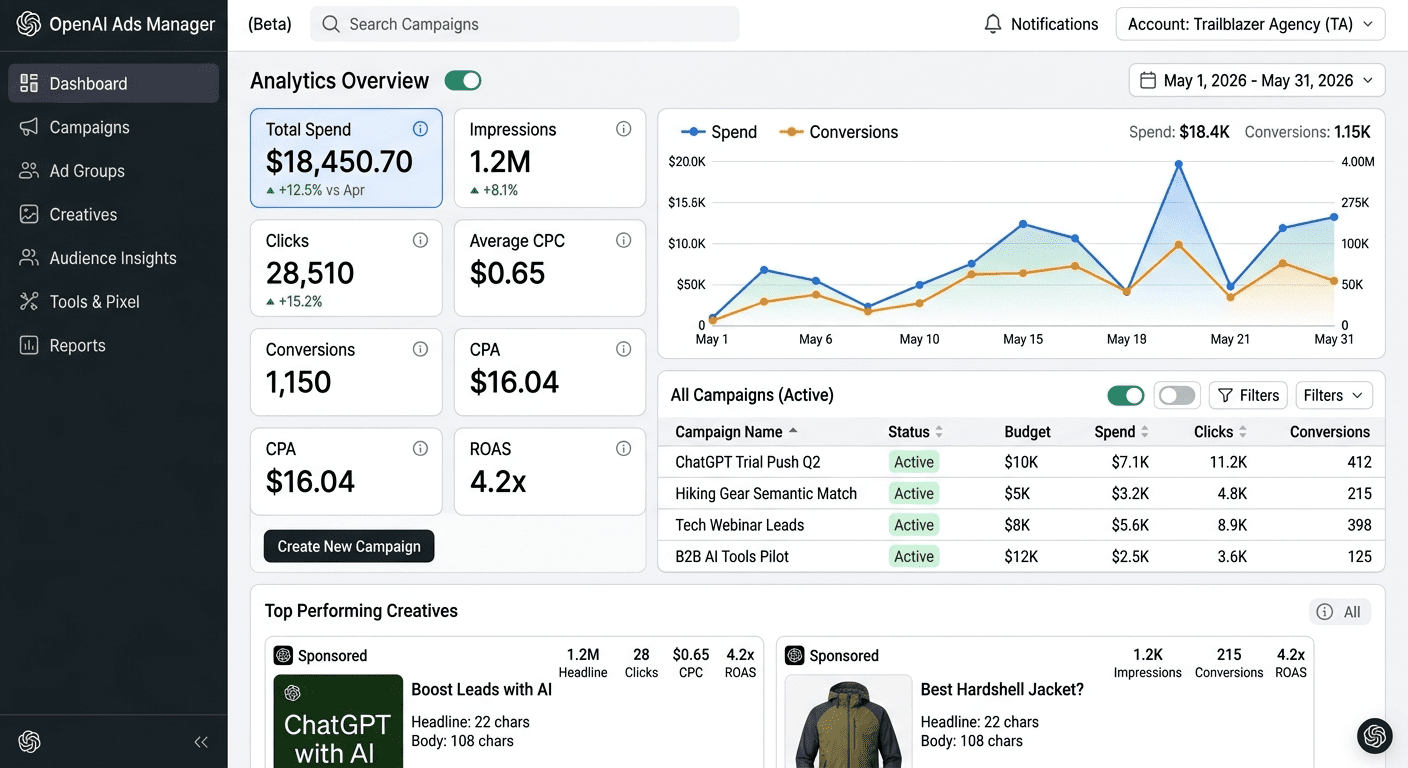
The platform is designed to look and feel intensely familiar to anyone who has run campaigns on Google Ads or Meta Ads Manager. It utilizes a traditional three-tier campaign architecture:
-
Campaign Level: Where you define your core marketing objectives, total budgets, and run dates.
-
Ad Group Level: Where you manage bidding strategies, pacing, and targeting parameters.
-
Ad Level: Where you upload your creative assets, headlines, and destination URLs.
How ChatGPT Ads Work: The Anatomy of a Conversational Placement
Unlike traditional programmatic display banners that disrupt the user experience, or social media ads that rely on passive scrolling feeds, ChatGPT ads are entirely native, contextual, and high-intent.
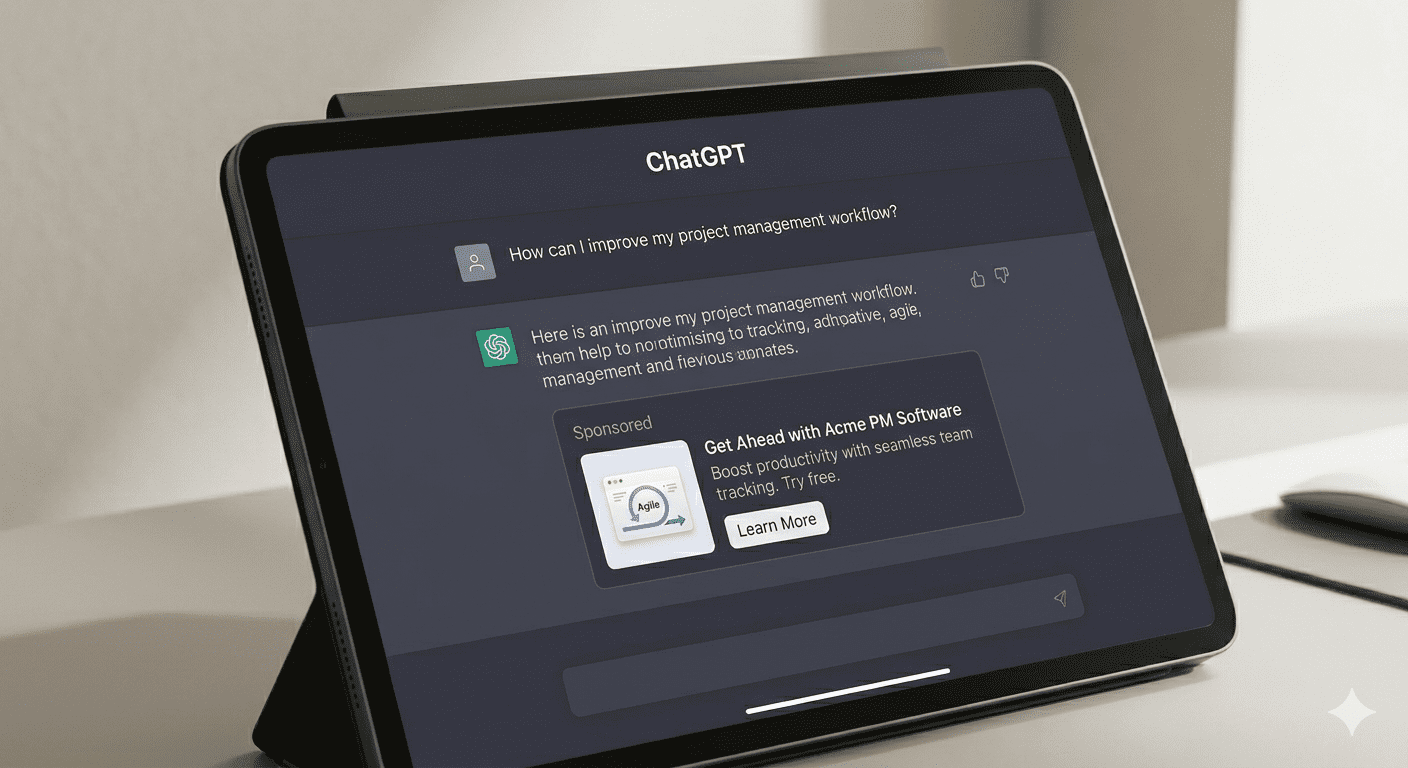
When an eligible user on the Free or “Go” tiers asks ChatGPT a question that demonstrates a clear purchasing or research intent, the AI generates its organic response as usual. Directly below or within the response, the platform injects a highly relevant “Sponsored” card.
The Creative Format
Currently, the ad formats allowed inside the dashboard are streamlined and highly structured to maintain a clean user interface. Every ad unit consists of three primary components:
-
A compelling, punchy Headline
-
A brief, text-based Description
-
An optional Square Image (Creative asset)
-
A clean outbound Destination URL
At this stage, video formats, carousel expansions, and interactive conversational ad variants are locked in development, though OpenAI’s tech partners like Smartly are actively testing interactive formats for future rollouts.
Semantic Targeting: Say Goodbye to Cookies, Say Hello to “Context Hints”
The most radical departure from traditional ad networks lies in how ChatGPT handles audience targeting.
As privacy regulations tighten and third-party cookies face total elimination, Meta and Google have struggled to maintain hyper-targeted user profiles. OpenAI is bypassing this problem entirely by focusing on semantic intent rather than historical user behavior.
Instead of targeting a user because they are a “25-34 year-old female interested in fitness,” the OpenAI Ads Manager introduces a feature called Context Hints.
What are Context Hints?
Context Hints allow advertisers to provide plain-language guidance directly to the AI model detailing exactly when an ad should appear. Marketers can type out descriptive sentences explaining the exact types of conversations or user queries that would make their product a perfect match. If you prefer traditional methods, the system also accepts standard lists of contextual keywords.
Currently, the only secondary targeting layer available is country-level geographic targeting. Because OpenAI relies completely on the real-time context of the live conversation, the user’s immediate mindset drives the ad delivery. Someone asking ChatGPT to “Compare the best lightweight hardshell jackets for a rainy hike in Oregon” is in an active, high-intent decision-making frame of mind. Delivering a sponsored card for an outdoor gear brand at that exact second yields a significantly higher conversion probability than a random banner on a blog or a sponsored post on a social feed.
Performance Marketing Evolution: Bidding on CPC and CPA
When the ad pilot first went live, OpenAI charged advertisers on a strict CPM (Cost Per Thousand Impressions) model, starting at a premium $60 CPM before settling closer to $25 to $30 in open transactions. While CPM is excellent for brand awareness, performance marketers demand measurable return on ad spend (ROAS).
Recognizing this, OpenAI fast-tracked performance-driven bidding models inside the self-serve portal:
-
Cost-Per-Click (CPC) Bidding: Advertisers can now bid directly on clicks, with early pilot benchmarks showing competitive bids landing between $3 and $5 per click depending on the product vertical. This allows performance teams to evaluate traffic quality using traditional multi-channel attribution frameworks.
-
Cost-Per-Action (CPA) Bidding: In an incredibly aggressive move to rival Google’s performance Max campaigns, OpenAI has started switching on CPA bidding for select beta accounts. This allows companies to pay only when a user executes a specific downstream action, such as submitting a lead form, signing up for a trial, or completing a purchase.
To fuel this performance ecosystem, OpenAI launched its native Conversions Pixel alongside an advanced Conversions API (CAPI). This infrastructure allows websites to pass secure, encrypted post-click conversion events back to the OpenAI Ads Manager to train its delivery algorithms.
The Core Features of OpenAI Ads Manager (At a Glance)
To help visualize how the platform stacks up against established ad networks, here is a breakdown of the infrastructure currently live or rolling out globally inside the beta portal:
| Platform Feature | Current Availability Status | Functional Mechanics |
| Self-Serve Dashboard | Live (Beta – U.S. Base) | Located at ads.openai.com; accessible by direct registration. |
| Campaign Hierarchy | Live | Standard 3-tier structure: Campaigns, Ad Groups, and Ads. |
| Bidding Options | Live (CPM & CPC) / Rolling Out (CPA) | Shifted from impression-only to click and conversion-based bidding. |
| Targeting Core | Live (Context Hints) | Plain-language semantic targeting based on real-time prompt intent. |
| Geo-Targeting | Live (Country-Level Only) | Restricts ad delivery to specific geographic regions. |
| Tracking Stack | Live (Pixel & Conversions API) | Measures downstream actions like leads, checkouts, and sign-ups. |
| Global Footprint | Expanding | Moving past U.S. bounds into the U.K., Japan, Brazil, Mexico, and South Korea. |
Balancing Monetization and User Trust: The Privacy Guardrails
Whenever a major tech company opens an ad platform, user privacy concerns immediately take center stage. This is doubly true for AI systems, where users routinely share highly sensitive personal, professional, or medical data during private chats.
To counteract potential backlash, OpenAI’s advertising solutions team, led by former Meta executive David Dugan and monetization head Asad Awan, has established rigid, non-negotiable data walls:
The Separation of Ad Tech and Core AI: Paid ad placements have absolutely zero bearing on how ChatGPT’s organic AI model operates, reasons, or extracts information. The core algorithm remains completely independent.
Furthermore, advertisers never receive raw conversation logs or personal user data. If your ad appears during a user’s session, your Ads Manager dashboard will only display rolled-up, heavily aggregated performance metrics (impressions, clicks, spend, and conversions). The precise phrasing of the user’s prompt remains completely anonymous.
Additionally, OpenAI is keeping category eligibility tightly constrained during the initial beta phase. Advertisers are currently limited to safe consumer verticals, including:
-
Consumer Packaged Goods (CPG)
-
Local Services & Hospitality
-
Travel and Leisure
-
Entertainment & Media
-
Digital Tools & Educational Products
Why Every Marketer Needs to Watch This Movie
The launch of a self-serve ad system is the exact load-bearing infrastructure that transformed Google, Meta, and Amazon from high-growth tech experiments into dominant global economic empires. OpenAI is executing this exact same playbook, but at three times the speed.
With over 900 million weekly users—more than 95% of whom utilize the ad-eligible free tier—the scale of inventory available inside ChatGPT is staggering. Within its first six weeks of deployment, the ad infrastructure quietly crossed an annualized revenue run rate of $100 million. Internal projections shared with investors indicate OpenAI is aiming for $2.5 billion in ad revenue by the end of the year, with a long-term north-star target of $102 billion by 2030.
As search behavior shifts away from traditional keyword engines and toward conversational answers, early adoption of ChatGPT Ads could provide a massive competitive advantage. Getting ahead of the curve means cheaper clicks, less competition, and a direct line to consumers at the exact moment they ask an AI for a solution.
If you are running digital campaigns, head over to ads.openai.com to secure your advertiser profile, install your tracking pixel, and prepare your creative pipeline for the next era of search engine marketing.