
I grew up thinking autocomplete was magic, turns out it was the beginning of something much bigger
The first time I used IntelliSense in Visual Studio, I thought my editor had gotten genuinely smart. It knew what method I was about to type. It knew the arguments. It felt, briefly, like the IDE was reading my mind. I had no idea that what I was experiencing was the visible tip of a decades-long effort to get computers to help humans write code, an effort that stretches back further than most developers realize.
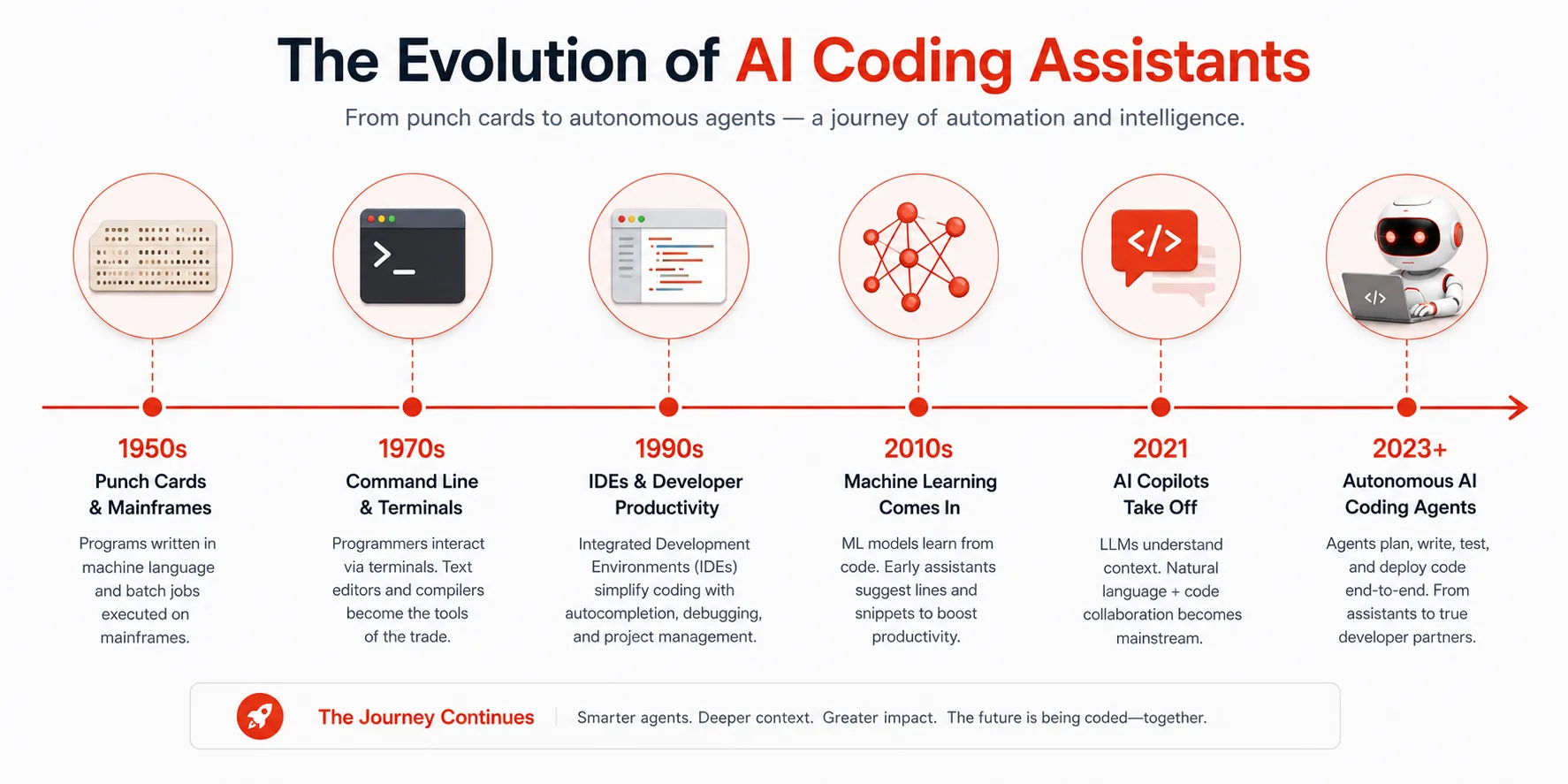
The history of AI coding tools didn’t start with GitHub Copilot. It didn’t even start with machine learning. It started in the 1950s, with researchers who believed that the act of programming pattern-laden, rule-governed, deeply structured was exactly the kind of task a machine should be able to assist with.
This is that story. From the earliest autocomplete experiments to the autonomous agents writing production code today, here’s how we arrived at the moment we’re in and why it matters for where we’re going.
The 1950s–1960s: the first dream of machines that write code
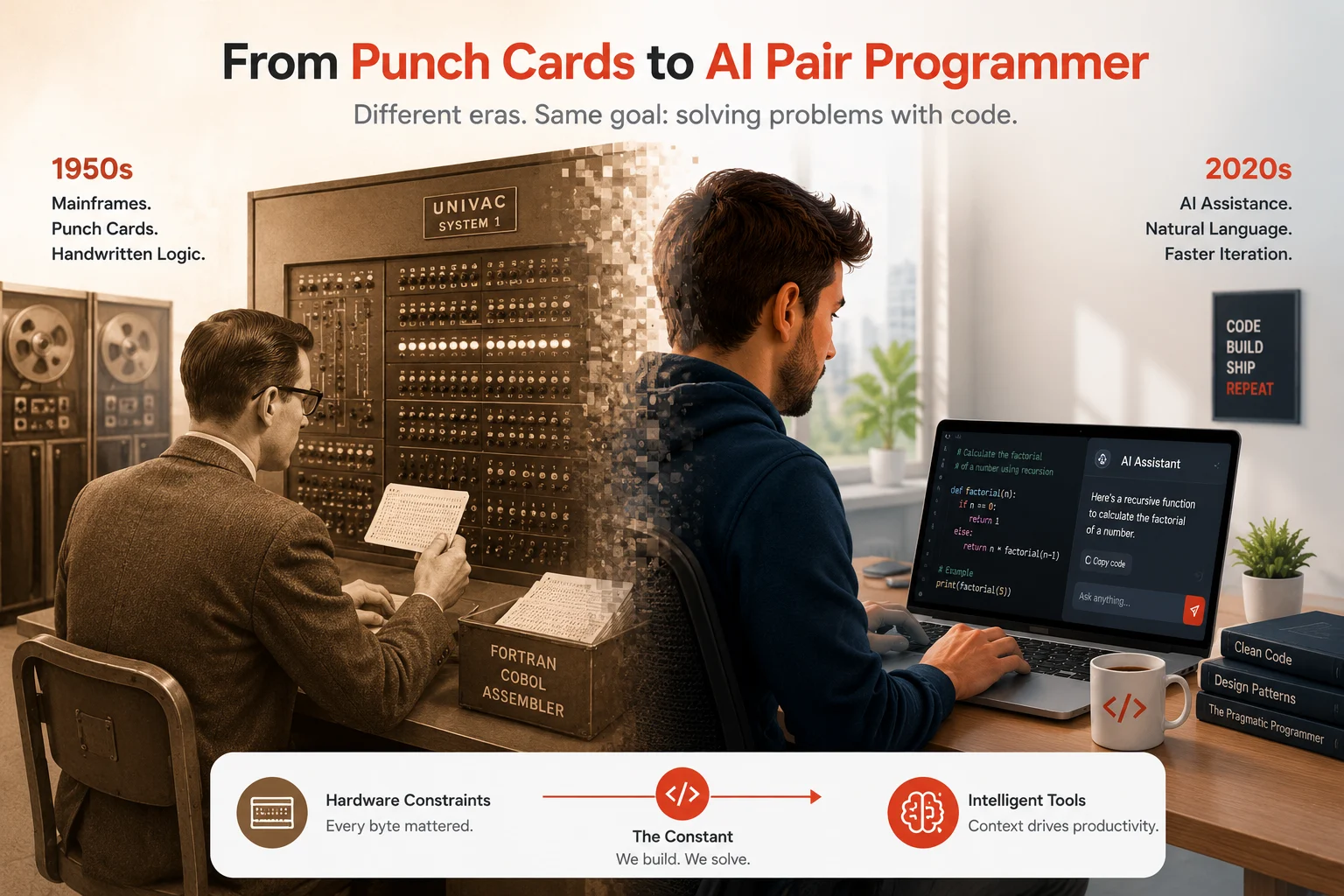
The idea that computers could help write their own programs is nearly as old as programming itself. In 1957, John Backus and his team at IBM released FORTRAN, the first widely used high-level programming language. Its compiler was, in a meaningful sense, the first AI coding tool: a program that translated human-readable mathematical notation into machine instructions, automating what had previously been done by hand by “human computers.”
A decade later, the field of automatic programming emerged as a formal research area. The goal was ambitious: given a high-level specification, generate working code automatically. Early systems like the GPS (General Problem Solver, 1957) by Allen Newell and Herbert Simon attempted to model human problem-solving, including the kind of step-by-step reasoning that programming requires.
These efforts were ahead of the available hardware by several decades. But they planted a seed: the conviction that code generation was a problem AI could eventually solve.
The 1970s–1980s: expert systems and structured autocomplete
The 1970s brought expert systems AI programs that encoded domain expertise as rules and applied them to new problems. In software development, this translated into early static analysis tools and rudimentary code checkers. Tools like lint (released with Unix in 1978) scanned code for common errors not by understanding what the code did, but by pattern-matching against a database of known bad constructs.
This was AI-adjacent rather than AI proper, but it established the template that every code quality tool since has followed: encode expert knowledge, apply it automatically, flag deviations.
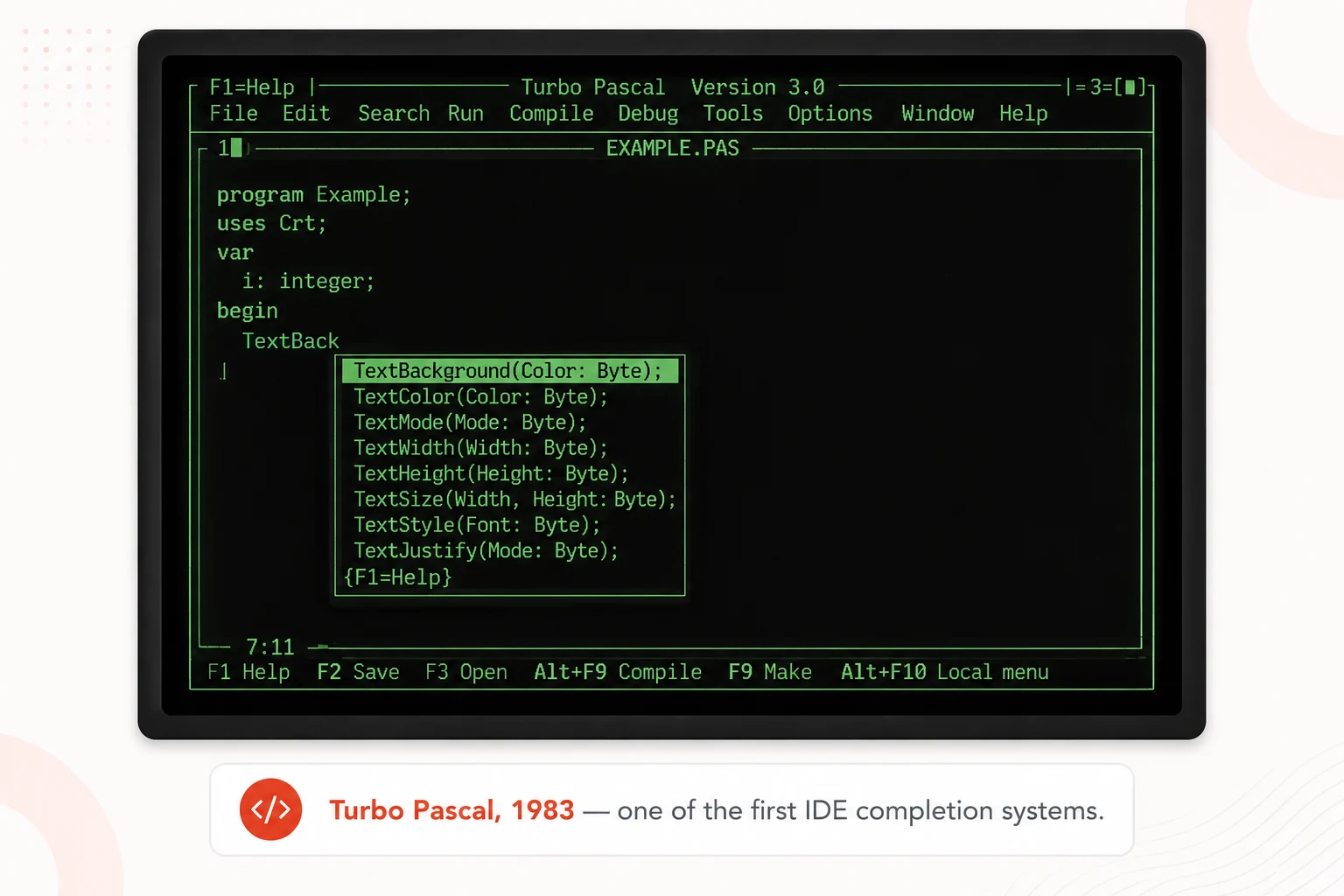
The 1980s introduced the first IDE-based code completion systems. Turbo Pascal (1983, Borland) and early Smalltalk environments could suggest method names from a known symbol table. The suggestions weren’t intelligent, they were alphabetically sorted lists from a static index, but the interaction model was born: developer types, tool suggests, developer accepts or ignores.
The 1990s: IntelliSense and the birth of modern code assistance
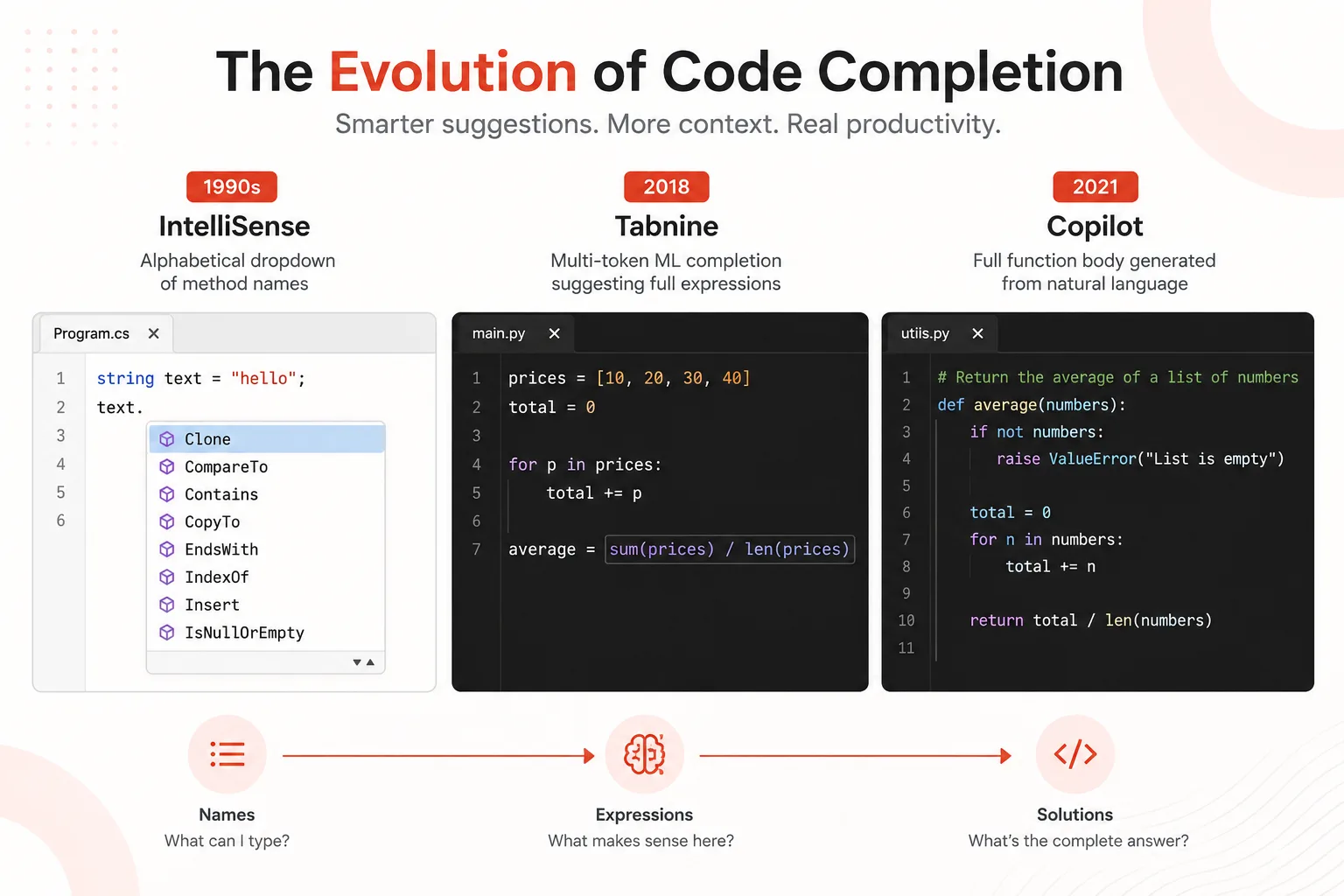
The decade that defined modern IDE tooling. Microsoft released IntelliSense with Visual Basic 5.0 in 1996, and later integrated it into Visual Studio. For the first time, code completion was context-aware: it understood the type of the object you were working with, parsed the imported libraries, and offered relevant suggestions, not just a flat alphabetical list.
IntelliSense wasn’t AI. It was sophisticated static analysis combined with deep integration into the language’s type system. But it felt intelligent because it was reasoning about your code’s structure. It knew that if you typed, myString. you probably wanted string methods, not file system APIs. That implicit reasoning about developer intent is exactly what the history of AI coding tools would later scale dramatically.
The 1990s also saw the rise of refactoring tools, most notably with the early versions of what would become JetBrains’ IDE suite (founded in 2000, but rooted in 1990s research). Automated refactoring went beyond suggestion: it performed code transformations, renaming variables across a codebase, extracting methods, reorganizing class hierarchies, actions that required understanding code structure at a semantic level.
The 2000s: machine learning enters the editor
The first decade of the 2000s brought the first serious applications of machine learning to code completion. Researchers began training statistical models on large codebases to predict what a developer would type next, not based on type signatures, but based on patterns learned from millions of actual code files.
A landmark 2009 paper by Charles Sutton and colleagues, “Mining Repetitive Code Changes”, showed that a substantial fraction of code changes are repetitive and predictable, exactly the kind of pattern that statistical models could learn. This set the theoretical foundation for probabilistic code completion.
Eclipse, IntelliJ IDEA, and Visual Studio all incorporated increasingly sophisticated completion engines during this period, drawing on larger type databases and more nuanced heuristics. None of these were neural-network-based, but they demonstrated that smarter suggestion systems measurably improved developer productivity, priming the market for the AI wave that would follow.
The 2010s: deep learning arrives, and everything accelerates
The 2010s were the decade that transformed theoretical possibility into practical tools. Three developments converged to make AI coding assistance real:
- Deep learning has matured. Recurrent neural networks (RNNs) and later transformer architectures showed that neural networks could model sequential data, including source code, with remarkable accuracy.
- Code datasets scaled up. GitHub, launched in 2008, had by 2015 accumulated hundreds of millions of public repositories, an unprecedented training corpus for code models.
- Cloud computing became affordable. Training large models on large datasets went from prohibitively expensive to merely expensive.
2015–2016: the first neural code completion tools
Kite launched in 2014 (public in 2016) as one of the first AI-powered coding assistants built on machine learning rather than static analysis. It used a combination of neural models and local analysis to offer completions that went beyond what type systems could infer. Kite was early; it preceded the transformer revolution, but it proved that demand existed and shaped what users would expect from AI coding tools.
Tabnine (originally named Codota in some markets) launched in 2018 and became the first widely adopted ML-based code completion tool. It trained a GPT-2 style model on public GitHub code and offered multi-token completions, not just the next method name, but the next several tokens of a likely expression. Developers noticed. It was the first time ML completion felt faster and more accurate than static-analysis completion for common patterns.
2017: the transformer changes everything
In June 2017, Google researchers published “Attention Is All You Need,” the paper introducing the transformer architecture. Transformers could model long-range dependencies in sequences far better than RNNs, and they parallelized during training in ways RNNs couldn’t. Within two years, every major language model was transformer-based.
For code, this was the catalyst. Transformer models trained on source code could understand context that stretched across entire functions, files, and even APIs, not just the last few tokens. The conditions for the next leap were now in place.
2020–2021: OpenAI Codex and the GitHub Copilot moment
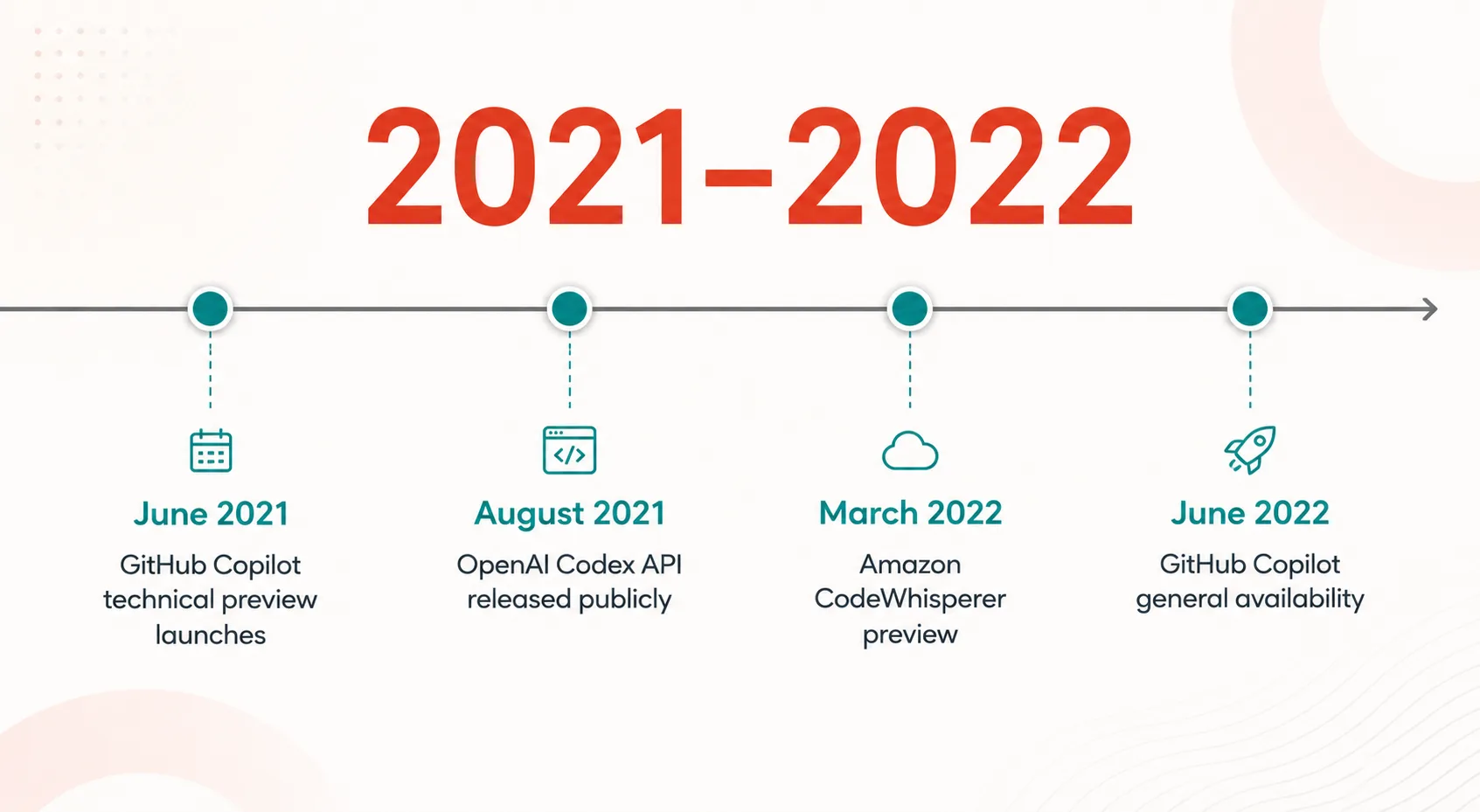
In May 2020, OpenAI released GPT-3, a 175-billion-parameter language model that could generate coherent, useful text across almost any domain, including code. Developers immediately began using it through the API for coding tasks, sharing results on Twitter and Reddit. The potential was obvious to everyone who saw it.
OpenAI followed in August 2021 with Codex, a model fine-tuned specifically on code, derived from GPT-3 but trained on 54 million public GitHub repositories. Codex could generate entire functions from natural language descriptions, complete code from partial implementations, and explain existing code in plain English. It was a qualitative leap beyond anything that had existed before.
GitHub, owned by Microsoft (which had a major investment in OpenAI), launched GitHub Copilot in June 2021 as a technical preview built on Codex. The reaction from the developer community was unlike anything in the history of developer tooling. Developers reported writing 30–55% of their code being accepted from Copilot suggestions. Some called it the most significant IDE feature since syntax highlighting. Others worried it would replace programmers entirely.
GitHub’s own research found that developers using Copilot completed tasks up to 55% faster than those who didn’t a productivity gain that no previous IDE feature had come close to delivering.
Copilot went into general availability in June 2022 and became GitHub’s fastest-growing product in company history. It marked the moment AI coding assistance crossed from research curiosity to mainstream developer workflow.
2022–2023: the ecosystem explodes (history of AI coding tools)
Copilot’s success triggered a wave of competing products and a rapid expansion of what AI coding tools could do.
Amazon CodeWhisperer launched in preview in 2022 (GA in 2023), offering Copilot-style completions with a focus on AWS service integration and security scanning. It identified security vulnerabilities in generated code, a feature that addressed one of the biggest concerns about AI-generated output.
Cursor launched in 2023 as an AI-first fork of VS Code, not just an extension, but an entire editor rebuilt around AI interaction. It introduced multi-file editing, natural language refactoring, and a chat interface with full codebase context. Cursor showed that the right interface for AI-assisted coding wasn’t a sidebar panel, it was a fundamentally redesigned editor.
Replit Ghostwriter, Sourcegraph Cody, and a dozen other tools launched in the same period, each carving a niche: Ghostwriter for browser-based development, Cody for large-enterprise codebase search and generation.
Meanwhile, the underlying models kept improving. OpenAI released GPT-4 in March 2023 with dramatically improved reasoning and code quality. Anthropic released Claude with a 100K token context window, meaning an agent could reason over an entire large codebase in a single context, something previously impossible.
2023: DeepMind AlphaCode and the benchmark moment
In February 2022, Google DeepMind published results for AlphaCode, a system that achieved roughly median performance on competitive programming challenges from Codeforces. This was significant not because competitive programming is representative of real-world development, but because it demonstrated that AI could solve novel algorithmic problems, not just complete familiar patterns.
AlphaCode’s paper introduced the concept of large-scale code generation with test-time filtering, generating thousands of candidate solutions and filtering by test cases. It was a preview of how agentic systems would later approach software development: generate broadly, verify automatically, keep what works.
2023–2024: from assistants to agents
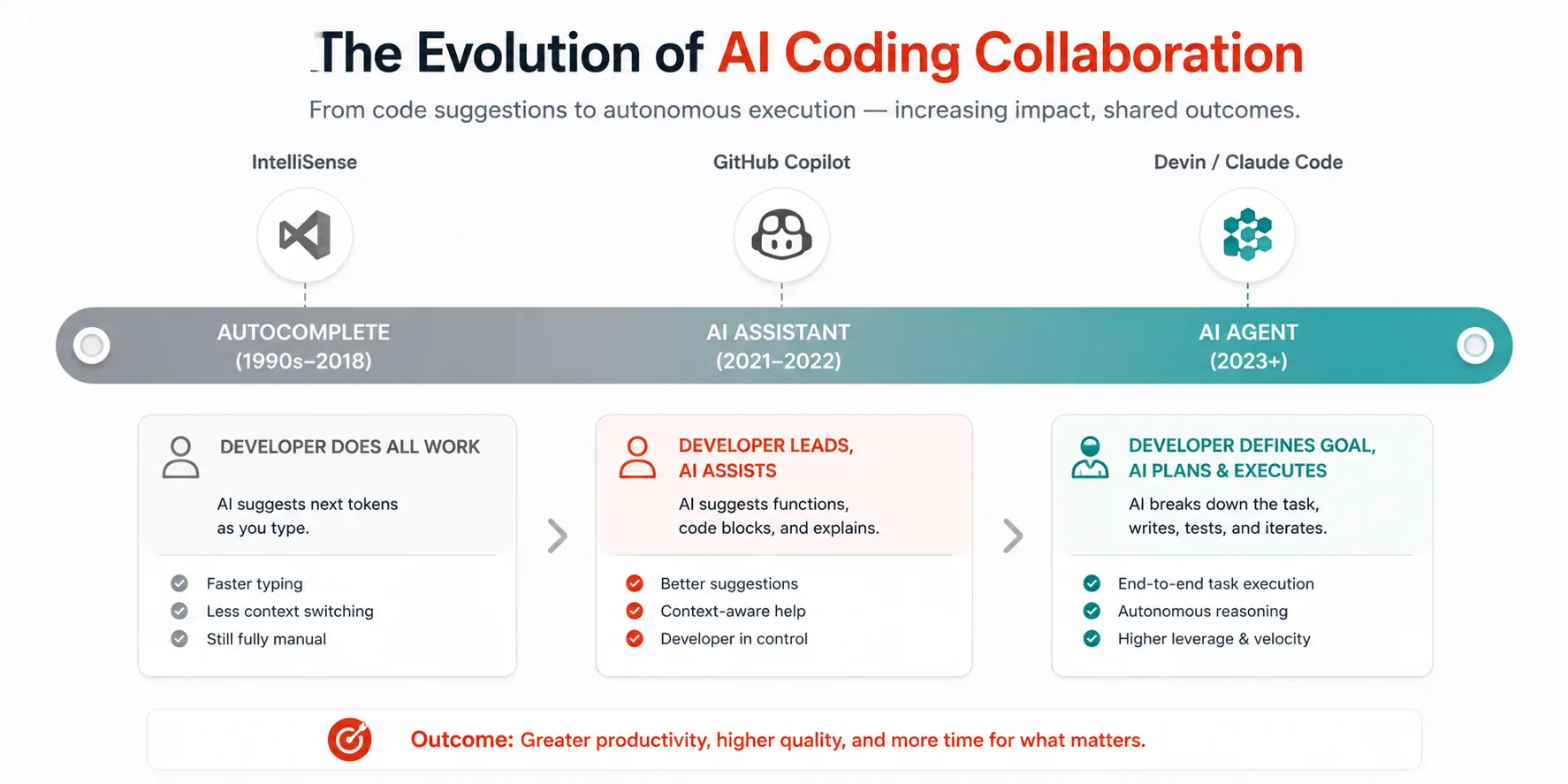
The defining shift of 2023–2024 wasn’t better completions; it was autonomy. AI coding tools stopped being things you queried and started being things you delegated to.
Claude Code (Anthropic), Devin (Cognition AI), and OpenAI’s operator-style agents represented a new category: systems that could take a task description, read a codebase, write and run code, fix failing tests, and deliver a working result all without step-by-step human instruction.
Devin, announced in March 2024 by Cognition AI, was marketed as “the first AI software engineer.” It could autonomously set up development environments, browse documentation, write code, run commands, and debug failures, completing real freelance programming tasks on Upwork. The benchmark claims were controversial, but the capability demonstration was real: AI had crossed from assistant to agent.
Claude Code, released by Anthropic, took a different approach, terminal-native, designed for developers who wanted deep codebase integration without leaving their workflow. It could understand large codebases via extended context, execute shell commands, run tests, and iterate until a task was complete.
Cursor added a full agent mode in late 2023, allowing the AI to autonomously make changes across multiple files in response to a single instruction. The line between “AI-assisted coding” and “AI-driven coding” became genuinely blurry for the first time.
2024–2025: multi-agent systems and the integrated development environment reinvented
The current frontier of AI coding tools is no longer about individual tools; it’s about systems of agents working together on the same codebase.
Frameworks like CrewAI, AutoGen, and Anthropic’s own multi-agent research have enabled architectures where a planner agent breaks a feature request into subtasks, dispatches them to specialist subagents (a code writer, a test writer, a documentation writer), and assembles the results. What used to be a solo developer task becomes a coordinated pipeline.
The IDE itself is being reinvented around this reality. Cursor’s rapid growth, reportedly reaching $100M ARR faster than almost any developer tool company in history signaled that developers were willing to abandon familiar tools entirely for ones built AI-first. JetBrains, Microsoft, and others responded by deeply integrating AI into their existing products.
GitHub Copilot expanded from inline completion to workspace chat, pull request summaries, code review suggestions, and automated fix proposals, moving from a single-feature tool to a platform layer woven through the entire development workflow.
The 2025 landscape looks nothing like 2021. The question is no longer “should I use AI to help write code?” It’s “how do I structure my work to get the most from AI systems that can do more and more of the implementation themselves?”
The through-line: what changed and what stayed the same
Across seventy years of AI coding tools, three forces have driven every major advance:
- Better models. From rule-based expert systems → statistical ML → deep learning → transformers → frontier LLMs. Each generation could model more context, more nuance, more abstraction.
- More data. From hand-crafted rule databases → millions of open-source repositories → the entire public internet of code. Models got better partly because they got bigger, but mostly because they trained on more and better examples of real programming.
- Tighter integration. From standalone tools → compiler plugins → IDE extensions → editor-native AI → terminal agents. The closer AI got to where the developer actually worked, the more useful it became.
What has stayed the same: the developer is still in the loop. Even the most autonomous agents today produce output that requires a skilled engineer to review, integrate, and take responsibility for. The tools have become dramatically more capable, but so has the job of working with them effectively.
Key milestones at a glance
| Year | Milestone | Significance |
|---|---|---|
| 1957 | FORTRAN compiler released | First tool to automate translation from human-readable code to machine instructions |
| 1978 | Unix lint released |
First widely used static analysis tool for catching code errors automatically |
| 1983 | Turbo Pascal IDE completions | First commercial IDE with symbol-based code completion |
| 1996 | Microsoft IntelliSense | Context-aware type-based completion set the standard for IDE assistance |
| 2018 | Tabnine (ML completion) | First widely adopted ML-based multi-token completion tool |
| 2017 | Transformer architecture (“Attention Is All You Need”) | Foundational architecture behind all modern AI coding models |
| 2021 | GitHub Copilot (technical preview) | First mainstream LLM-powered coding assistant; redefined developer productivity expectations |
| 2022 | DeepMind AlphaCode | AI reaches median human performance on competitive programming benchmarks |
| 2023 | Cursor, Claude (100K context), GPT-4 | AI-first editors, codebase-scale context windows, and dramatically improved reasoning |
| 2024 | Devin, Claude Code, agentic Copilot | Autonomous AI agents capable of end-to-end software development tasks |
| 2025 | Multi-agent development systems | Coordinated agent pipelines handling full feature development workflows |
What this history tells us about what comes next
Every transition in this history followed the same pattern: a capability that seemed like science fiction became a research demo, then a niche tool, then a mainstream expectation, then table stakes. Autocomplete was once impressive. IntelliSense was once a differentiator. Copilot-style completion is now the baseline expectation for any serious IDE.
Autonomous agents are currently in the “impressive research demo / early adopter” phase. Based on the pattern, they will become mainstream developer workflow within a few years, not replacing developers, but changing what developers spend their time doing. The history suggests the shift won’t be gradual: it will feel sudden to those who weren’t paying attention, and obvious in retrospect to those who were.
The developers who navigated every previous transition well from manual to compiled, from compiled to IDE-assisted, from static to ML-powered, were the ones who understood the tools deeply, not just superficially. They knew what the tool was actually doing, where it was reliable, and where it would let them down. That remains the most valuable skill in any era of AI coding tools.
Further reading and resources
- “Attention Is All You Need,” Vaswani et al. (arXiv), the 2017 transformer paper that made modern AI coding tools possible
- DeepMind AlphaCode blog post on how DeepMind achieved median human performance on competitive programming and what it means
- GitHub’s research on Copilot’s productivity impact, the controlled study showing up to 55% task completion speed improvement with Copilot
The history of AI coding tools is, at its core, a story about what happens when you apply each generation’s most powerful computational techniques to the structured, pattern-rich problem of writing software. Every generation of developers has inherited tools that would have seemed magical to their predecessors and passed on tools that seemed primitive to their successors.
We’re living through one of those transitions right now. The tools available to a developer in 2025 would have been indistinguishable from science fiction to the engineers who shipped IntelliSense in 1996. The tools available in 2030 will likely make today’s agents look quaint. Knowing where you are in that arc is the first step to using the current moment well.