
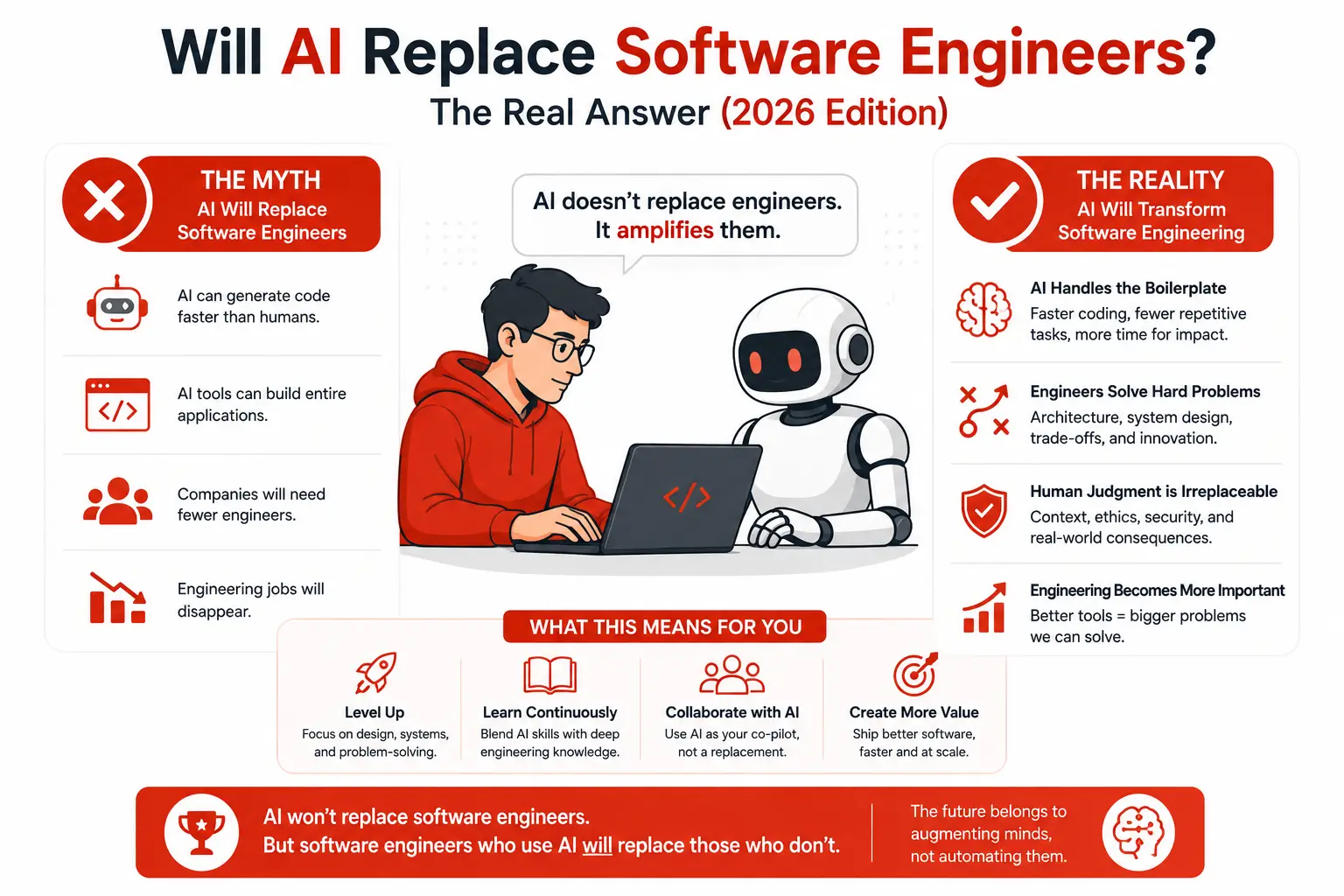
Will AI Replace Software Engineers? The Real Answer From a Dev in the Trenches
Every few weeks, a new headline drops declaring the absolute death of software engineering. First, it was basic autocomplete. Then came advanced LLMs. Now, we have fully autonomous coding agents, terminal-native systems, and multi-file orchestrators hitting over 70% on complex engineering benchmarks.
If you look at the industry from the outside, it looks like a slaughterhouse. People are panic-buying prompt engineering courses, and new computer science grads are wondering if their degrees are glorified, expensive paperweights.
So, let’s skip the corporate marketing fluff and give you the real answer from someone who actually writes, reviews, and ships production code for a living: No, AI will not replace software engineers. But it is violently replacing the old definition of what a software engineer does.
If your entire job consists of writing generic boilerplate, copying and pasting Stack Overflow snippets, or churning out basic CRUD (Create, Read, Update, Delete) APIs, then yes—the robots are coming for your desk. But if you actually solve problems, architect systems, and translate messy human requirements into precise logic, your leverage has never been higher.
Here is the unvarnished reality of what is actually happening to our industry.
1. Syntax is Now a Commodity, but Architecture is King
Writing code is to software engineering what laying bricks is to building an architecturally sound skyscraper.
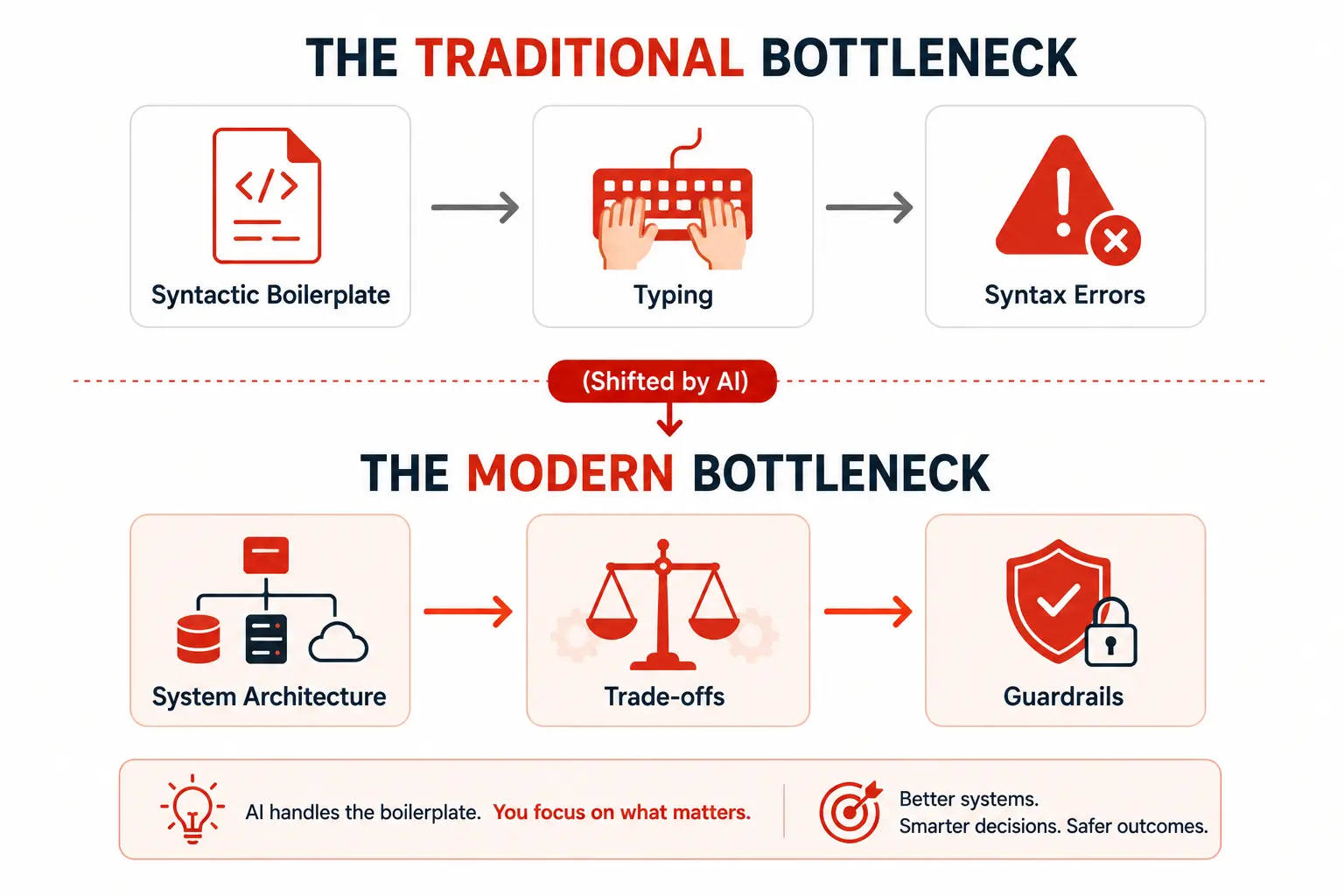
AI agents are spectacular at syntax. They can ingest a 10-million-line codebase, figure out the variable conventions, and write a perfectly formatted pull request in seconds. They have essentially commoditized the mechanical act of typing.
But what AI cannot do autonomously is understand strategic system design. An AI can give you five different ways to scale a microservice architecture or optimize a database partition, but it has zero context on the structural trade-offs. It doesn’t know the human cost of maintaining that framework, it doesn’t understand the cloud budget constraints of your startup, and it can’t predict how a subtle architectural shortcut today will accumulate catastrophic technical debt three years from now.
As developers, we are moving away from being “syntactic executioners” to becoming systems orchestrators, reviewers, and gatekeepers.
2. Jevons’ Paradox: Lowering Costs Explodes the Demand
People who don’t understand economics assume that if AI makes a developer 3x more productive, companies will simply fire 66% of their engineering staff. This completely ignores Jevons’ Paradox—an economic principle stating that as a resource becomes more efficient to use, the total consumption of that resource actually increases.
When you drastically lower the cost and time required to write software, two things happen:
- The backlog opens up: Projects that were previously deemed too expensive, too niche, or too complex suddenly become financially viable.
- System complexity skyrockets: More software means more surface area. It means more APIs to connect, more legacy migrations to manage, more distributed data to synchronize, and exponentially more security boundaries to defend.
AI doesn’t shrink the world of software; it expands it exponentially. We aren’t running out of engineering problems to solve; we are just drastically increasing our capacity to build.
3. The “Vibe Coding” Trap and AI Tech Debt
There is a growing trend in the industry right now called vibe coding. This is where a non-technical founder or a junior developer builds an entire application simply by tossing conversational prompts back and forth with an AI agent until it works.
It feels intoxicatingly fast. You can ship a working full-stack Minimum Viable Product (MVP) in an afternoon. But here is the catch: poor use of AI just scales chaos faster.
AI tools operate on immediate pattern recognition, not deep structural understanding. When you build an enterprise application via pure vibe coding without rigorous human oversight, you create a house of cards. The AI will write syntactically clean code that solves the immediate problem but introduces structural vulnerabilities, missing authentication flows, and race conditions.
The Reality Check: When that vibe-coded application breaks under load at 2:00 AM, the AI isn’t going to wake up, jump on an incident call, and parse the raw telemetry data to find the root cause. A highly-skilled human engineer will.
4. Entry-Level Hiring is Changing (The Real Bottleneck)
While I refuse to join the “AI doom” camp, we have to be completely honest about one painful reality: the market for junior developers has drastically changed.
Because AI agents can instantly handle the routine, isolated tasks traditionally assigned to fresh-out-of-college junior devs (like writing unit tests, drafting documentation, or building basic components), companies are hiring fewer absolute beginners. Senior hiring remains incredibly competitive, but the barrier to entry for your first engineering job has risen significantly.
To break into the industry now, you cannot just be a basic “coder.” You have to build AI-native engineering skills:
- Task Decomposition: The ability to take a vague product requirement, break it down into modular, technical components, and guide an AI agent to execute those sub-tasks flawlessly.
- Rigorous Verification: Treating AI code output exactly like a junior developer’s PR—reviewing every line for security flaws, compliance, and architectural alignment.
How to Stay Unreplaceable: The Engineer’s Playbook
If you want to ensure your engineering career survives and thrives over the next decade, stop fighting the tools and start using them as leverage.
| What AI Replaces (Low Context) | What Humans Stay Owning (High Context) |
|---|---|
| Writing standard boilerplate & CRUD setups | Defining domain models & system boundaries |
| Formatting code & fixing basic syntax errors | Weighing architecture trade-offs & cloud costs |
| Generating basic unit testing scaffolds | End-to-end integration, security, and edge cases |
| Writing documentation and comments | Interfacing with human stakeholders and business goals |
Final Thought
AI is not going to replace software engineers. However, software engineers who use AI effectively will absolutely replace software engineers who don’t.
The industry isn’t dying; it’s evolving. We are dropping the boring, repetitive typing part of the job and elevating ourselves to true system designers and technical directors. And honestly? It’s about time.