
Something genuinely interesting happened in AI this week, and it did not come from OpenAI, Google, or Anthropic.
On July 15, 2026, Mira Murati’s startup Thinking Machines Lab quietly released its first model. It is called Inkling. The weights are on Hugging Face right now, free to download, free to fine-tune, free to ship in your own products without paying Thinking Machines a single dollar. And it is a 975 billion parameter multimodal model trained on 45 trillion tokens of text, images, audio, and video.
That is a serious piece of infrastructure to just drop on the internet. So let’s talk about what it actually is, what Thinking Machines is betting on, and whether Inkling belongs in your stack.
Who built Inkling and why it matters
Before getting into the specs, the backstory matters here, because the people who built Inkling are not a random startup.
Mira Murati left OpenAI in late 2024 after serving as its Chief Technology Officer, leading projects like ChatGPT and DALL-E, and briefly serving as interim CEO during the board crisis in 2023. She did not go quietly. She founded Thinking Machines Lab in February 2025 alongside OpenAI co-founder John Schulman and former OpenAI safety VP Lilian Weng, then raised a $2 billion seed round at a $12 billion valuation from Andreessen Horowitz, all before shipping a single public model.
The company launched its first product, a fine-tuning platform called Tinker, in October 2025. Inkling is the model that Tinker was always waiting for.
The mission Thinking Machines states publicly is to build AI that extends human will and judgment rather than replacing it. Inkling is the first real artifact of that philosophy shipped into the world.
What Inkling actually is
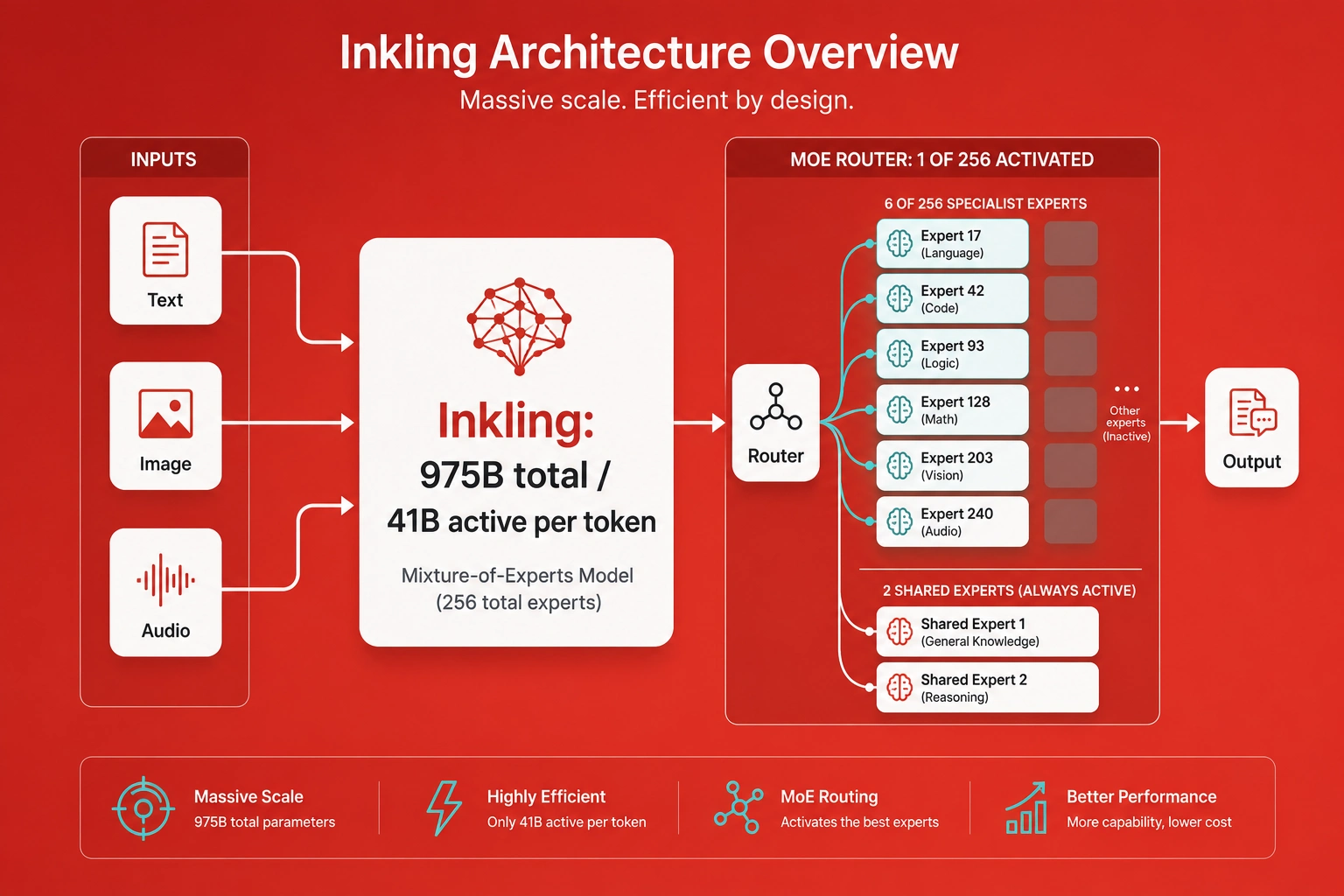
According to Thinking Machines’ own announcement, Inkling is a Mixture-of-Experts transformer with 975 billion total parameters, 41 billion active per token. It supports a context window of up to one million tokens. It was pretrained on 45 trillion tokens of text, images, audio, and video.
That last sentence is doing a lot of work. Inkling can natively understand text, images, and audio as inputs. Right now it only outputs text, but the multimodal input layer is already baked in at the pretraining level, which is a different and more fundamental thing than bolting a vision module onto an existing text model.
The architecture broadly follows the DeepSeek-V3 MoE pattern. A router selects six of 256 specialist feed-forward experts for each token, with two shared experts always active. That is what keeps a 975 billion parameter model affordable to run. You are not firing every parameter on every token; you are firing about 41 billion of them, which is closer to a mid-sized dense model in compute terms. Thinking Machines also made some distinctive choices in the attention stack, using relative positional embeddings instead of rotary ones, interleaving sliding-window attention layers with global attention layers, and adding short convolutions to key and value projections.
The controllable thinking dial: the feature nobody is talking about enough
Here is the part that stood out most in early testing, and it is getting less coverage than the parameter count.
Inkling has what Thinking Machines calls controllable thinking effort. You set a value between 0.2 and 0.99 per API call. Low effort means fast, cheap responses. High effort means more reasoning tokens spent before the model commits to an answer, and correspondingly better quality on hard problems.
This is not just a temperature knob. It is a per-call handle on how much the model actually thinks before responding. The practical implication is that you can run Inkling at low effort for simple classification tasks and at high effort for complex reasoning, all from the same model endpoint, without paying for maximum quality on every single query. MarkTechPost’s breakdown noted that Inkling spends one-third as many reasoning tokens as Nvidia Nemotron 3 Ultra to reach equivalent Terminal Bench performance, which is the kind of efficiency number that matters the moment you start running inference at any real volume.
What the benchmarks actually say
Thinking Machines was unusually upfront about this: Inkling is not the strongest model available, open or closed. That sentence is literally in their announcement. It is a refreshing thing for a lab to say, and it is also strategically important to understand.
Here is an honest read of where Inkling lands. Among open-weight models, it is the best multimodal generalist available right now. It scored 77.6% on SWE-bench Verified, which beats Nvidia’s Nemotron 3 Ultra at 71.9% but trails DeepSeek V4 Pro at 80.6% and GLM 5.2 even further. VentureBeat’s detailed breakdown puts Inkling at 97.1% on AIME 2026 math benchmarks, which actually edges out DeepSeek V4 Pro’s 96.7% in that category. On voice understanding it hit 91.4% on VoiceBench. On instruction following it scored 79.8% on IFBench, ahead of Kimi K2.6’s 76.0%.
The picture that emerges is consistent: Inkling is very good across a broad range of tasks. It is not the best in any single category. That is a feature, not a bug, given what Thinking Machines is actually building.
| Benchmark | Inkling | DeepSeek V4 Pro | GLM 5.2 | Kimi K2.6 |
|---|---|---|---|---|
| SWE-bench Verified | 77.6% | 80.6% | Leading | Ahead |
| AIME 2026 | 97.1% | 96.7% | N/A | N/A |
| MMMU Pro (multimodal) | 73.5% | N/A | N/A | N/A |
| VoiceBench | 91.4% | N/A | N/A | N/A |
| IFBench (instruction following) | 79.8% | N/A | N/A | 76.0% |
| FORTRESS Adversarial | 78.0% | N/A | N/A | N/A |
Open weights is not the same as open source, and it matters here
This distinction trips up a lot of coverage, so let’s be clear about it.
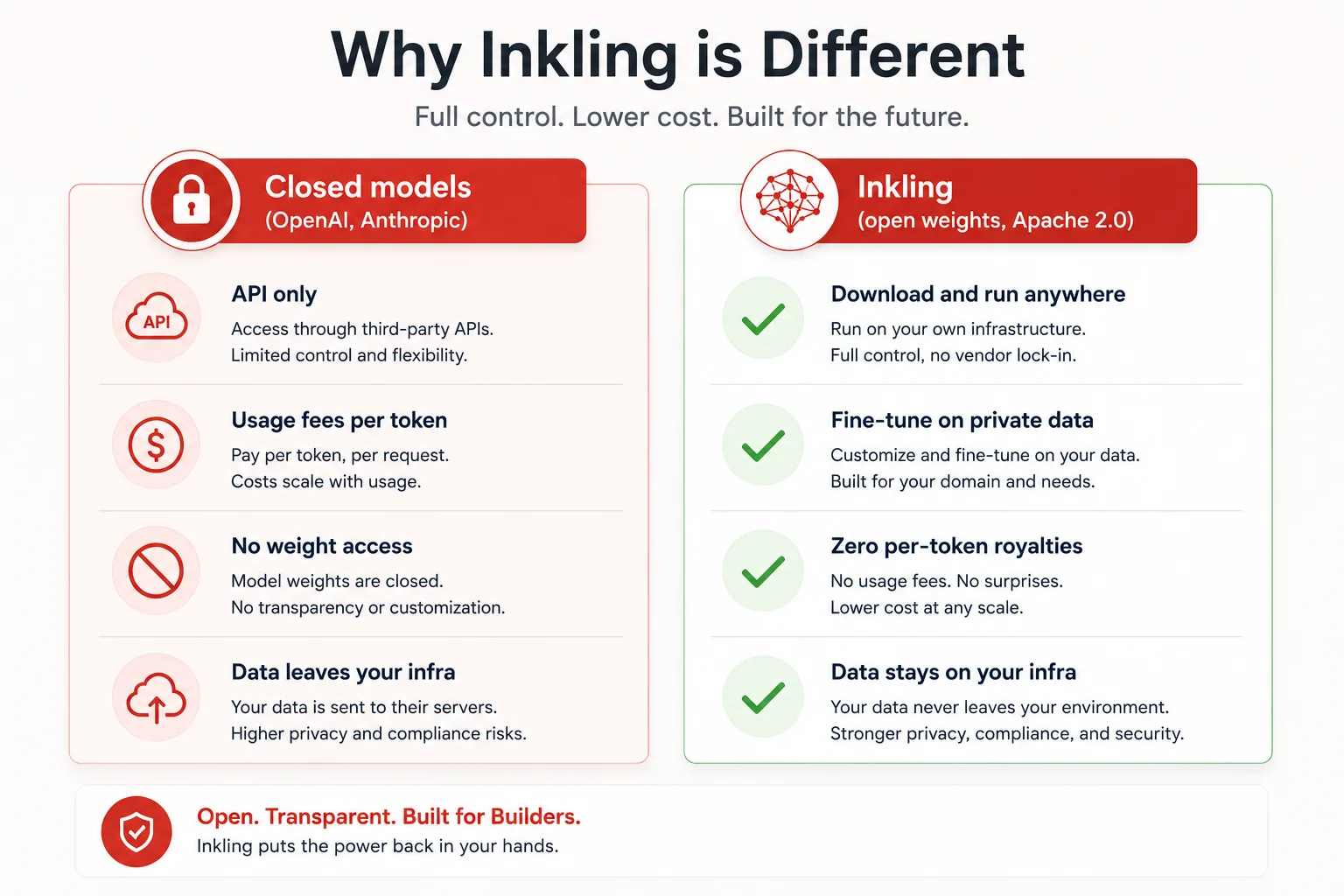
Inkling is open source under an Apache 2.0 license. That means you can download the full model weights, modify them, fine-tune on your own data, and ship in commercial products without royalties. It does not mean the training data or training code is public. That is the same model Llama and DeepSeek use: open weights, not fully open source.
What that buys you in practice: complete control over hosting, zero dependency on Thinking Machines’ API for inference, and the ability to fine-tune on proprietary data that never leaves your own infrastructure. That last point is exactly why enterprises like Bridgewater Associates are paying customers. According to reporting from The AI Insider, a fine-tuned Inkling reportedly outperformed proprietary closed models on financial reasoning benchmarks for Bridgewater at a fraction of the cost.
That is the real pitch for Inkling. Not that it beats GPT or Claude on leaderboards. That it can become a better version of itself for your specific domain, on your hardware, with your data, and with no ongoing licensing exposure.
The censorship resistance angle
This is the unusual part of the Inkling story that deserves its own section, because no other frontier lab has foregrounded it quite this directly.
Thinking Machines explicitly trained Inkling to answer directly on topics that may be subject to censorship. The model showed what Cognition’s evaluation team described as strong patterns of censorship non-compliance on their Propaganda and Censorship Eval. Thinking Machines calls this part of Inkling’s epistemics, a design choice alongside calibration and instruction following rather than an accident of training.
The safety picture is a separate thing from the censorship angle, and worth keeping distinct. InfoWorld reported that Inkling scored 98.6% on StrongREJECT, a test of whether a model refuses unambiguously harmful requests. The company also commissioned external safety testers for dangerous capabilities, including CBRN and cyber, before release.
The design intention is a model that does not dodge hard questions for political or reputational reasons while still refusing genuinely dangerous ones. Whether that calibration holds after fine-tuning is something each enterprise deployer will need to verify on their own setup.
How to actually use Inkling today
If you want to run it right now without thinking about infrastructure, Inkling is available via API through Together AI, Fireworks, Modal, Databricks, and Baseten. Pricing at launch sat at $1.87 per million input tokens and $4.68 per million output tokens at the 64K context tier, which is meaningfully higher than class averages, so self-hosting will make more financial sense at volume.
Full weights are on Hugging Face, including an NVFP4 checkpoint tuned for NVIDIA Blackwell hardware. The BF16 checkpoint needs at least 2TB of aggregate GPU memory to run, which means this is a data-center-scale model. The NVFP4 version needs roughly 600GB, still substantial but more accessible on a multi-GPU server.
Fine-tuning goes through Tinker, Thinking Machines’ platform, which was purpose-built for this workflow. You do not have to use Tinker if you have your own fine-tuning pipeline, since the weights are open, but Tinker is the path of least resistance if you want to get a domain-specific version of Inkling running quickly without building the scaffolding yourself.
Inkling-Small, a sibling with 276B total parameters and 12B active, is previewed but not yet fully released. According to Thinking Machines, it matches or beats the full Inkling on several benchmarks due to an improved training recipe, and at 12B active parameters, it will be considerably cheaper to run for teams that do not need the full context window or the heavy multimodal stack.
Who should actually pay attention to Inkling
Not everyone needs a 975 billion parameter model. But if you are in one of these situations, Inkling is worth a close look.
- You are building a product that needs to run on your own infrastructure for data privacy or compliance reasons, and you have been stuck using a closed model API because nothing open was good enough.
- You are working in a domain like finance, legal, or healthcare where a general-purpose model keeps missing the mark, and fine-tuning on proprietary data is the obvious fix you have not been able to do cleanly.
- You are building an agentic system that needs to understand images or audio alongside text, and you want a single model handling all three modalities rather than stitching together separate pipelines.
- You need controllable reasoning cost per query rather than paying for maximum effort on everything.
If you just want the best possible model for a single task and you are comfortable with a closed API, Inkling is probably not your answer today. The Chinese open-weight models still lead on raw coding and reasoning benchmarks. This is a different tool for a different goal.
Wrapping up
Inkling is not the model that wins every benchmark table. Thinking Machines said so themselves before anyone could say it for them. What it is instead: the most capable open-weight multimodal base model available as of July 2026, built by the right people to be fine-tuned into something excellent for your specific use case, under a license that gives you real control.
That is a different and arguably more durable bet than chasing state-of-the-art on SWE-bench. If the next wave of AI products is thousands of narrow, specialized models rather than one giant assistant that everyone rents, Inkling is positioned well for what comes next.
You can download the weights now on Hugging Face, read the full technical details on the official Thinking Machines announcement, and start fine-tuning through Tinker if you want to see what a domain-specific version of Inkling looks like for your use case.